

Abstract
Steel wire rope lifespan is rarely settled at the point of purchase. It is determined on site, under real operating loads, in real environments, with real maintenance discipline — or the absence of it. Most premature failures trace back not to a defective product but to a specification gap: a sheave that was slightly too small, a lubrication schedule that was never written into the maintenance contract, or a rope construction selected on breaking load alone rather than fatigue performance.
This article examines the structural variables embedded in rope construction, the four on-site factors that most aggressively shorten service life, the quantitative inspection criteria that define end-of-life under ISO 4309 and EN 12385-4, and the procurement framework that converts lifespan data into measurable total cost of ownership (TCO) advantage. Engineering and procurement teams that internalize these variables before specification — not after the first replacement — consistently achieve longer service intervals, lower incident risk, and stronger regulatory compliance.
1. How Wire Rope Construction Dictates Its Operational Ceiling
1.1 Core Type, Strand Count & Wire Grade — The Hidden Lifespan Formula
Before any external variable applies, the rope’s construction sets a theoretical fatigue ceiling that cannot be exceeded regardless of how well the installation is managed.
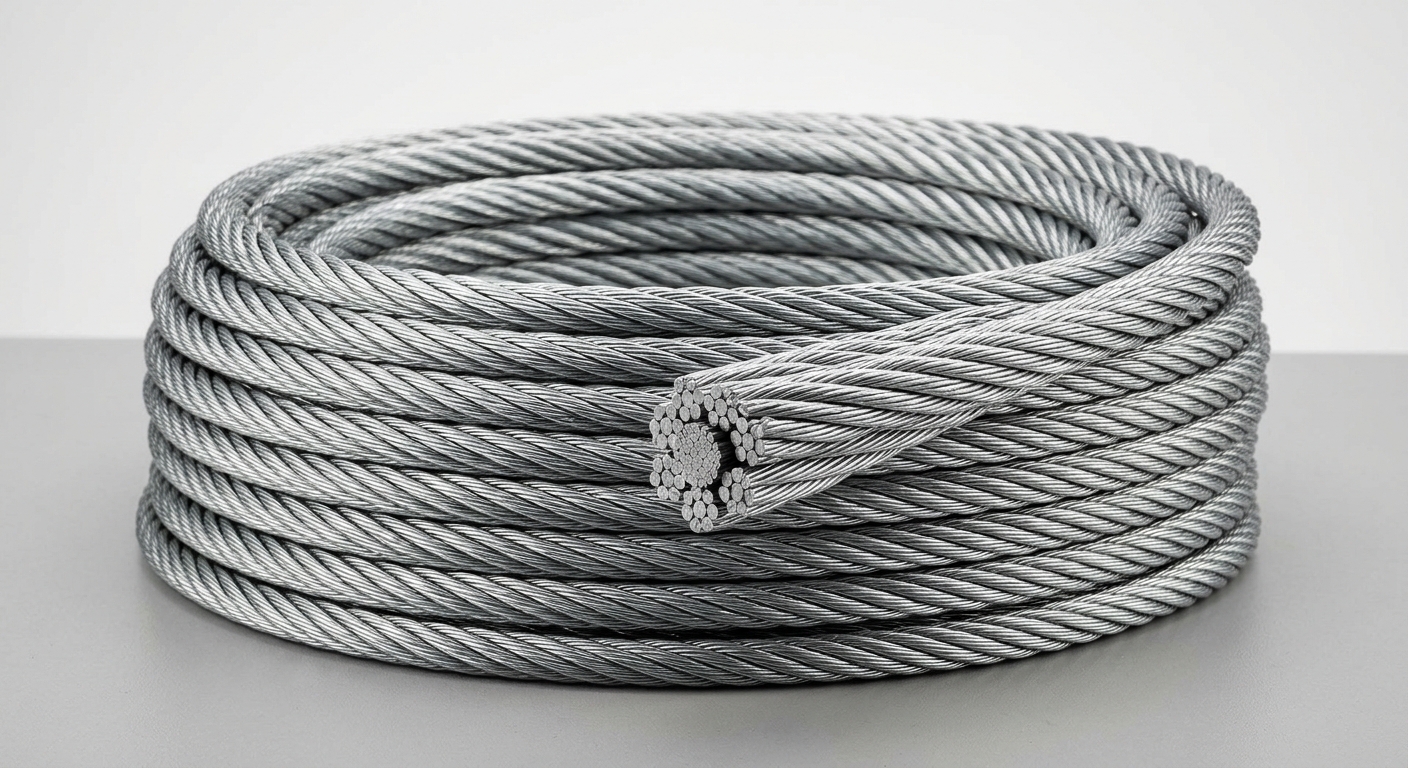
Core type is the first determinant. An Independent Wire Rope Core (IWRC) provides approximately 7.5% greater metallic cross-section than a fiber core (FC), resists radial crushing forces under load, and maintains geometric stability across high-cycle applications. Fiber cores — whether natural or synthetic — offer superior flexibility and shock absorption but compress under sustained radial load, accelerating internal strand wear. For crane hoisting, offshore lifting, and mining haulage, IWRC is the technically correct default unless flexibility requirements explicitly override it.
Strand geometry defines the contact pattern between wires. A 6×19 construction (six strands, nominally 19 wires per strand) offers a coarser wire diameter and higher resistance to abrasion and surface wear — appropriate for haulage and traction applications. A 6×37 construction uses finer wires and a larger contact area, producing superior flexibility and fatigue resistance over small-diameter sheaves. Selecting the wrong geometry for the application is one of the most common specification errors.
Wire grade — IPS (Improved Plow Steel), EIPS (Extra IPS), or EEIPS (Extra Extra IPS) — scales tensile strength and sets the fatigue threshold. Higher grade wire sustains greater working loads within the same nominal diameter, but finer high-grade wires are more notch-sensitive to corrosion pitting. Grade selection must therefore be balanced against the environmental class of the installation, not optimized for breaking load alone.
1.2 Lay Type and Rotational Balance Under Load
Lay type governs how the rope behaves under tension and determines the internal wear rate between strands and core.
- Regular lay (wires and strands wound in opposite directions) offers greater resistance to kinking and crushing, making it suitable for most general lifting and haulage applications.
- Lang’s lay (wires and strands wound in the same direction) presents a larger wire surface to sheave contact, improving abrasion resistance and fatigue life on fixed-end applications — but it is torque-unstable and must never be used on free-hanging loads.
- Rotation-resistant ropes (typically 8-strand or 18×7 multi-layer constructions) minimize torque transmission to the load, which is mandatory for single-fall crane configurations. However, they are more sensitive to crushing on drum spooling and require precise installation tension.
Mismatched lay selection produces corkscrew deformation, birdcaging under shock load, and accelerated internal strand-on-strand wear — all of which shorten service life independently of any external environmental factor.
2. The Four On-Site Variables That Shorten Rope Life Most
2.1 Sheave & Drum Geometry — The D/d Ratio Problem
The ratio of sheave or drum diameter (D) to rope diameter (d) is the single most underestimated mechanical factor in wire rope fatigue. Every pass over a sheave imposes a bending cycle. If the sheave is undersized, the bending stress per cycle exceeds the rope’s fatigue tolerance, and the cumulative damage accumulates exponentially rather than linearly.
ISO 4308 and ASME B30 series standards specify minimum D/d ratios by duty class and rope construction. For a standard 6×19 IWRC rope in M5 duty class service, the minimum recommended D/d ratio is typically 25:1 for sheaves and 18:1 for drums. Operating at D/d ratios 20–30% below the standard minimum can reduce rope fatigue life by 40–60% — a reduction that will not appear in any pre-delivery test certificate.
Groove profile matters equally. An oversized groove allows the rope to flatten under load; an undersized groove pinches the outer strands. Correct tread radius is 0.53×d for most constructions. Procurement specifications should require sheave and drum geometry compliance documentation alongside the rope supply order.
2.2 Environmental Exposure: Corrosion, Temperature & Contamination
Corrosion is responsible for a disproportionate share of wire rope failures in outdoor, marine, and industrial chemical environments. Internal corrosion — invisible during routine visual inspection — is particularly dangerous because it attacks the core and inner strands before any surface discoloration appears.
Selection logic by environment:
- Galvanized rope (hot-dip or electro-galvanized) provides sacrificial zinc protection suitable for general outdoor and moderately corrosive environments. It is cost-effective for applications where rope is accessible for regular lubrication.
- Stainless steel rope (typically AISI 316) is specified for aggressive marine, chemical, or food-grade environments where galvanic compatibility and hygiene are critical. It carries a higher unit cost but eliminates corrosion-driven replacement cycles.
- Polymer-coated rope provides a physical barrier against abrasive particle ingress and moisture, extending lubrication retention between service intervals.
High-temperature cycling above 100°C degrades fiber core integrity and accelerates lubricant oxidation. Applications involving arc furnaces, foundry cranes, or steam environments require IWRC construction with high-temperature-stable lubricants specified by grade, not generic grease.
Steel Wire Rope Lifespan Influencing Factors — Comparison Matrix
Factor Low-Risk Condition High-Risk Condition Estimated Lifespan Impact Mitigation Standard Core type IWRC, heavy-duty crane Fiber core, high-cycle hoist Up to –30% fatigue life EN 12385-4 construction class D/d ratio ≥25:1 (sheave), ≥18:1 (drum) <18:1 either application –40% to –60% fatigue cycles ISO 4308, ASME B30.2 Lubrication frequency Per OEM schedule, penetrating type Irregular or surface-only –25% to –50% corrosion life ISO 4309 maintenance annex Environment class Dry, indoor, controlled Marine, acidic, abrasive –50% or more without coating EN 12385-4 corrosion class Load cycle intensity M3–M4 duty, moderate frequency M7–M8 duty, high frequency Design life reduced per class step ISO 4301 M-class duty Inspection interval Documented, quantitative per ISO 4309 Visual-only, irregular Failure risk 3–5× higher ISO 4309, EN 12385-4 §10
3. Inspection Protocols & Discard Criteria That Procurement Teams Must Specify
3.1 Quantitative Discard Criteria per ISO 4309 & EN 12385-4
Visual judgment is not an inspection protocol. ISO 4309 and EN 12385-4 §10 define measurable discard criteria that must be written into maintenance contracts and commissioning documents:
- Broken wire count: Discard thresholds are expressed per rope lay length (6×d) and reference length (30×d). For a 6×19 IWRC rope, the threshold is typically 4 broken wires in one lay length or 8 in any reference length under running rope conditions.
- Diameter reduction: A reduction of more than 3% from nominal diameter (for non-rotation-resistant ropes) indicates internal core failure or strand compaction and triggers mandatory retirement.
- Corrosion class: ISO 4309 defines four corrosion classes (1–4). Class 3 (significant pitting) requires immediate load-factor reduction; Class 4 mandates discard regardless of broken wire count.
- Deformation criteria: Kinking, birdcaging, core protrusion, and localized diameter increase are absolute discard triggers — no threshold applies.
These criteria must appear in the project’s maintenance specification document, not left to site-level judgment.
3.2 Site Lubrication Schedules as a Contract Requirement
Lubrication is not a maintenance preference — it is a design requirement. Factory-applied lubricant penetrates the rope core during manufacture but is progressively displaced by bending cycles, washed out by environmental exposure, and oxidized by heat. Re-lubrication must be scheduled, documented, and specified by lubricant type.
Penetrating lubricants (low-viscosity petroleum-based or synthetic compounds) reach the core and inner strands — the correct choice for running ropes on cranes and hoists. Surface-coating lubricants protect outer wires from atmospheric corrosion but do not address internal wear and are appropriate only as a supplementary treatment.
Lubrication intervals should be written into maintenance contracts with the following parameters: lubricant specification by grade, application method (drip, bath, or pressure injection), frequency in operating hours or calendar interval (whichever occurs first), and documentation requirement for compliance audit. Suppliers who provide lubrication recommendations in their technical datasheets strengthen the procurement case for specifying those requirements contractually.
4. Translating Lifespan Data Into Procurement & TCO Decisions
4.1 Specifying Rope by Duty Class, Not Only Breaking Load
Minimum Breaking Load (MBL) is a static measurement. It tells procurement teams the maximum load the rope can sustain in a single pull test. It says nothing about how many load cycles the rope will sustain at working load — which is the operationally relevant metric.
ISO 4301 defines M-class duty classifications (M1 through M8) based on load spectrum and total number of working cycles. A rope specified to M5 duty class at the correct D/d ratio will reliably reach its design fatigue life. The same rope installed on an M7-class crane with undersized sheaves will fail in a fraction of that time — and the MBL figure on the certificate will be unchanged.
Procurement specifications for compliance-sensitive applications should require suppliers to confirm rope suitability by duty class, not only provide MBL and safety factor data. The total cost difference between a correctly specified rope that reaches design life and a lowest-price rope that requires mid-contract replacement — including downtime, re-certification, and labor — consistently favors the higher-specification option.
4.2 Supplier Documentation Checklist for Compliance-Sensitive Projects
A qualified steel wire rope supplier must provide the following before delivery:
- Mill certificate confirming wire grade, construction, nominal diameter, and MBL per manufactured batch
- EN 12385-4 or API 9A conformity declaration with third-party test report reference
- Dimensional inspection report: actual diameter, lay length, and weight per meter against nominal specification
- Lubrication specification: lubricant type, penetration depth, and re-lubrication interval recommendation
- Corrosion protection class declaration (for galvanized or coated rope)
- Traceability marking: heat/batch number on reel tag and certificate cross-reference
Any supplier unable to provide this documentation package represents a compliance risk on regulated lifting operations, regardless of unit price.
FAQ
Q1: How many operating hours should I expect from steel wire rope in a heavy-lift crane application before mandatory replacement?
There is no universal hour-based answer because service life depends on duty class, D/d ratio, lubrication discipline, and environmental class simultaneously. Under ISO 4309 discard criteria, a correctly specified and maintained rope on an M5-class crane with proper D/d geometry and documented lubrication can achieve 2,000–5,000 operating hours before reaching discard thresholds. Deviations from any one of these variables can reduce that range by 50% or more.
Q2: What is the most common cause of premature steel wire rope failure that buyers overlook during the specification stage?
Undersized sheave and drum geometry (D/d ratio non-compliance) is the most consistently overlooked factor. It is invisible in the rope’s documentation, produces no immediate observable symptom, and only manifests as accelerated broken wire accumulation after several hundred operating cycles — typically interpreted as a rope quality issue rather than an installation geometry problem.
Q3: Does galvanized steel wire rope always outlast ungalvanized rope in outdoor environments?
Not unconditionally. Galvanizing provides sacrificial corrosion protection that significantly extends outdoor service life in moderate environments. However, in highly acidic or chloride-rich marine atmospheres, the zinc coating can be consumed rapidly, leaving the base wire exposed sooner than expected. In those environments, stainless steel or polymer-coated rope with appropriate internal lubrication is the technically correct specification, not galvanized carbon steel.
Conclusion
Steel wire rope lifespan is an engineered outcome, not a fixed product attribute. Construction specification, mechanical installation geometry, environmental class, lubrication discipline, and inspection rigor collectively determine whether a rope reaches its design life or fails prematurely and expensively. The variables that cause the most failures — D/d ratio non-compliance, absent lubrication schedules, and duty-class misspecification — are all controllable at the procurement and engineering stage. Procurement teams that embed quantitative discard criteria, supplier documentation requirements, and maintenance contract parameters into their specification documents before the first delivery consistently achieve lower total cost of ownership, stronger regulatory compliance, and fewer unplanned operational stoppages. The cost of correct specification is a fraction of the cost of the first failure.
Tags: steel wire rope · wire rope lifespan · how long does steel wire rope last · steel wire rope failure causes · wire rope inspection on site