

Abstract
Selecting the wrong wire rope sling configuration is not merely a procurement inefficiency—it is a safety liability. In industrial lifting operations, the difference between a grommet sling and an eye-and-eye sling determines how load forces are distributed, which hardware interfaces are compatible, and whether a given rigging configuration meets regulatory requirements.
Both sling types are widely specified across heavy construction, offshore lifting, shipbuilding, and manufacturing sectors, yet they serve fundamentally different mechanical roles. A grommet sling offers a continuous-loop geometry with no mechanical terminations, making it uniquely suited to cylindrical and irregular loads. An eye-and-eye sling provides fixed, defined-length terminations that deliver predictable geometry and direct hook or shackle engagement.
This article provides procurement engineers, rigging supervisors, and supply chain managers with a structured comparison across construction, load performance, connection options, compliance standards, and total cost of ownership. The objective is a defensible, specification-ready decision—not a general overview.
1. Construction & Design Fundamentals
1.1 How a Grommet Sling Is Built
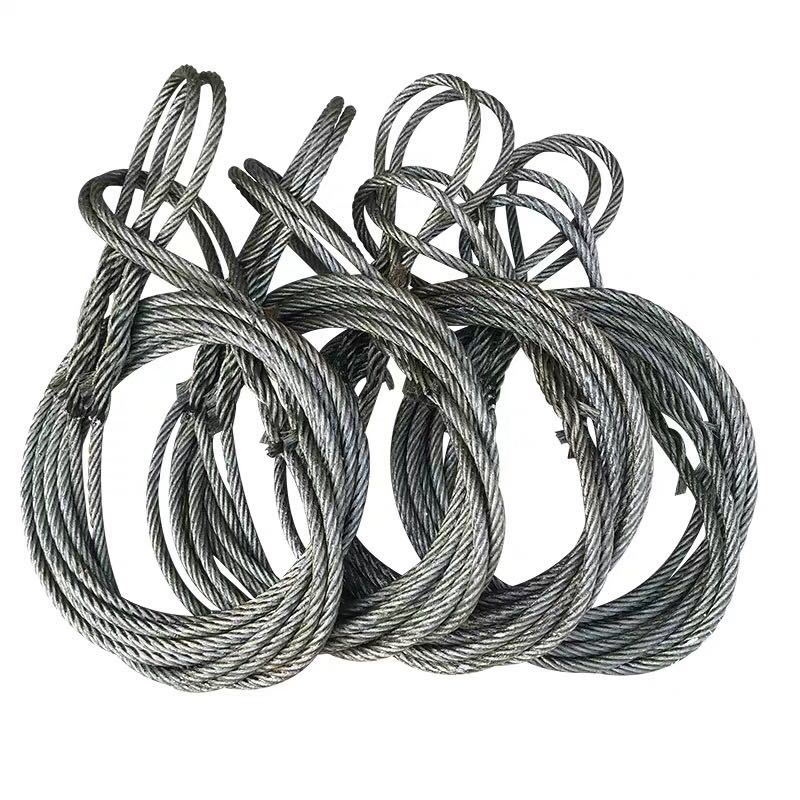
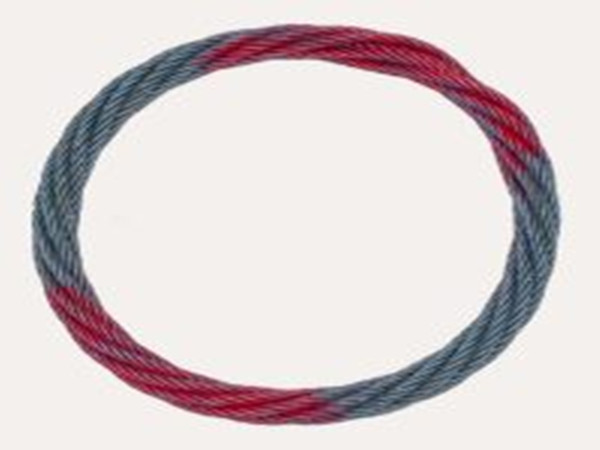
A grommet sling is manufactured as a single, continuous wire rope loop. The rope is laid around a mandrel for a precise number of turns, then the two free ends are tucked and spliced back into the body of the rope using a hand-tuck or mechanical splice method—eliminating any discrete end termination. The result is a closed loop with no mechanically swaged or socketed fittings.
This construction principle has a critical load-distribution consequence: when the sling is placed in a basket hitch, the load is shared across multiple strands simultaneously rather than concentrated at a terminal point. The continuous geometry also allows the sling to rotate and self-equalize around irregular load profiles, which is why grommet slings are the default choice for pipe bundles, cylindrical pressure vessels, and irregularly shaped fabrications.
Typical grommet slings are manufactured from 6×19, 6×36, or 8×19 wire rope constructions with independent wire rope cores (IWRC) or fiber cores, depending on flexibility requirements. Flexibility grade is higher than most two-leg configurations, enabling tighter bend radii around load contact points.
1.2 How an Eye-and-Eye Sling Is Built
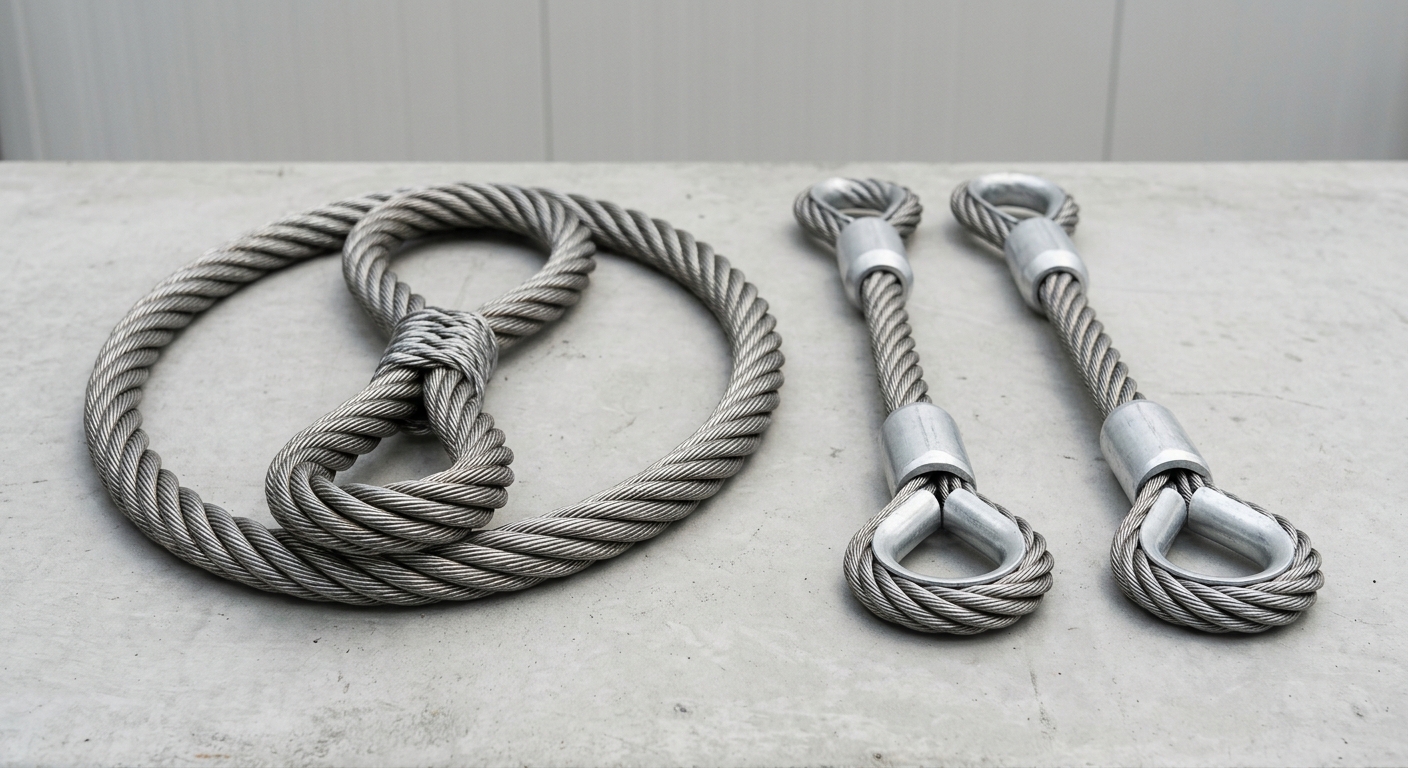
An eye-and-eye sling consists of a straight wire rope body with a formed eye at each end. Eyes are produced by one of three termination methods: swaged (mechanically compressed) ferrule-secured eyes, hand-tucked spliced eyes, or speltered (zinc-poured) sockets. Swaged eyes dominate industrial procurement due to their consistent mechanical efficiency (typically 100% of wire rope breaking strength when correctly applied) and resistance to splice loosening under cyclic loading.
The fixed eye terminations define the sling’s working length precisely, which is a structural advantage in multi-point lifts where load geometry must be engineered in advance. The rigidity of the straight body also provides predictable behavior under tension—there is no loop geometry to shift or rotate.
Eye-and-eye slings are typically manufactured to ASME B30.9 or EN 13414-1 and are available in single-part or multi-part (cable-laid) configurations for higher WLL requirements.
| Dimension | Grommet Sling | Eye-and-Eye Sling |
|---|---|---|
| Termination Type | No termination (continuous loop) | Swaged / spliced / speltered eyes |
| Construction Method | Hand-tucked or mechanical splice | Straight body with formed ends |
| Typical Core Type | IWRC or fiber core | IWRC (standard), fiber core (optional) |
| Flexibility Grade | High | Medium |
| Manufacturing Standard | ASME B30.9, EN 13414-2 | ASME B30.9, EN 13414-1 |
2. Technical Specifications & Load Performance
2.1 Working Load Limit, Rated Capacity & Sling Angles
Working Load Limit (WLL) for both sling types is derived from the wire rope’s catalog breaking strength divided by a design factor—typically 5:1 under ASME B30.9 for standard industrial applications. However, the effective capacity delivered to the load varies significantly by hitch type and sling angle.
For a grommet sling in a basket hitch (the most common configuration), the rated capacity is effectively doubled relative to a single vertical hitch because both legs of the loop share the load. As sling angle decreases from vertical, a de-rating factor applies: at 60° from horizontal, capacity is reduced to approximately 87% of the vertical rating; at 30°, reduction reaches 50%. These factors are identical in principle for eye-and-eye slings but the starting capacity baseline differs.
| Hitch Configuration | Grommet Sling | Eye-and-Eye Sling |
|---|---|---|
| Vertical | 1× single-leg WLL | 1× WLL |
| Basket (60° angle) | ~1.73× single-leg WLL | ~1.73× WLL |
| Choker | ~0.75× single-leg WLL | ~0.75× WLL |
Eye-and-eye slings used in choker hitches must account for the reduced contact angle at the choke point. Grommet slings in choker configuration benefit from the loop geometry distributing the choke load across a wider rope section, marginally improving fatigue resistance at that contact zone.
2.2 Wear Resistance, Fatigue Life & Inspection Criteria
Grommet slings exhibit superior fatigue resistance in basket hitch applications due to the absence of mechanical terminations—statistically, the majority of wire rope sling failures initiate at or near end fittings. The continuous-loop construction eliminates this failure mode entirely.
However, grommet slings are more susceptible to localized abrasion at the load contact zone, particularly on sharp-edged loads without corner protection. Eye-and-eye slings, with their defined straight body, allow more predictable contact zone management using sleeve protectors.
Discard criteria under ASME B30.9 and EN 13414-2 include:
- Ten randomly distributed broken wires in one rope lay length
- Five broken wires in one strand within one lay length
- Kinking, crushing, or birdcaging deformation
- Corrosion visible to the naked eye affecting rope integrity
- Any distortion of eye geometry or fitting deformation (eye-and-eye specific)
3. Connection Options & Application Scenarios
3.1 Hardware Compatibility & Rigging Configurations
Eye-and-eye slings connect directly to shackles, hooks, and lifting beams through their formed eyes—the interface is clean, dimensionally predictable, and compatible with standard rigging hardware catalogs. This makes them the preferred choice for multi-leg bridle assemblies where each leg must engage a defined attachment point with a specific load vector.
Grommet slings require a different interface strategy. Because the sling is a closed loop, it is typically engaged using a shackle passed through the loop, or by placing the loop directly over a hook. In basket hitch applications, the load itself becomes the lower connection point, which eliminates hardware at that interface entirely. This is a significant advantage when lifting smooth-bodied cylindrical loads where shackle attachment is geometrically impractical.
For multi-leg rigging, eye-and-eye slings are more straightforward to specify and balance. Grommet slings can be used in multi-point configurations but require careful equalization planning to prevent unequal load sharing between loop legs.
3.2 Industry-Specific Application Matching
Grommet slings are the preferred specification for:
- Pipe and tube bundle lifts in oil & gas and petrochemical facilities
- Cylindrical pressure vessel and heat exchanger handling during fabrication
- Structural members with no defined attachment points
- Marine and offshore applications requiring loop-over-post engagement
- Situations where the sling must wrap entirely around the load
Eye-and-eye slings are the preferred specification for:
- Structural steel erection with defined lift points (shackle to bolt hole or pad eye)
- Construction crane lifts with engineered multi-leg bridle assemblies
- Precast concrete panel handling with cast-in lift anchors
- Any application where working length must be precisely controlled
- High-cycle production lifting where repeatable geometry reduces rigging time
4. Compliance, Standards & Procurement Considerations
4.1 Applicable Regulatory & Industry Standards
Both sling types fall under the ASME B30.9 Slings standard in North American jurisdictions, which governs design factors, proof load testing, marking requirements, and inspection intervals. OSHA 29 CFR 1926.251 mandates that all slings used in construction comply with applicable ASME or manufacturer standards and requires that slings be removed from service when damage criteria are met.
In European markets, EN 13414-1 covers steel wire rope slings with mechanical end fittings (applicable to eye-and-eye slings), while EN 13414-2 specifically addresses grommet slings and cable-laid slings. This distinction matters for procurement documentation: a CE-marked eye-and-eye sling and a CE-marked grommet sling reference different harmonized standards and require separate Declaration of Conformity documentation.
Procurement teams should require the following certifications from suppliers regardless of sling type:
- Material test certificates for wire rope (mill certificate)
- Proof load test certificate (typically 2× WLL)
- Conformity declaration referencing applicable standard
- Traceability marking on the sling body or attached tag
4.2 Total Cost of Ownership & Supplier Qualification
Unit price comparison between grommet slings and eye-and-eye slings of equivalent WLL typically favors the grommet sling at smaller diameters, while eye-and-eye slings become cost-competitive at larger diameters due to simpler termination manufacturing. However, unit price is a poor proxy for TCO.
Grommet slings generally deliver longer service life in basket hitch applications due to the elimination of termination-point fatigue. Eye-and-eye slings may require earlier retirement if swaged eyes show deformation or if the splice shows wire breaks. Maintenance cost (corner protector replacement, periodic re-inspection) should be factored into multi-year procurement contracts.
Supplier qualification checklist for B2B buyers:
- ISO 9001-certified manufacturing facility
- In-house proof load testing capability with calibrated equipment
- Compliance with ASME B30.9 or EN 13414 (specify jurisdiction)
- Documented traceability from wire rod to finished sling
- Technical support for custom length and diameter specifications
FAQ
1. Can a grommet sling be used as a direct replacement for an eye-and-eye sling at the same rated capacity?
Not without rigging review. While both sling types can be manufactured to equivalent WLL ratings, they interface with hardware differently and behave differently under load. A grommet sling in a basket hitch distributes load across the loop; an eye-and-eye sling in a straight pull concentrates force at the terminations. Substitution requires confirmation that the connection hardware, hitch configuration, and load geometry remain compatible with the grommet sling’s loop construction.
2. What is the maximum sling angle permitted before a mandatory WLL reduction is required under ASME B30.9?
ASME B30.9 does not prohibit any specific angle but requires that the WLL be de-rated as the angle from vertical increases. The standard explicitly warns against sling angles less than 30° from horizontal, where the de-rating factor reduces effective capacity to 50% or less. Most rigging engineers specify a practical minimum of 45° from horizontal as a conservative operational limit.
3. How should procurement teams specify sling diameter and length when requesting quotes for a multi-leg lift?
Specify the following in your RFQ: required WLL per leg (derived from engineered lift plan), nominal wire rope diameter, overall sling length (eye-to-eye for eye-and-eye slings; circumference for grommet slings), applicable standard (ASME B30.9 or EN 13414), proof load requirement, and surface finish or coating if corrosion protection is needed. Providing load geometry drawings allows the supplier to validate the specification against angle de-rating requirements.
Conclusion
The grommet sling and eye-and-eye sling are not interchangeable tools—they are engineered solutions for distinct lifting geometries. The grommet sling’s continuous-loop construction excels when load contact is distributed, hardware attachment points are absent, and fatigue resistance at terminations is a priority. The eye-and-eye sling’s fixed-length, defined-termination design is the correct choice when lift geometry is engineered in advance, multi-leg bridle assemblies require precise load vectors, and direct hardware engagement is required.
| Decision Factor | Choose Grommet Sling | Choose Eye-and-Eye Sling |
|---|---|---|
| Load Shape | Cylindrical / irregular | Flat / defined attachment points |
| Rigging Configuration | Basket hitch, loop-over-load | Vertical, choker, multi-leg bridle |
| Hardware Interface | Loop-over-hook / shackle through loop | Direct shackle or hook to eye |
| Working Length Control | Flexible | Precise and fixed |
| Primary Standard | EN 13414-2 / ASME B30.9 | EN 13414-1 / ASME B30.9 |
For procurement and rigging engineers, the correct specification begins with the load—its geometry, weight, and attachment possibilities—not the sling catalog. Apply the decision matrix above, validate against your jurisdiction’s regulatory requirements, and qualify suppliers on both technical capability and documentation integrity.