

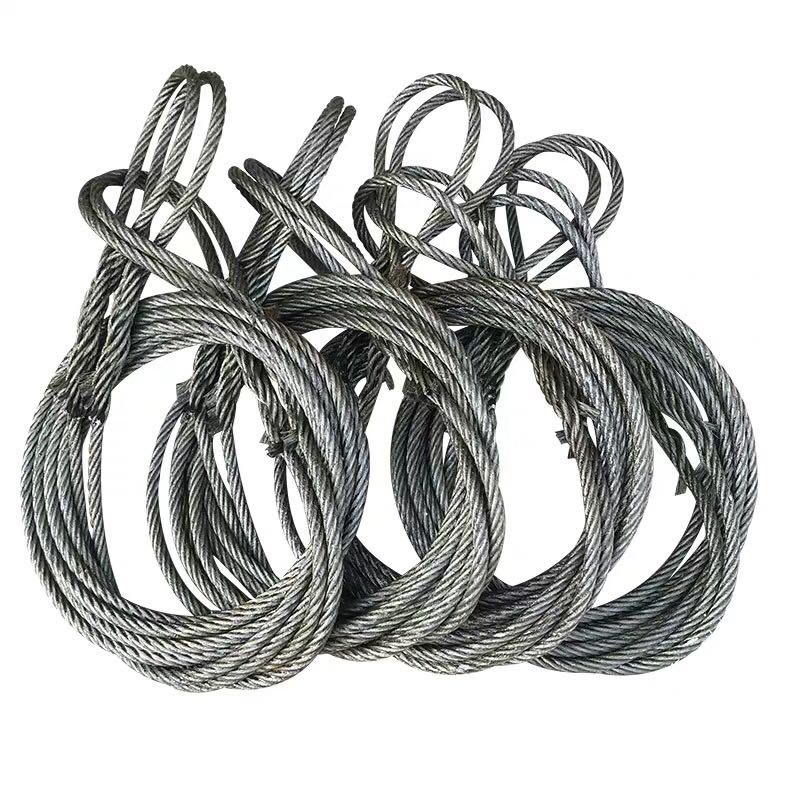
Lifting slings are lifting tools widely used in marine engineering, industry, construction, mining, and other fields. They can be used for lifting, securing, and transporting goods. Several precautions must be taken when using lifting slings to ensure safety and improve work efficiency.
(1) For major lifting and hoisting projects, a construction plan and safety measures must be developed and communicated before construction can begin.
(2) When the lifting capacity reaches the rated load of the lifting machinery, when two or more lifting machines are used to lift the same object, when lifting large, difficult-to-lift, or heavy-duty items, when lifting large items in complex locations, or when cranes are operating under or near high-voltage power lines, a safety work permit must be obtained.
(3) Lifting machinery should be equipped with fire extinguishers, and the operating room should be lined with insulating mats. Flammable materials must not be stored in the operating room.
(4) Tower cranes and other overhead cranes should have reliable lightning protection devices.
(5) Crane operations should be conducted under unified command and signaling. Command should be carried out using flags and whistles; walkie-talkies should not be used for command and communication alone. The person in charge should be an experienced crane operator.

(6) Before each action of the crane during startup and lifting, the operator must give a signal, and unauthorized personnel must leave the work area. No one may stand on the lifted object or the boom while lifting heavy objects.
(7) The crane must not perform three actions simultaneously. When the load is close to its rated load, only one action is permitted at a time. When a cantilever crane is at full load, it is strictly forbidden to lower the boom.
(8) If a power outage occurs while the crane is in operation or has finished its work, the controller should be returned to the zero position first, and then the power supply should be cut off.
(9) Cranes must not be operated outdoors during heavy snow, fog, or thunderstorms. Cranes should be stopped when site lighting is insufficient.
(10) Outdoor crane operations must be stopped during winds of level six or higher.
(11) When lifting large objects, they must be securely tied. The hook’s suspension point should be on the same vertical line as the center of gravity of the object being lifted. The hook wire rope should be kept vertical; oblique lifting is strictly prohibited. When lowering the hook, prevent the lifting equipment from partially touching the ground, which could cause the lifting rope to become skewed. Do not release the hook if the load is not properly secured.
(12) Explosives and hazardous materials (compressed gas cylinders, acids, alkalis, flammable oils, etc.) must not be lifted. If lifting is necessary, reliable safety measures must be taken, and the operation must be approved by an engineer before proceeding. Gn Ocean Engineering Equipment Co., Ltd., located in the beautiful coastal city of Tianjin Binghai New Area, is a professional equipment company specializing in the agency sales of imported steel wire ropes and imported accessories. We are committed to providing imported steel wire ropes and connectors for large-scale engineering projects such as marine oil and gas engineering, underwater construction, shipbuilding, and mining engineering. Welcome to call for inquiries. You can also consult online/leave a message to communicate directly with customer service.