

Abstract
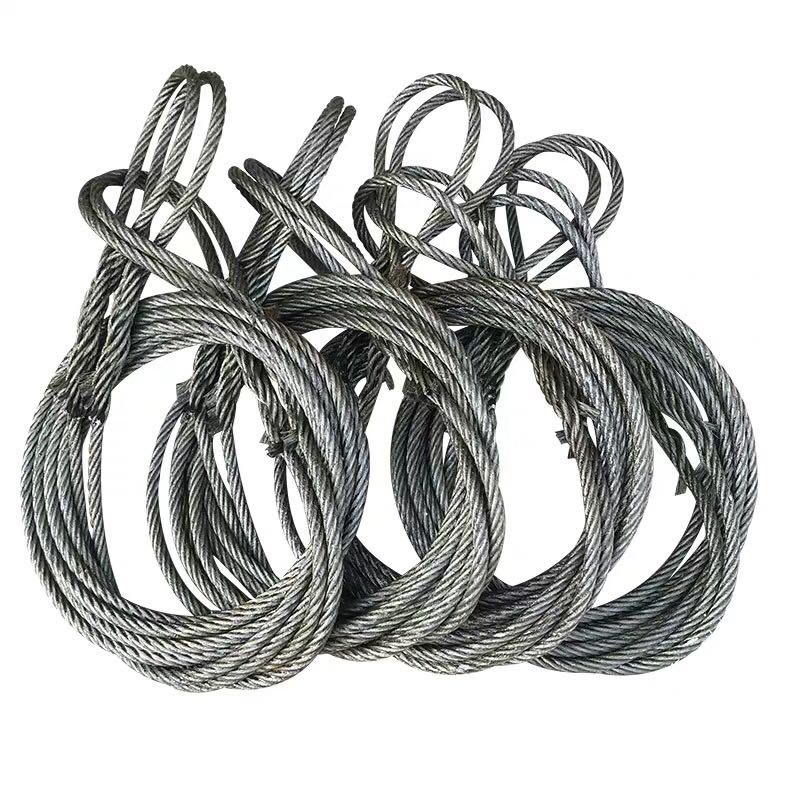
Pressed wire rope slings are critical lifting components in industrial applications, manufactured through hydraulic compression of ferrules onto wire rope loops. This guide covers their construction principles, technical specifications, international safety standards (ISO 4878, ASME B30.9, EN 13414), and compliance requirements for procurement professionals seeking reliable rigging solutions.
Construction and Manufacturing Process of Pressed Wire Rope Slings
Ferrule Pressing Technology and Quality Control
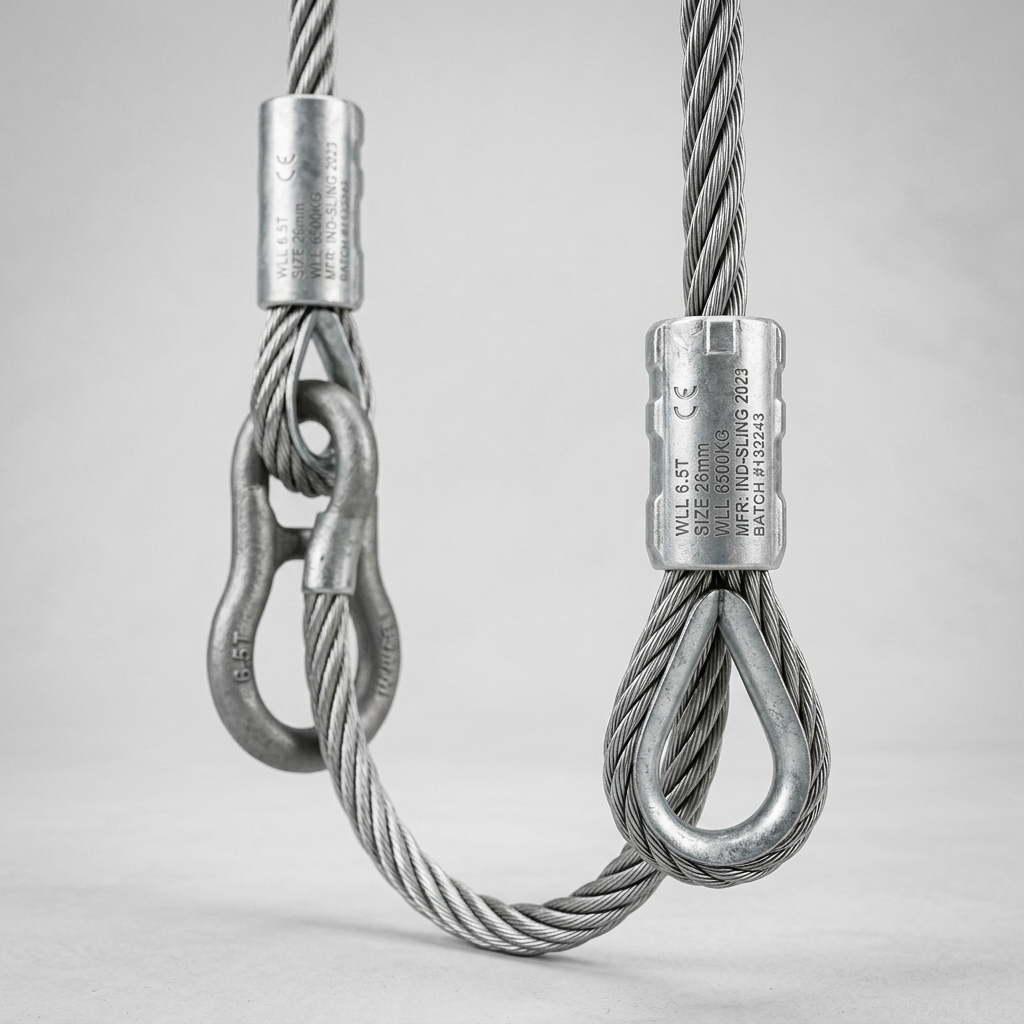
The structural integrity of a Wire Rope Sling depends primarily on the ferrule pressing process. Unlike spliced or mechanically joined terminations, a pressed Wire Rope Sling uses hydraulic compression to create a permanent mechanical bond between the ferrule and the rope loop. During production, controlled radial pressure—typically between 1500 and 3000 bar—is applied to deform the ferrule into the rope strands, ensuring full-surface load distribution and long-term stability.
Quality control begins with strict material compatibility checks. Ferrules must balance ductility and hardness to ensure proper deformation without cracking or premature wear. Aluminum ferrules (typically 6061-T6 or higher) are commonly used with galvanized wire ropes in corrosive environments, while steel ferrules (minimum yield strength of 370 MPa) are preferred for high-load Wire Rope Sling applications where maximum holding strength is required. The compression ratio—defined as ferrule diameter reduction—must be controlled within 8–12% to avoid under-compression (risk of slippage) or over-compression (damage to rope core structure).
Non-destructive testing is essential for ensuring reliability. Radiographic inspection identifies internal voids or incomplete material flow, while ultrasonic testing detects delamination between layers. For every batch of Wire Rope Sling products, destructive pull testing is also conducted, verifying that ferrule slippage only occurs beyond 90% of the rope’s minimum breaking load. Certified third-party organizations such as TÜV or Bureau Veritas often audit these processes to ensure compliance with international lifting standards.
Wire Rope Core Configurations and Load Distribution
The internal core structure of a Wire Rope Sling directly determines its mechanical performance and application suitability. Independent Wire Rope Core (IWRC) constructions incorporate a steel core strand, delivering 15–20% higher breaking strength compared to fiber core alternatives. This makes IWRC the preferred choice for heavy-duty Wire Rope Sling applications exceeding 10-ton working load limits or operating in high-temperature environments above 200°C.
Fiber core ropes, made from natural sisal or synthetic polypropylene, offer superior flexibility and reduce bending fatigue in applications requiring tight wrapping around irregular loads. However, their moisture absorption characteristics require galvanized outer strands to prevent internal corrosion over time.
Load distribution is another critical design factor. In multi-leg assemblies, a four-leg Wire Rope Sling does not simply multiply capacity by four. Due to angular load effects and asymmetrical tension distribution, the effective capacity is typically reduced to about 2.8 times that of a single-leg configuration at 90-degree sling angles. Engineers must apply proper trigonometric de-rating factors when calculating safe working loads for basket, choker, or vertical hitch operations.
Technical Specifications and Performance Parameters
Breaking Strength and Working Load Limits (WLL)
The relationship between wire rope diameter and safe working capacity follows internationally standardized safety factors. ASME B30.9 mandates a minimum 5:1 design factor for wire rope slings, meaning the breaking strength must equal or exceed five times the marked working load limit. This conservative approach accounts for dynamic loading, shock absorption, and gradual strength degradation from operational wear.
Diameter-to-WLL correlation depends on wire rope construction and steel grade. A 16mm diameter pressed sling using 6×36 IWRC construction with 1960 MPa steel wires typically achieves 2.5 tons WLL in straight vertical lift. Upgrading to 2160 MPa extra-improved plow steel increases this to 2.8 tons without changing physical dimensions. Multi-leg configurations require additional de-rating: a two-leg sling at a 60-degree included angle retains only 87% of the combined single-leg capacity due to horizontal force components.
Pressed Wire Rope Sling Specification Chart
| Wire Rope Diameter (mm) | Ferrule Size (mm) | Single Leg WLL (tons) | Breaking Strength (kN) | Compliance Standard |
|---|---|---|---|---|
| 12 | 18 x 45 | 1.5 | 73.5 | ISO 4878 / EN 13414-1 |
| 16 | 24 x 60 | 2.5 | 122.5 | ASME B30.9 / ISO 4878 |
| 20 | 30 x 75 | 4.0 | 196.0 | EN 13414-1 / AS 3569 |
| 26 | 38 x 95 | 6.5 | 318.5 | ISO 4878 / ASME B30.9 |
| 32 | 48 x 120 | 10.0 | 490.0 | EN 13414-1 / ISO 4878 |
Material Grade Requirements and Corrosion Resistance
Steel wire tensile strength directly impacts sling durability and service life. Standard grade ropes (1570 MPa) suffice for general indoor applications, while improved plow steel (1770 MPa) extends fatigue resistance by approximately 30%. Extra-improved plow steel (1960-2160 MPa) becomes essential for offshore marine environments or continuous-duty crane operations where replacement downtime costs exceed material premiums.
Corrosion protection strategies vary by exposure severity. Hot-dip galvanizing applies a minimum 275 g/m² zinc coating, providing 10-15 years protection in moderate industrial atmospheres. Stainless steel wire ropes (AISI 316 grade) eliminate galvanic corrosion risks in chemical processing plants handling acidic or alkaline solutions, though their 20-25% lower breaking strength requires diameter compensation. For extreme marine applications, duplex systems combining galvanized wire with polymer jacketing achieve 25+ year service life, justifying their 40% cost premium through reduced replacement frequency and inspection intervals.
International Safety Standards and Compliance Framework
ISO 4878 and EN 13414 Core Requirements
ISO 4878:2020 sets global benchmarks for Wire Rope Sling construction and testing. Ferrules for pressed terminations must achieve a minimum compressive strength of 400 MPa for aluminum alloys and 500 MPa for steel, with elongation exceeding 8% to prevent brittle failure. Proof load testing requires each sling to sustain 2.5 times its working load limit for 60 seconds without visible deformation or ferrule slippage beyond 3mm.
EN 13414-1 complements ISO standards with specific European market requirements. Article 5.3 mandates permanent identification markings on all Wire Rope Sling products, including manufacturer code, production date, wire rope diameter, and working load limit. Traceability must extend to material certificates, linking each production batch to mill test reports that detail steel chemistry (carbon ≤0.85%, manganese 0.60–1.60%) and mechanical properties. Non-compliance prevents CE marking, restricting market access across the EU.
Both standards also govern ferrule composition. Aluminum ferrules must contain ≤0.05% copper to avoid galvanic corrosion with galvanized ropes, while steel ferrules require documented heat treatment with hardness between 120–180 HB, balancing pressability with operational wear resistance—a critical factor for high-capacity Wire Rope Sling applications.
ASME B30.9 and OSHA Regulations for North American Markets
ASME B30.9-2018 Chapter 9 regulates Wire Rope Sling use in U.S. industrial facilities. Section 9-5.2 requires frequent inspections before each shift and documented periodic inspections at least every 12 months. Retirement criteria include visible ferrule cracks, rope diameter reduction >10%, broken wires exceeding 10% of total in any lay length, or heat damage evidence.
OSHA 1926.251(c)(4) enforces these standards, with fines up to $15,625 per incident. Unauthorized sling alterations are strictly prohibited. Valid recertification requires destructive testing of sample units from the same production batch, not just visual inspection of individual slings. Comprehensive documentation—including inspection date, inspector identity, sling ID, and disposition—is essential for regulatory compliance and liability protection.
Industrial Applications and Selection Criteria
Construction, shipbuilding, and heavy lifting operations are primary markets for pressed Wire Rope Sling products, where compact ferrule terminations and high load capacities are critical. Tower cranes typically use 32–40mm slings rated for 15–25 tons, while shipyard multi-leg slings (e.g., four-leg) handle irregular geometries with stable vertical lifts up to 30 meters.
Hitch configuration strongly impacts effective capacity. Basket hitches provide ~200% of vertical capacity at angles below 120°, whereas choker hitches reduce capacity to ~75% due to bending stresses. Angular load adjustments follow trigonometric de-rating: 60° from vertical reduces leg capacity to 87%, 45° to 71%.
Wire rope fatigue is influenced by load edge radius. Sharp edges can reduce service life by 80%. ASME B30.9 recommends minimum edge radii of 2× rope diameter, with 3× offering optimal fatigue resistance. Procurement specifications often require corner protectors or slings with integrated edge guards to protect both the rope and load—an important consideration when specifying high-performance Wire Rope Sling assemblies.
Procurement Checklist for B2B Buyers
Third-party certifications form the foundation for evaluating Wire Rope Sling suppliers. Request batch-specific test reports with actual breaking strength values, not generic data. Certificates should feature traceable serial numbers linked to permanent markings on each sling.
Audit supplier process controls, including hydraulic press calibration, ferrule material inspections, and rope mill qualifications. Sourcing ropes from ISO 9001-certified mills with documented traceability ensures consistent Wire Rope Sling quality and reduces supply chain risks.
Total cost of ownership often favors premium slings. Stainless steel pressed slings priced 140% above galvanized equivalents can achieve up to 300% longer service life in corrosive environments, reducing replacements and downtime. Forged master links further enhance durability, commanding 25% premiums while preventing premature deformation.
FAQ Module
Q1: What is the minimum safety factor required for pressed wire rope slings under ASME B30.9?
ASME B30.9 mandates a minimum 5:1 design factor, meaning the sling’s breaking strength must equal or exceed five times the marked working load limit. This factor accounts for dynamic loading, wear degradation, and provides a safety margin against unpredictable operational stresses. Some specialized applications (personnel lifting platforms) require 10:1 factors per ASME B30.23.
Q2: How do you verify the authenticity of ferrule pressing quality during supplier audits?
Request access to non-destructive testing records (X-ray or ultrasonic reports) from recent production batches. Examine sample slings for uniform ferrule compression—proper pressing creates consistent diameter reduction along the entire ferrule length without visible bulging. Demand witness testing where a sample sling from your order undergoes destructive pull testing, verifying that rope failure occurs before ferrule slippage. Legitimate manufacturers maintain calibrated hydraulic presses with digital pressure monitoring and retain compression force data for each production run.
Q3: Can pressed wire rope slings be repaired or re-certified after damage?
No. ASME B30.9 Section 9-5.2.3 explicitly prohibits repairs to wire rope slings, including ferrule replacement or wire rope splicing. Once a pressed sling exhibits retirement criteria (broken wires, diameter reduction, ferrule damage), it must be permanently removed from service. “Re-certification” services offering to restore damaged slings violate safety standards and create liability exposure. Only the original manufacturer can provide replacement ferrules for undamaged wire rope sections, and such work requires complete disassembly and re-pressing under controlled conditions equivalent to new production.
Conclusion
Pressed wire rope slings combine robust load-bearing capacity with compliance flexibility across ISO, ASME, and EN standards. Procurement decisions should prioritize third-party certified products with transparent material traceability, while maintenance protocols must align with jurisdiction-specific inspection mandates to ensure operational safety and regulatory adherence. The hydraulic ferrule pressing technology delivers superior strength-to-weight ratios compared to mechanical fittings, making these slings indispensable for heavy industrial lifting where reliability directly impacts operational continuity and worker safety. By understanding the technical specifications, material science, and regulatory framework governing pressed wire rope slings, B2B buyers can make informed decisions that balance initial investment against lifecycle performance, ultimately reducing total cost of ownership while maintaining uncompromising safety standards in demanding lifting applications.