

Abstract
In heavy industrial lifting, the integrity of every component in the rigging system is non-negotiable. Pressed wire rope slings represent one of the most widely adopted lifting solutions across oil and gas, shipbuilding, steel manufacturing, and construction—yet procurement managers and safety officers frequently ask: are they genuinely safe, and how do we verify compliance?
This article provides a structured technical and regulatory answer. We examine how the swaged ferrule-pressing process creates a mechanically superior termination, how international standards—OSHA 1910.184, ASME B30.9, and EN 13414—define and enforce safety requirements, and how field inspection protocols protect workers throughout the sling’s service life. Whether you are sourcing pressed wire rope slings for the first time or auditing an existing rigging inventory, this guide delivers the decision-making framework you need to select compliant products, manage risk, and demonstrate due diligence to regulators and insurers alike.
1. What Makes a Pressed Wire Rope Sling Structurally Safe?
1.1 Construction & Load-Bearing Mechanism
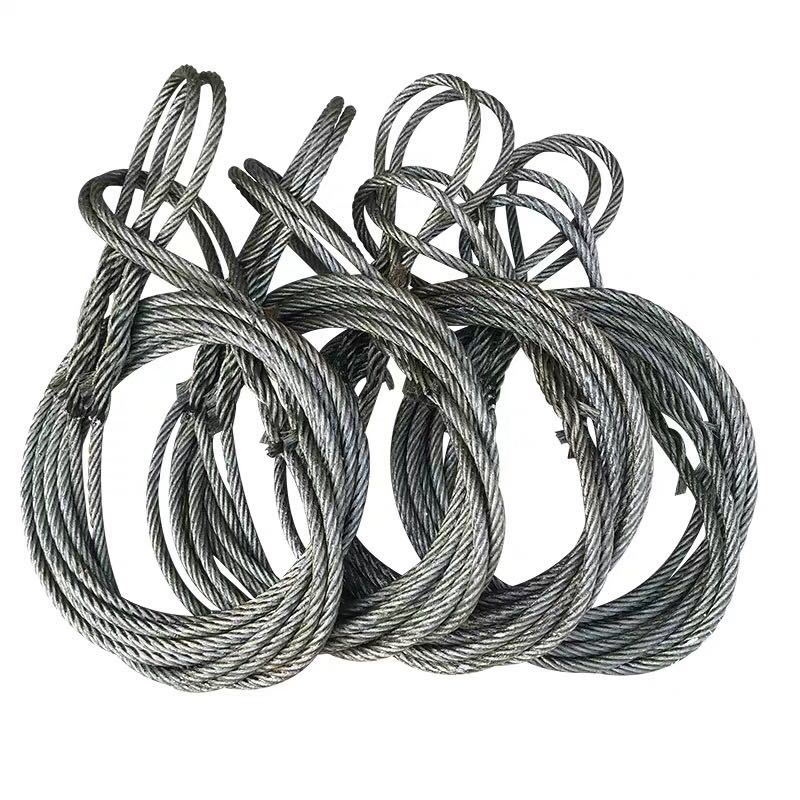
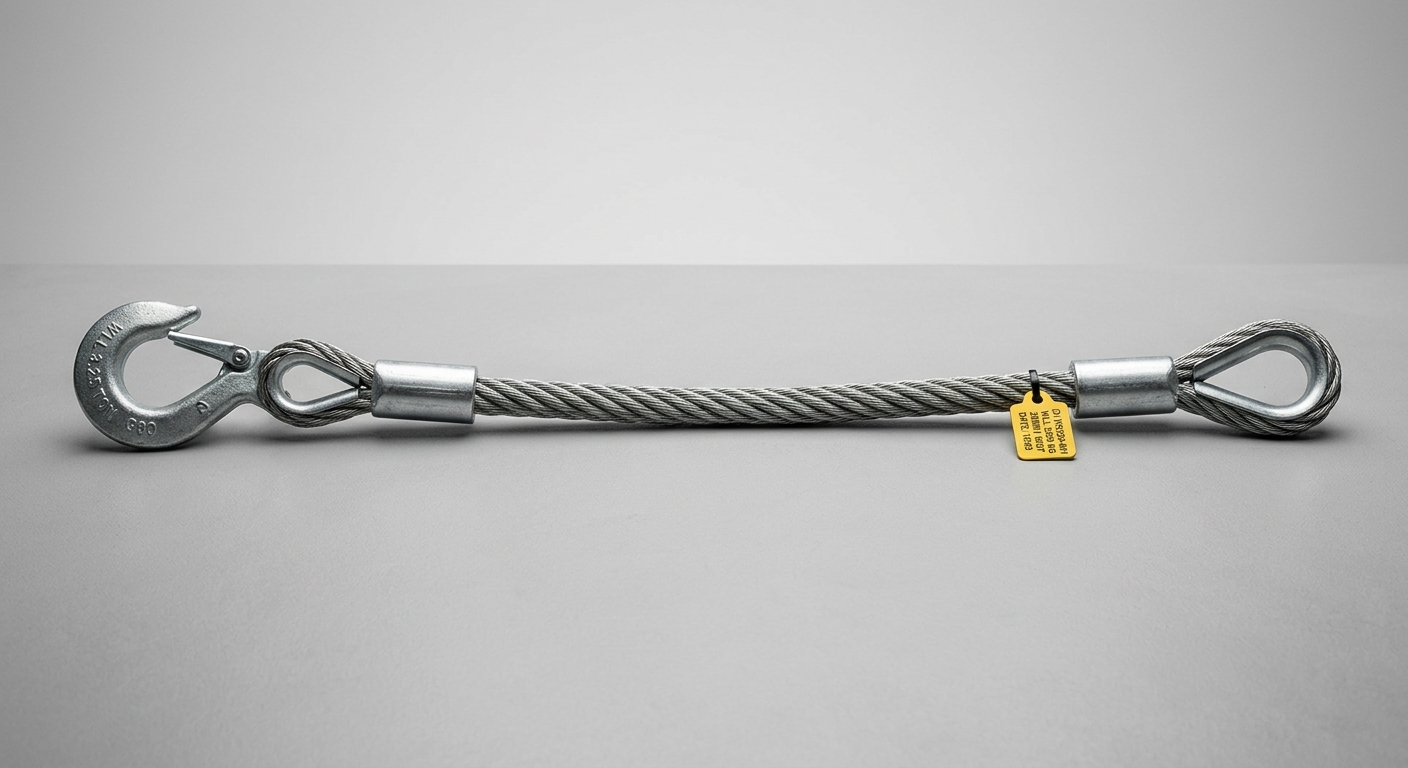
The defining feature of a pressed wire rope sling is its swaged or ferrule-pressed termination. In this process, a steel or aluminum ferrule sleeve is mechanically compressed around the wire rope eye at precisely controlled pressures—typically using hydraulic swaging machines calibrated to manufacturer specifications. The result is a cold-forged, monolithic connection in which the individual wire strands are mechanically locked within the sleeve, eliminating any possibility of slippage under load.
This is a fundamental mechanical advantage over hand-spliced or mechanically assembled slings. In a spliced eye, load transfer depends on friction between interwoven strands—a mechanism susceptible to fatigue and loosening over repeated load cycles. In a swaged termination, the load path is direct: tensile force travels from the load hook, through the eye, into the compressed sleeve, and distributes uniformly across all wire strands of the rope body. Independent tensile testing consistently demonstrates that properly swaged terminations achieve 95–100% of the rope’s catalog breaking strength, compared to 80–90% efficiency for hand splices.
The wire rope core—whether fiber core (FC) or independent wire rope core (IWRC)—further contributes to structural stability. IWRC constructions resist crushing under lateral loads and maintain cross-sectional geometry under heavy tension, making them the preferred choice for critical lifts in industrial environments.
1.2 Breaking Strength vs. Working Load Limit (WLL)
Every pressed wire rope sling carries two critical load parameters: Minimum Breaking Force (MBF) and Working Load Limit (WLL). The WLL is derived by dividing the MBF by the design factor—standardized at 5:1 under both ASME B30.9 and OSHA 1910.184 for wire rope slings used in general industrial lifting.
This means a sling with a vertical WLL of 2.0 tonnes must have a verified breaking strength of at least 10.0 tonnes. The design factor accounts for dynamic loading, shock loads, environmental degradation, and the statistical variability inherent in wire rope manufacture.
The effective WLL also changes with sling configuration. A two-leg bridle at 60° included angle reduces the vertical WLL by approximately 13%; at 90°, the reduction reaches 30%. Rigging engineers must consult angle correction factors for every multi-leg lift.
Pressed Wire Rope Sling — Typical WLL Reference Table
| Rope Diameter | Construction | Vertical WLL | 60° Basket WLL | MBF (kN) | Standard |
|---|---|---|---|---|---|
| 10 mm / 3/8″ | 6×19 IWRC | 1.0 t | 2.0 t | 51.5 kN | ASME B30.9 |
| 13 mm / 1/2″ | 6×19 IWRC | 1.8 t | 3.6 t | 90.0 kN | ASME B30.9 |
| 16 mm / 5/8″ | 6×37 IWRC | 2.7 t | 5.4 t | 135.0 kN | EN 13414 |
| 20 mm / 3/4″ | 6×37 IWRC | 4.2 t | 8.4 t | 210.0 kN | EN 13414 |
| 26 mm / 1″ | 6×37 IWRC | 7.1 t | 14.2 t | 355.0 kN | ASME/EN |
Note: Values are indicative. Always verify against the manufacturer’s certified load table for the specific product.
2. Do Pressed Wire Rope Slings Meet OSHA, ASME, and EN Standards?
2.1 OSHA 1910.184 & ASME B30.9 Compliance Requirements
In the United States, wire rope sling safety is governed by two interlocking frameworks. OSHA 1910.184 establishes mandatory requirements for sling use in general industry, while ASME B30.9 provides the detailed technical standard that defines manufacturing, testing, and marking requirements. OSHA explicitly references ASME B30.9 as the accepted industry standard, making compliance with B30.9 effectively mandatory for any operation subject to OSHA jurisdiction.
For pressed wire rope slings specifically, OSHA 1910.184 mandates:
- Each sling must be marked with its rated capacity for each configuration of use.
- Slings must not be loaded beyond their rated capacity.
- Damaged or defective slings must be immediately removed from service.
ASME B30.9 adds manufacturing precision requirements, including minimum breaking force verification through destructive testing of production samples, ferrule pull-out resistance testing, and permanent identification tagging. Every compliant sling must carry a durable tag or stamp showing: manufacturer identification, rated load, rope diameter and construction, and length.
Procurement officers should require Mill Test Reports (MTRs) and third-party test certificates from suppliers as standard documentation. ASME B30.9-compliant slings produced by reputable manufacturers will include these documents as part of the standard delivery package.
2.2 EN 13414 & International Market Acceptance
For operations in the European Union and markets that reference European standards, EN 13414-1 (Steel Wire Rope Slings — Safety) and EN 13414-2 (Specification for Information for Use and Maintenance) define the compliance framework. The CE marking requirement under EN 13414 is enforced through the EU Machinery Directive (2006/42/EC), requiring that slings be assessed by a Notified Body and accompanied by a Declaration of Conformity.
Key divergences from North American standards include:
- Design factor: EN 13414 mandates a minimum factor of 5:1 for single-leg slings, consistent with ASME B30.9, but applies specific factors for multi-leg configurations based on mode factor tables.
- Marking language: CE-marked slings must display rated capacity in kilonewtons (kN) alongside tonne equivalents, and documentation must be available in the language of the destination market.
- Proof load testing: EN 13414 requires proof load testing at 2× WLL for each sling or production batch, providing an additional safety verification layer beyond ASME requirements.
For global procurement teams sourcing a single product line for multi-region deployment, selecting slings certified to both ASME B30.9 and EN 13414 is the most efficient compliance strategy, reducing documentation overhead and simplifying inventory management.
3. How to Inspect Pressed Wire Rope Slings Before and After Use?
3.1 Pre-Use Visual Inspection Checklist
ASME B30.9 mandates a pre-use inspection before each lift. This is a visual and tactile examination that should take no more than two to three minutes but can prevent catastrophic failure. Inspectors should check for:
- Broken wires: Remove from service if 10 or more randomly distributed broken wires are found in any one rope lay, or 5 or more broken wires in one strand in one rope lay.
- Ferrule/sleeve integrity: Any cracking, deformation, elongation, or corrosion at the pressed termination is grounds for immediate removal. The sleeve should show no visible gap between the ferrule end and the rope body.
- Kinks and birdcaging: Any permanent distortion of the rope’s helical geometry indicates internal wire damage and renders the sling unserviceable.
- Corrosion: Surface rust is a warning sign; pitting corrosion that has penetrated into the wire strands requires immediate retirement.
- Core exposure: Visible fiber core or IWRC protrusion through the outer strands indicates severe rope distortion.
- Wear: Reduction in rope diameter exceeding 1/3 of the original diameter at any point constitutes a retirement criterion.
A simple color-coded tagging system—green for in-service, red for quarantined pending inspection, and black for condemned—is a best practice that reduces the risk of inadvertently deploying damaged slings.
3.2 Periodic Inspection & Lifecycle Management
Beyond daily pre-use checks, ASME B30.9 requires periodic inspections at intervals determined by frequency of use, severity of service, and environmental conditions. For slings in continuous heavy industrial use, monthly formal inspections documented by a qualified rigger are standard practice. Annual third-party inspections are recommended for high-criticality applications.
Lifecycle management best practices include:
- Inspection logs: Maintain a serial-numbered record for each sling, documenting inspection date, inspector identity, findings, and disposition.
- Storage: Store slings coiled on racks in a dry, ventilated area away from direct sunlight, chemicals, and extreme heat. Avoid floor storage where slings can be driven over or contaminated.
- Lubrication: Periodic re-lubrication with a compatible wire rope lubricant extends fatigue life and retards corrosion, particularly in marine or chemical processing environments.
- Retirement policy: Establish a maximum service life policy—regardless of visual condition—for slings used in critical or high-cycle applications. Many operators retire slings after a defined number of lifts or years of service as a conservative risk management measure.
4. When Are Pressed Wire Rope Slings the Right Choice for Your Application?
4.1 High-Risk Lifting Scenarios & Load Types
Pressed wire rope slings outperform alternatives in several demanding industrial contexts. Their high strength-to-diameter ratio makes them ideal where headroom is limited but load capacity is critical. Their resistance to cutting and abrasion under sharp-edged loads—particularly when used with corner protectors—makes them preferable to synthetic slings in steel mill and fabrication yard environments.
Specific high-value applications include:
- Offshore oil and gas: Resistance to saltwater corrosion (with galvanized or stainless wire rope) and ability to maintain rated capacity in dynamic sea-state conditions.
- Shipbuilding and heavy plate handling: Capacity to handle irregular, heavy steel components with predictable load distribution.
- Petrochemical plant maintenance: Suitability for elevated temperatures up to approximately 200°C (392°F) for standard carbon steel wire rope, with stainless steel variants extending this range.
- Steel and structural fabrication: Durability against abrasive contact with rough metal surfaces.
In contrast, synthetic web or round slings are preferred where load surfaces are delicate or painted, and chain slings are selected for temperatures exceeding wire rope limits.
4.2 Total Cost of Compliance vs. Safety ROI
The business case for investing in certified pressed wire rope slings is straightforward. A single lifting incident resulting in injury, fatality, or dropped load can generate direct costs—medical, legal, equipment damage—measured in hundreds of thousands of dollars, alongside indirect costs including regulatory fines, project delays, and reputational damage that are often multiples of the direct figure.
OSHA penalty structures for serious violations related to rigging non-compliance can reach $16,550 per violation (2024 figures), with willful or repeat violations reaching $165,514. Against this exposure, the incremental cost of sourcing ASME/OSHA/EN-certified slings with full documentation is negligible. Certified slings also simplify third-party audits, insurance renewals, and client safety prequalification processes—delivering measurable administrative value alongside physical safety performance.
FAQ
Q1: What is the minimum safety factor required for pressed wire rope slings under OSHA regulations?
OSHA 1910.184, in conjunction with ASME B30.9, requires a minimum design factor of 5:1 for wire rope slings used in general industry lifting operations. This means the minimum breaking force of the sling must be at least five times its rated Working Load Limit (WLL) for the intended configuration.
Q2: How do I know when a pressed wire rope sling should be removed from service?
Remove a pressed wire rope sling from service immediately if you observe: 10 or more randomly distributed broken wires per rope lay, 5 or more broken wires in a single strand per lay, any deformation or cracking at the pressed ferrule, kinking, birdcaging, severe corrosion with pitting, or rope diameter reduction exceeding one-third of the nominal diameter. These are the retirement criteria defined in ASME B30.9.
Q3: Can pressed wire rope slings be used in high-temperature or corrosive environments?
Standard carbon steel wire rope slings are rated for use up to approximately 200°C (392°F); above this temperature, WLL must be derated per manufacturer guidelines. For corrosive environments—marine, chemical processing—galvanized or stainless steel wire rope constructions provide substantially extended service life. Always consult the manufacturer’s environmental service data before deploying slings in non-ambient conditions.
Conclusion
Pressed wire rope slings are among the safest and most technically robust lifting solutions available to industrial operators—provided they are correctly specified, sourced from compliant manufacturers, and managed through a disciplined inspection and retirement program. The swaged ferrule termination eliminates the primary failure mode of conventional spliced slings, while the 5:1 design factor mandated by OSHA, ASME B30.9, and EN 13414 builds substantial engineering margin into every lift.
For procurement managers, the priority is clear: source slings with full third-party certification documentation, verify ASME B30.9 or EN 13414 compliance for your target market, and implement the pre-use and periodic inspection protocols outlined in this article. For safety officers, the inspection checklists and retirement criteria provided here align directly with regulatory requirements and provide defensible, auditable safety management records.
When selected and managed correctly, pressed wire rope slings do not merely meet safety standards—they represent the engineering standard against which other lifting solutions are measured.