

Resumo
Marine environments impose compounding mechanical and chemical stresses that disqualify general-purpose wire rope from many offshore and coastal applications. Saltwater accelerates corrosion at wire contact points, cyclic bending over sheaves and drum layers induces fatigue fractures, and dynamic shock loads from vessel motion multiply working stresses beyond static calculations. Selecting the wrong corda de arame de aço construction leads to premature failure, unplanned downtime, and — in lifting-critical applications — serious safety consequences.
This article provides procurement engineers and vessel equipment managers with a structured framework for matching steel wire rope construction to marine operating conditions. It covers the primary construction variables (strand count, core type, lay direction, and surface treatment), marine-specific performance requirements, applicable certification standards, and equipment-specific recommendations for deck cranes, winches, and mooring systems. The goal is to reduce specification errors and support informed purchasing decisions backed by recognized marine standards.
1. Understanding Steel Wire Rope Construction: Core Variables for Marine Use
1.1 Strand Arrangement & Wire Count
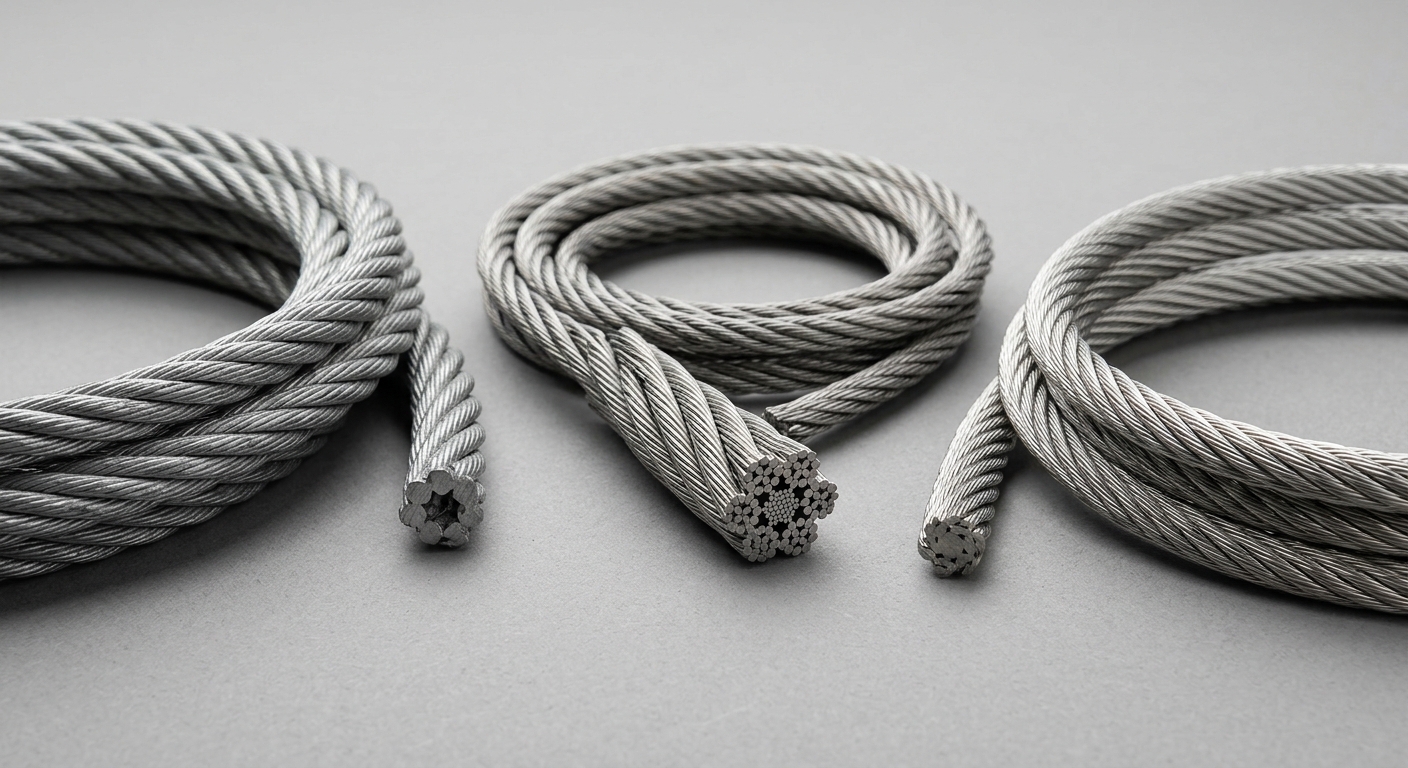
The numerical designation of a steel wire rope — such as 6×19, 6×36, or 8×19 — defines the number of strands and the approximate number of wires per strand. These figures directly govern flexibility, load distribution, and fatigue resistance, all of which are critical in marine lifting cycles.
6×19 Class ropes contain 6 strands with 15–26 wires each. The relatively coarse wire diameter provides high abrasion resistance on rough surfaces such as fairleads and open-drum winches, but limited flexibility makes them unsuitable for small-diameter sheaves or multi-layer drum applications.
6×36 Class ropes use more wires per strand, each of smaller diameter. This increases flexibility and fatigue life under repeated bending — a key advantage for deck crane hoist lines that cycle hundreds of times per shift. The trade-off is reduced abrasion resistance compared to 6×19.
8×19 Class ropes add two additional strands, distributing load across a wider contact area and improving flexibility further. This construction suits compact winch drums with tight fleet angles, where rope-to-drum contact stresses are elevated.
For marine lifting applications with moderate sheave ratios (D/d ≥ 18), 6×36 IWRC is the most widely specified construction. Where abrasion from deck hardware dominates, 6×19 galvanized remains standard.
1.2 Core Types: Fiber Core vs. Independent Wire Rope Core (IWRC)
The rope core occupies the center of the strand assembly and determines crush resistance, elongation behavior, and resistance to saltwater ingress.
Fiber Core (FC) — typically polypropylene in marine-grade ropes — provides a lubrication reservoir that reduces inter-wire friction. However, FC ropes compress under radial load on multi-layer drums and absorb moisture if the outer lubricant film degrades, creating an internal corrosion pathway that is difficult to inspect.
Independent Wire Rope Core (IWRC) replaces the fiber center with a small wire rope assembly. IWRC ropes resist radial crushing by approximately 7–10% higher than FC equivalents, maintain rounder cross-sections under drum pressure, and do not absorb water. For below-hook lifting gear, offshore crane falls, and any application involving more than three layers on a drum, IWRC is the technically correct choice and is typically required under DNV/GL type approval conditions.
2. Marine-Specific Performance Requirements & Construction Selection
2.1 Corrosion Resistance: Galvanized, Stainless, and Coated Options
Surface protection is the single largest differentiator between wire rope grades in marine service. Three primary options exist:
Zinc Galvanizing is graded by coating mass. Class A galvanizing (light coating) suits moderately corrosive environments such as sheltered harbor cranes. Class B and Class C (heavy coating) provide greater zinc reserve for open-sea and splash-zone exposure. Hot-dip galvanized rope is cost-effective and compatible with standard lubrication programs, making it the default specification for most commercial vessel deck equipment.
AISI 316 Stainless Steel Wire Rope offers superior pitting resistance in chloride-rich environments due to its molybdenum content. It is specified for permanently immersed mooring pendants, architectural rigging on passenger vessels, and applications where re-lubrication is impractical. The cost premium over galvanized rope is significant — typically 3–5× — so stainless is reserved for high-consequence or maintenance-inaccessible installations.
Polymer-Coated Constructions apply an extruded HDPE or nylon jacket over a galvanized or stainless core rope. The coating blocks seawater ingress and reduces wear on contact surfaces. Coated ropes are increasingly used in oceanographic winch systems and ROV tether management where both corrosion isolation and low surface friction are required.
2.2 Abrasion & Fatigue: Matching Lay Type to Operating Conditions
Lay type describes the relationship between wire twist direction within a strand and strand twist direction within the rope.
Regular Lay (wires and strands twisted in opposite directions) produces a rope with a smoother outer surface and better resistance to kinking and rotation. It is the standard choice for deck cranes, hoists, and any application where the rope runs over sheaves in a single plane. Regular lay rope is also more resistant to crushing on multi-layer drums.
Lang’s Lay (wires and strands twisted in the same direction) exposes a longer wire length at the surface, increasing contact area with sheaves and improving fatigue life under bending. Lang’s lay is preferred for dragline applications and single-layer drum winches where rotation-induced unlaying is controlled by termination design. It is not recommended for free-hanging loads without rotation-resistant rope.
Rotation-Resistant Constructions (19×7, 35×7) use opposing lay directions in inner and outer strand layers to minimize torque under load. These are specified for single-fall crane configurations and personnel transfer equipment where rope rotation would be hazardous.
Marine Wire Rope Construction Comparison Table
| Construction | Core Type | Lay Type | Surface Treatment | Min. Breaking Force (18mm, approx.) | Typical Marine Application | Standard |
|---|---|---|---|---|---|---|
| 6×19 | IWRC | Regular | Galvanized Class B | ~185 kN | Deck crane, fairlead systems | ISO 2408, EN 12385-4 |
| 6×36 | IWRC | Regular | Galvanized Class B | ~178 kN | Hoist lines, multi-layer winches | ISO 2408, DNV |
| 8×19 | IWRC | Regular | Galvanized | ~172 kN | Compact winch drums | EN 12385-4 |
| 6×37 | FC | Regular | Bright/Galvanized | ~170 kN | General deck use, mooring assists | ISO 2408 |
| 19×7 | — | Rotation-resistant | Galvanized/Stainless | ~190 kN | Single-fall offshore cranes | DNV/GL, IMCA |
| 1×19 Stainless | — | Strand | AISI 316 | ~145 kN | Standing rigging, pendants | EN 12385-4 |
Breaking force values are indicative for 18mm nominal diameter; verify against manufacturer test certificates and applicable standard tables.
3. Applicable Standards & Compliance for Marine Wire Rope
3.1 International Standards Overview
Marine wire rope procurement must reference recognized standards to satisfy class society surveys and operational safety requirements:
- ISO 2408 defines construction, dimensions, and minimum breaking forces for general-purpose steel wire ropes, serving as the baseline reference for most commercial specifications.
- EN 12385-4 covers steel wire ropes for general lifting applications and is the primary European standard cited in offshore crane and deck equipment certifications.
- DNV/GL Type Approval is required for wire rope used in lifting appliances on classed vessels. DNV-ST-0378 governs offshore lifting equipment and specifies design factor, proof load, and certification documentation requirements.
- IMCA M 179 (International Marine Contractors Association) provides guidance on the inspection, maintenance, and retirement criteria for wire ropes used in offshore operations.
Procurement teams should request mill certificates, third-party test reports, and — where class survey is required — a valid DNV/GL or Bureau Veritas type approval certificate with the delivery documentation.
3.2 Breaking Force, Safety Factors & Proof Load Requirements
Marine lifting operations typically require a minimum design factor (breaking force ÷ working load limit) of 4:1 for general deck cranes and 5:1 for personnel transfer and offshore crane falls per DNV-ST-0378 and IMCA guidelines. Some flag state administrations mandate higher factors for specific cargo categories.
Proof load testing — typically at 50% of minimum breaking force — must be documented for new installations on classed vessels. Wire rope selected purely on catalog breaking force values without verified mill certificates will not satisfy class survey requirements. Always specify: nominal diameter tolerance (EN 12385 allows +6%/−0%), rope grade (1770 or 1960 N/mm²), and lubrication type (petroleum-based or biodegradable for environmentally sensitive zones).
4. Application Scenarios: Matching Construction to Marine Equipment
4.1 Deck Cranes, Winches & Mooring Systems
- Deck Cranes: 6×36 IWRC, regular lay, Class B galvanized, grade 1770 or 1960. Fleet angle should not exceed 2° for grooved drums; exceeding this accelerates cross-winding wear.
- Anchor Windlasses & Mooring Winches: 6×19 or 6×36 IWRC galvanized. Multi-layer spooling requires IWRC to resist radial crush. Minimum drum D/d ratio of 16:1 recommended.
- Mooring Lines (Synthetic Pendant Backup): Where wire rope mooring tails are used, 6×37 FC galvanized provides adequate flexibility for repeated surging loads at bollards.
4.2 Offshore Lifting vs. Coastal Vessel Operations
Environmental severity determines coating and construction upgrades:
- Splash Zone / Open Sea Offshore: IWRC, Class C galvanized or AISI 316 stainless, rotation-resistant construction for single-fall lifts. DNV type approval mandatory.
- Open Sea Commercial Vessels: IWRC, Class B galvanized, 6×36 or 6×19 depending on equipment. Annual inspection and retirement criteria per IMCA M 179.
- Sheltered Harbor / Coastal Ferry Operations: FC or IWRC, Class A galvanized acceptable. Standard ISO 2408 compliance sufficient; class survey requirements vary by flag state.
Perguntas frequentes
Q1: What is the difference between galvanized and stainless steel wire rope for marine applications, and which offers better long-term value?
Galvanized rope provides sacrificial zinc protection that is cost-effective for most deck equipment with regular maintenance and re-lubrication. AISI 316 stainless eliminates corrosion in high-chloride environments but costs significantly more upfront. For permanently immersed or maintenance-inaccessible applications, stainless delivers better lifecycle value. For routinely maintained deck cranes and winches, Class B galvanized with a structured inspection program is typically the most economical choice.
Q2: How do I determine the correct wire rope construction for a deck crane with a multi-layer drum arrangement?
Multi-layer drums impose radial crushing loads on lower rope layers. Specify IWRC (not FC) to resist deformation, and select 6×36 class for adequate flexibility at the required D/d ratio. Confirm fleet angle is within equipment manufacturer limits and that the drum groove profile matches the rope diameter tolerance per EN 12385-4.
Q3: Does a fiber core wire rope meet DNV/GL requirements for offshore marine lifting operations?
Generally, no. DNV-ST-0378 and most offshore crane OEM specifications require IWRC for lifting applications due to its superior crush resistance and dimensional stability under load. FC rope may be acceptable for light-duty deck rigging or mooring assists, but should not be used as crane hoist rope on classed offshore vessels.
Conclusão
Selecting the correct steel wire rope construction for marine applications requires systematic evaluation across four dimensions: strand geometry and wire count, core type, surface protection, and compliance with recognized marine standards. No single construction suits every application — a 6×36 IWRC galvanized rope that performs excellently on a multi-layer deck crane drum may be over-flexible and under-abrasion-resistant for a coastal fairlead system.
By mapping construction specifications to actual operating conditions — equipment type, corrosion exposure zone, drum geometry, and load cycle frequency — procurement and engineering teams can reduce premature failures, meet class survey requirements, and optimize total cost of ownership over the wire rope’s service life. Always request certified test documentation, verify design factors against applicable DNV/GL or EN standards, and implement an inspection and retirement program aligned with IMCA guidelines.