

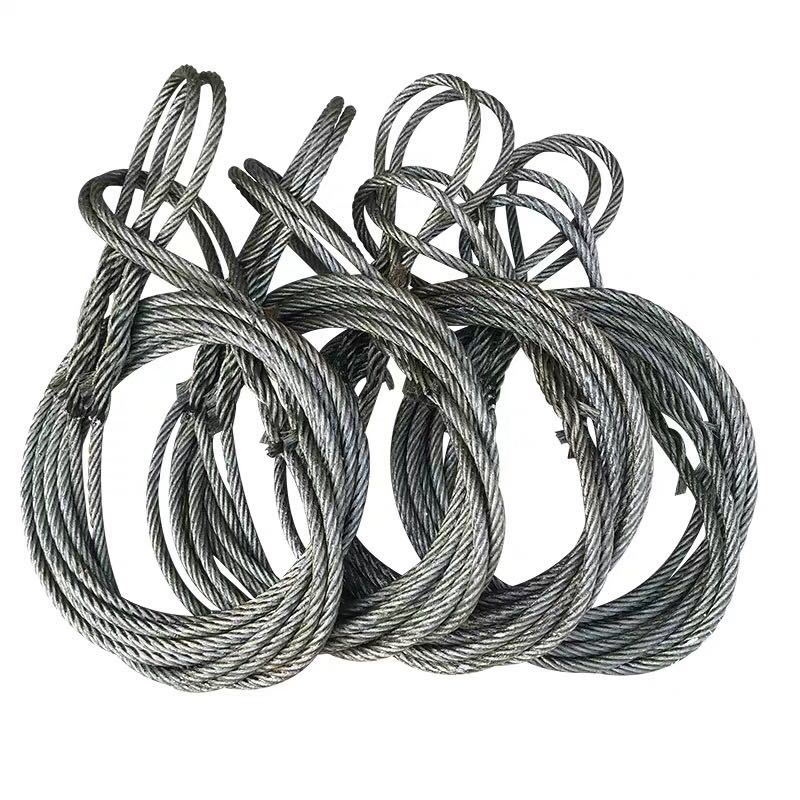
Selecting the correct Estropo de Cabo de Aço Pressionado is an engineering decision, not an estimate. Load weight, sling angle, hitch configuration, and working load limits (WLL) interact in ways that can silently compromise lift safety long before a sling visibly fails. For procurement engineers, rigging supervisors, and safety managers, understanding these interdependencies is the foundation of every compliant lifting operation.
This article provides a structured technical framework for evaluating sling suitability. Whether you are specifying slings for heavy industrial lifts, port container handling, or structural steel installation, the selection logic presented here applies directly to real procurement and operational decisions. Each section targets a specific variable in the sling selection equation—WLL calculation, angle derating, hitch configuration, specification parameters, and compliance requirements—so your team can move from load data to verified sling selection with confidence.
Understanding Working Load Limits for Pressed Wire Rope Slings
How WLL Is Calculated and Rated
The Working Load Limit of a Pressed Wire Rope Sling is the maximum mass or force the sling is authorized to support in a specific configuration under normal service conditions. It is derived from the sling’s Minimum Breaking Force (MBF) divided by a Design Factor (DF), also referred to as a safety factor.
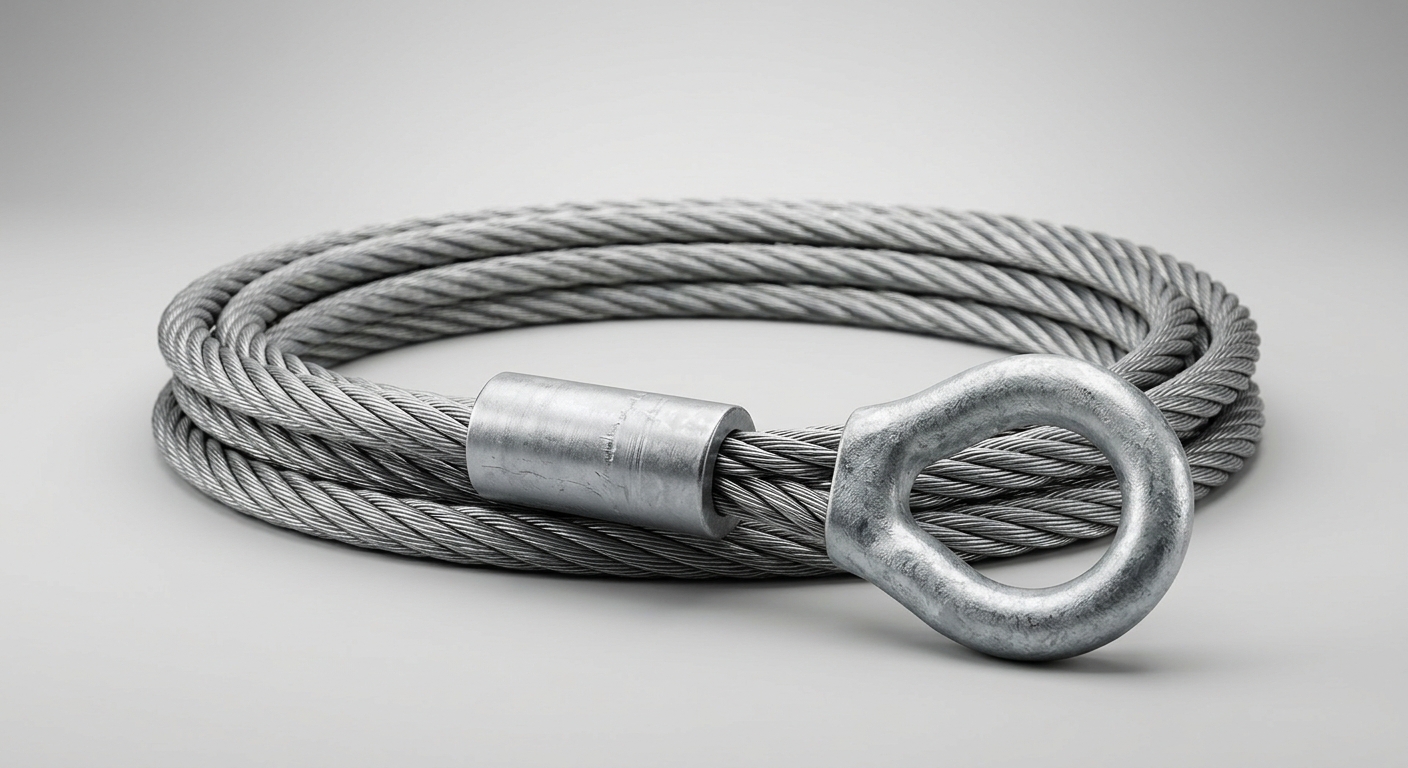
For wire rope slings used in general lifting, ASME B30.9 and EN 13414-1 both mandate a minimum Design Factor of 5:1, meaning a sling with an MBF of 100 kN carries a rated WLL of 20 kN in straight vertical pull. The pressed (swaged) termination method used in Pressed Wire Rope Slings is critical here: a high-quality hydraulic press ferrule retains 95–100% of the rope’s catalog breaking strength, compared to hand-spliced terminations that may retain only 80–90%. This efficiency advantage directly translates into a higher rated WLL for a given rope diameter.
WLL is always rated for a specific configuration. A sling rated at 2.0 t in vertical straight hitch will carry a different effective load in basket or choker hitch, and will derate further as the sling angle decreases. Procurement documents must specify configuration and angle explicitly—a bare WLL figure without these parameters is commercially incomplete.
How Sling Angle Reduces Effective WLL
The Sling Angle Factor (SAF) quantifies how horizontal deviation from vertical increases tension in each sling leg. As the angle between the sling leg and the horizontal plane decreases, each leg must carry a proportionally higher tension to support the same vertical load. At 30°, the tension per leg is double that at 90°—a risk multiplier that is frequently underestimated on site.
The table below illustrates WLL derating across standard angles for a single-leg sling with a vertical WLL of 2.0 t, and shows effective combined WLL for two-leg and four-leg configurations:
| Sling Angle | Angle Factor (SAF) | Single-Leg Effective WLL | 2-Leg Basket WLL | 4-Leg Basket WLL | Risk Level |
|---|---|---|---|---|---|
| 90° (Vertical) | 1.000 | 2.0 t | 4.0 t | 8.0 t | ✅ Low |
| 60° | 0.866 | 1.73 t | 3.46 t | 6.93 t | ✅ Acceptable |
| 45° | 0.707 | 1.41 t | 2.83 t | 5.66 t | ⚠️ Moderate |
| 30° | 0.500 | 1.00 t | 2.00 t | 4.00 t | 🔴 High |
Key operational rule: Never allow sling angles below 30° without engineering review. Below this threshold, leg tension escalates rapidly and the risk of terminal fitting overload increases significantly. For multi-leg configurations, the angle factor applies to each individual leg, not the combined system.
Hitch Configuration and Its Impact on Load Suitability
Straight, Choker, and Basket Hitch — Capacity Comparison
Hitch configuration is the second most impactful variable after sling angle. Three fundamental configurations apply to Pressed Wire Rope Slings:
- Vertical (Straight) Hitch: The sling supports the load directly below the hook. WLL multiplier = 1.0×. This is the baseline rating printed on the sling tag.
- Choker Hitch: The sling passes around the load and through its own eye or fitting, creating a self-tightening grip. WLL multiplier = approximately 0.75× (75% of vertical WLL). The reduction accounts for the bending stress at the choke point and the compression applied to the rope body.
- Basket Hitch: Both sling ends attach to the hook while the sling body supports the load from below. At 90°, WLL multiplier = 2.0×. This doubles effective capacity but is angle-dependent—at 60°, the basket hitch delivers 1.73× vertical WLL, not 2.0×.
For procurement specification, always state the intended hitch type. A 3.2 t vertical-rated sling delivers only 2.4 t in choker configuration—a 25% capacity reduction that must be accounted for in lift planning.
Matching Hitch Type to Load Geometry and Surface
Load geometry directly governs hitch selection. Cylindrical loads (pipes, shafts, rolled coils) are well-suited to basket hitch because the sling body distributes load across the contact surface. Flat plate or structural sections with defined lift points are best handled with vertical hitch and shackle connections. Irregular or asymmetric loads require careful choker hitch evaluation.
For choker hitch applications, the Choke Angle—the angle formed between the sling body and the load surface at the choke point—further modifies capacity. When the choke angle is less than 120°, an additional derating factor applies. Many rigging references reduce effective WLL to 65% of vertical when choke angles fall below 120°. On surfaces with sharp edges or abrasive finishes, choker hitch should be avoided unless edge protection is fitted, as wire rope damage at the choke point accelerates fatigue failure.
Pressed Wire Rope Sling Specifications and Selection Criteria
Core Specification Parameters for Procurement
A complete procurement specification for a Pressed Wire Rope Sling must address five parameters:
- Rope Construction: 6×19 classification offers higher stiffness and abrasion resistance, suitable for heavy industrial and structural lifts. 6×37 construction provides greater flexibility, preferred for applications requiring the sling to conform to load contours or pass through tight rigging configurations.
- Rope Diameter: Directly determines MBF and therefore WLL. Specify diameter in millimeters with tolerance per the applicable standard.
- Sling Length and Leg Configuration: Overall length, number of legs (single, two-leg, four-leg), and leg length symmetry affect angle management on site.
- End Fittings: Swaged eye loops, hooks, shackles, or master links. Fitting WLL must match or exceed rope WLL—the weakest component governs the system.
- Press Termination Efficiency: Specify hydraulic swaging with documented efficiency ≥95% MBF retention. Request press force records or pull-test certificates as part of delivery documentation.
Material grade also matters: Grade 1770 and 1960 wire ropes deliver higher breaking strength at lower diameters, improving lift-to-weight ratios in weight-sensitive applications such as offshore or elevated structural work.
Compliance Standards and Certification Requirements
Pressed Wire Rope Slings supplied into regulated markets must meet documented compliance benchmarks:
- ASME B30.9 (USA/North America): Governs sling design, manufacture, inspection, and use. Mandates 5:1 design factor and requires permanent sling identification tags.
- EN 13414-1 (European Union): Specifies technical requirements for steel wire rope slings, including proof load testing at 2× WLL and marking requirements. CE marking is mandatory for slings placed on the EU market.
- ISO 2766 / ISO 8792: International standards covering wire rope sling dimensions and performance requirements, relevant for global supply chain procurement.
When qualifying a supplier, request: CE Declaration of Conformity, third-party test certificates (proof load and breaking force), material mill certificates for wire rope, and dimensional inspection reports. For OSHA-regulated sites, verify that sling identification tags include WLL in all relevant configurations, not only vertical hitch.
Application Scenarios and Commercial Considerations
Industry-Specific Use Cases
Different industries impose distinct specification requirements on Pressed Wire Rope Slings:
- Heavy Industrial Manufacturing: High-cycle lifts of machinery and press tooling demand 6×37 construction for flexibility combined with robust swaged fittings rated to match crane hook WLL.
- Port and Container Terminals: Corrosion resistance is critical. Galvanized wire rope with stainless or hot-dip galvanized fittings extends service life in marine environments. Four-leg configurations are standard for container spreader bar backup lifts.
- Structural Steel Installation: Asymmetric load geometries and variable lift points favor adjustable-length two-leg slings with shackle terminations, enabling angle management during beam and column placement.
- Petrochemical Equipment Lifts: Pressure vessels and heat exchangers require engineered lift plans with documented WLL verification at the specific angle used. Four-leg slings with master link assemblies are standard.
Total Cost of Ownership vs. Rated Capacity Trade-offs
Procurement decisions based solely on unit price routinely underestimate total cost of ownership (TCO). A lower-cost sling with inadequate documentation increases inspection overhead, shortens service intervals, and elevates replacement frequency. Key TCO variables include:
- Inspection interval: Slings used in high-cycle or abrasive environments require more frequent inspection, increasing labor cost.
- Retirement criteria: ASME B30.9 and EN 13414-1 define discard criteria including broken wire counts (typically 10 randomly distributed broken wires per rope lay length), kinking, crushing, or corrosion. Higher-quality rope construction with independent wire rope core (IWRC) resists deformation and extends service life.
- Compliance cost: Non-certified slings may trigger regulatory non-compliance findings, work stoppages, or insurance liability—costs that dwarf any unit price saving.
Specifying a certified Pressed Wire Rope Sling with documented WLL ratings and traceable test records is the lower-risk, lower-TCO procurement decision in any regulated lifting environment.
Perguntas frequentes
Q1: How do I determine the minimum WLL required for my specific lift when using a multi-leg Pressed Wire Rope Sling at an acute angle?
Calculate the total load weight, then divide by the number of legs to get load per leg. Apply the Sling Angle Factor (SAF) for the intended angle: divide the per-leg load by the SAF to determine the minimum rated WLL per leg. Add a margin of at least 10–15% for dynamic loading. Select a sling whose vertical WLL meets or exceeds this calculated value.
Q2: What certifications and test reports should I request from a Pressed Wire Rope Sling supplier to meet OSHA and EN compliance requirements?
Request: CE Declaration of Conformity (EN 13414-1), proof load test certificate at 2× WLL, breaking force test report, wire rope mill certificate, and dimensional inspection report. For OSHA compliance, confirm sling identification tags list WLL per configuration and that the manufacturer maintains quality system documentation.
Q3: When should a Choker Hitch configuration be avoided, and what is the recommended alternative for irregularly shaped loads?
Avoid choker hitch when loads have sharp edges, abrasive surfaces, or when the choke angle falls below 120°, as capacity drops to approximately 65% of vertical WLL and rope damage risk increases. For irregular loads, use a basket hitch with edge protection padding, or specify a multi-leg sling with individual attachment points engineered into the load structure.
Conclusão
Matching a Pressed Wire Rope Sling to its load requires systematic evaluation of four interdependent variables: WLL rating, sling angle derating via the Angle Factor, hitch configuration multipliers, and compliance with applicable standards such as ASME B30.9 and EN 13414-1. No single variable can be assessed in isolation—an undersized sling at an acute angle in choker hitch can deliver less than 40% of its labeled vertical WLL.
Procurement and rigging teams that apply this structured selection framework reduce overload incidents, extend sling service life, and maintain regulatory compliance across all lifting operations. The investment in correctly specified, fully certified Pressed Wire Rope Slings consistently delivers lower total cost of ownership than price-driven procurement that defers compliance and inspection costs to the operational phase.