

Bow shackle overloading is one of the leading causes of catastrophic rigging failures in industrial lifting operations. Despite their robust forged construction, bow shackles have clearly defined mechanical limits — and exceeding those limits, even momentarily under dynamic conditions, can result in sudden deformation, pin ejection, or complete structural failure. For procurement engineers and site supervisors, understanding the technical boundaries of a bow shackle is not optional; it is a fundamental safety obligation.
This article provides a structured decision framework covering four critical prevention pillars: correctly interpreting Working Load Limit (WLL) markings, maintaining proper load alignment, identifying and controlling side loading risks, and applying rigorous inspection and discard criteria. Whether you are specifying hardware for offshore lifting, construction hoisting, or heavy industrial rigging, the following guidance draws on EN 13889, ASME B30.26, LEEA, and OSHA standards to support both compliant procurement and operational risk reduction.
1. Understanding Bow Shackle Rated Capacity
1.1 How to Read and Verify WLL Markings
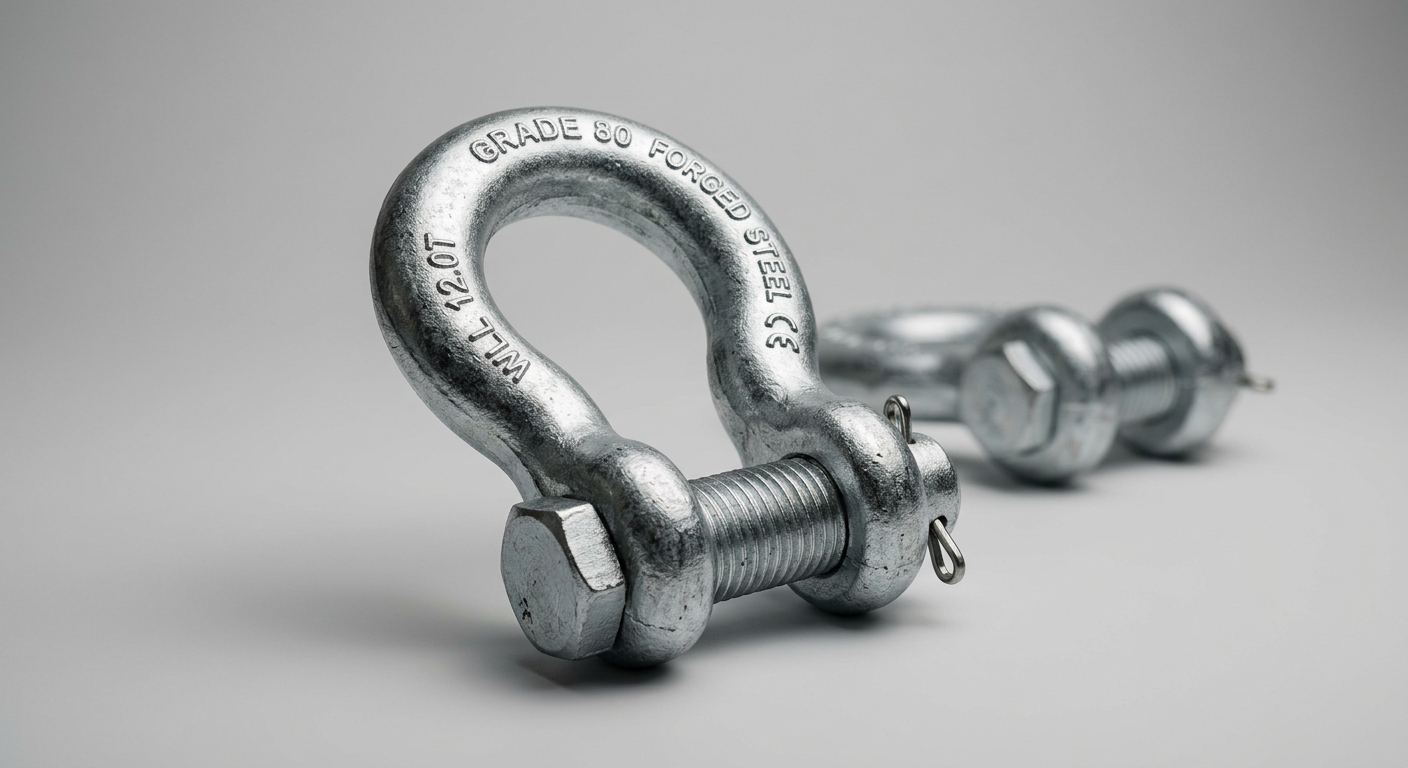
Every compliant bow shackle carries stamped or embossed markings that communicate its load rating and manufacturing traceability. Understanding these markings is the first line of defense against overloading.
The Working Load Limit (WLL) is typically expressed in metric tons and stamped directly onto the bow body. On forged alloy shackles, you will also find a grade code — commonly “6” for Grade 6 (carbon steel) or “8” for Grade 8 (alloy steel) — which directly correlates to the safety factor applied during design. Grade 8 shackles, for example, carry a minimum safety factor of 4:1 against the minimum breaking load (MBL).
Third-party certification marks are equally important. CE marking indicates conformity with EU Machinery Directive 2006/42/EC and compliance with EN 13889. For North American markets, look for compliance with ASME B30.26, which governs rigging hardware performance and marking requirements. Shackles without traceable certification should be rejected at the procurement stage, regardless of price advantage.
Key verification steps at goods receipt:
- Confirm WLL stamp matches the purchase specification
- Cross-reference the manufacturer’s test certificate (material cert, proof load test)
- Verify CE or third-party certification mark is legible and permanent
- Check that the pin and bow carry matching lot or batch identifiers
1.2 Common Causes of Rated Capacity Misapplication
Even correctly marked shackles are routinely overloaded through misapplication. The most frequent errors include:
Dynamic load factor neglect: WLL ratings apply to static loads. Shock loading, sudden starts, or load swing can multiply actual forces by 1.5× to 3× or more. A 3-tonne WLL shackle subjected to a 2× dynamic factor under a 2.5-tonne load is effectively loaded beyond its rated limit.
Multi-leg sling angle reduction: When a bow shackle connects multiple sling legs, the included angle between legs directly increases the tension per leg. At a 120° included angle, each leg carries the full load — eliminating the load-sharing benefit entirely. Many operators fail to apply the appropriate angle correction factor.
Environmental derating: Elevated temperatures above 200°C reduce alloy steel strength progressively. Corrosive environments (marine, chemical processing) accelerate surface degradation and may require a conservative derating of 10–25% on nominal WLL.
| Shackle Size (mm) | WLL (t) | MBL (t) | Compatible Rope Diameter (mm) | Standard |
|---|---|---|---|---|
| 13 | 2.0 | 8.0 | 10–13 | EN 13889 |
| 16 | 3.2 | 12.8 | 13–16 | EN 13889 |
| 20 | 5.0 | 20.0 | 16–20 | EN 13889 / ASME B30.26 |
| 25 | 8.5 | 34.0 | 20–26 | EN 13889 / ASME B30.26 |
| 32 | 13.5 | 54.0 | 26–32 | ASME B30.26 |
2. Load Alignment and Side Loading Risks
2.1 Principles of In-Line Load Application
Bow shackles are engineered to carry loads along their primary axis — meaning the load should travel in a straight line through the center of the pin and down through the crown of the bow. This axial alignment ensures that stress is distributed symmetrically across the bow cross-section and that the pin remains in pure shear rather than combined bending and shear.
In practice, achieving true axial alignment requires attention to both the attachment point geometry and the rigging configuration. The pin must be fully seated and the bow must hang vertically relative to the load vector. Any angular offset introduces bending moments that the shackle body is not designed to sustain at full WLL.
For anchor point connections, ensure that the shackle pin axis is perpendicular to the load direction. When connecting to a master link or lifting beam, confirm that the bow is free to rotate and self-align under load rather than being constrained in a cocked position.
2.2 Identifying and Mitigating Side Loading Scenarios
Side loading — where the load vector acts perpendicular to the pin axis or at an angle across the bow — is among the most dangerous and underappreciated misuse scenarios. Under side loading conditions, the effective WLL of a standard bow shackle can be reduced by up to 50%, as the bow is subjected to asymmetric bending stress it was not designed to handle.
Common side loading triggers include:
- Connecting to a horizontal beam where the shackle cannot self-align
- Multi-point lifts where geometry forces the bow to rotate sideways
- Dragging operations where lateral forces are applied continuously
Mitigation strategies:
- Limit included sling angles to ≤120° at the shackle connection point
- Use swivel shackles when rotation or angular loading is unavoidable — these incorporate a rotating head that maintains axial loading regardless of load direction
- Install a dee shackle (chain shackle) for straight-line pulls where the narrower body reduces lateral play
- Document and review any lift plan where the shackle cannot be confirmed to hang freely and align axially
When side loading cannot be eliminated by rigging redesign, select a shackle with a WLL at least 2× the calculated load to compensate for the reduction in effective capacity.
3. Inspection Criteria: Wear, Deformation, and Fatigue
3.1 Visual and Dimensional Inspection Standards
A bow shackle that has been in service must be inspected systematically before each use and formally at defined intervals. Visual inspection alone is insufficient for critical lifts; dimensional measurement is required to confirm the shackle remains within serviceable limits.
Wear threshold: EN 13889 and LEEA guidelines specify that a shackle should be removed from service when any cross-sectional dimension has been reduced by 10% or more from the nominal dimension. This applies to both the bow body and the pin diameter. Use vernier calipers or a dedicated wear gauge to measure the crown, both bow legs at the pin entry points, and the pin shank.
Deformation assessment: Any visible bending, twisting, or elongation of the bow body constitutes a discard condition. Measure the internal width of the bow at the crown and compare against the manufacturer’s nominal dimension — elongation exceeding 5% is a rejection criterion under most standards. Similarly, pin thread damage, cross-threading, or corrosion pitting that compromises thread engagement depth requires immediate removal.
Crack detection: For shackles operating in fatigue-intensive applications (repeated lifts, vibration environments), magnetic particle inspection (MPI) or dye penetrant testing (DPT) should be applied at annual formal inspections to detect subsurface cracking.
3.2 Inspection Frequency and Discard Criteria
Inspection frequency must be calibrated to operational intensity:
| Inspection Type | Frequency | Authority |
|---|---|---|
| Pre-use visual check | Before every lift | OSHA 1926.251 / EN 13889 |
| Periodic formal inspection | Every 6–12 months | LEEA / LOLER (UK) |
| Thorough examination | After shock load event | ASME B30.26 |
| Full dimensional inspection | Annually (minimum) | EN 13889 |
Non-conforming shackles must be physically segregated from serviceable stock — marking with paint, tagging with a “Do Not Use” label, and logging in the equipment register before disposal. Never return a condemned shackle to the tool store, even temporarily.
Fatigue cycle records should be maintained for shackles in high-frequency applications. While standard forged shackles do not carry a fixed cycle life, documented load history supports risk-based inspection decisions and supports liability management in the event of an incident.
4. Operational Best Practices for Overload Prevention
4.1 Pre-Lift Checklist for Shackle Selection and Rigging
Preventing overload begins before the shackle is attached to the load. A structured pre-lift checklist eliminates the most common selection and rigging errors:
- Load calculation verified: Confirm gross load weight including below-hook equipment, dynamic factors applied
- Shackle WLL confirmed ≥ calculated rigging load with appropriate safety margin
- Pin fully threaded and moused: The pin must be screwed in until the shoulder seats against the bow, then secured with a cotter pin (split pin) or mousing wire through the pin hole — this prevents unscrewing under vibration or load rotation
- Bow orientation correct: The load-bearing point (sling, chain, wire rope) should bear on the bow crown, not the pin
- No visible damage: Confirm pre-use visual check completed and documented
4.2 Training and Compliance Requirements for Rigging Personnel
Operational compliance depends on trained personnel who understand both the mechanical principles and the regulatory framework. Rigging personnel should hold recognized qualifications — ASME B30.26 awareness training for North American operations, or LEEA/OPITO-accredited rigging certification for international and offshore environments.
Supervisory responsibilities include verifying that lift plans specify shackle type, size, and WLL; that personnel performing rigging are competent and current in their certification; and that incident reporting procedures capture near-misses involving hardware deformation or unexpected load events. Traceability records — linking each shackle’s serial number to its inspection history and lift log — are increasingly required under ISO 9001-aligned quality management systems and are essential for post-incident investigation.
Часто задаваемые вопросы
Q1: What is the maximum allowable side load percentage for a standard bow shackle, and when should a swivel shackle be used instead?
Standard bow shackles should not be subjected to side loads exceeding 50% of their rated WLL, and most manufacturers recommend avoiding side loading entirely in critical applications. A swivel shackle should be specified whenever the load direction cannot be guaranteed to remain axial — particularly in multi-leg lifts with variable geometry, rotating loads, or horizontal beam connections where the shackle cannot self-align freely.
Q2: How do environmental factors such as corrosion, extreme temperature, or chemical exposure affect a bow shackle’s WLL rating?
Corrosion reduces the effective cross-section of the bow and pin, directly lowering load capacity and accelerating fatigue crack initiation. Temperatures above 200°C require progressive WLL derating — consult the manufacturer’s derating curve. Chemical environments (acids, chlorides, hydrogen sulfide) may cause stress corrosion cracking in alloy steel shackles; in such applications, stainless steel or hot-dip galvanized variants with adjusted WLL ratings should be specified.
Q3: What are the mandatory discard criteria for bow shackles under EN 13889 and ASME B30.26 standards?
Under EN 13889, discard is mandatory when: cross-sectional wear exceeds 10% of nominal dimension; bow elongation exceeds 5%; cracks, deformation, or pin thread damage are detected; or certification markings are illegible. ASME B30.26 adds discard criteria for evidence of heat damage, corrosion that reduces load-bearing area, and any shackle that has been subjected to a load exceeding its WLL.
Заключение
Preventing bow shackle overloading is not a single intervention — it is a system of overlapping controls spanning procurement, rigging design, pre-use inspection, and personnel competency. Correctly reading and applying WLL markings eliminates misspecification at the source. Enforcing axial load alignment and controlling side loading scenarios preserves the shackle’s designed load path. Systematic wear and deformation inspection against EN 13889 and ASME B30.26 thresholds removes compromised hardware before failure occurs. And structured training ensures that every person in the rigging chain understands both the mechanical limits and the regulatory obligations that govern bow shackle use.
For procurement teams, the commercial implication is clear: specifying certified, traceable bow shackles from manufacturers who provide full documentation — material certificates, proof load test records, and third-party conformity assessments — is not a cost overhead. It is the foundation of a defensible, audit-ready lifting safety program that protects both personnel and assets.