

Resumo
The question of whether a grommet sling can replace a standard eye sling is not a matter of one being universally superior—it is a procurement decision rooted in load geometry, rigging configuration, and operational workflow. For rigging engineers and heavy-lift project managers, selecting the wrong sling type introduces risk at the termination point, the contact surface, and the compliance audit.
This article provides a structured technical comparison between Endless Grommet Wire Rope Slings and Standard Eye Slings, evaluating both against criteria that matter in real crane operations and heavy equipment transport: construction mechanics, working load limits, D/d ratio sensitivity, applicable regulatory standards, and total lifecycle cost. The findings indicate that grommet slings offer distinct, quantifiable advantages in specific high-demand applications—particularly where load symmetry, contact surface area, and multi-configuration rigging flexibility are critical. Standard eye slings, however, retain clear operational advantages in fixed-attachment, rapid-deployment scenarios. Understanding precisely where each excels is the foundation of a defensible rigging specification.
1. Structural Differences: How Grommet Slings and Standard Eye Slings Are Built
1.1 Construction Mechanics of Endless Grommet Wire Rope Slings
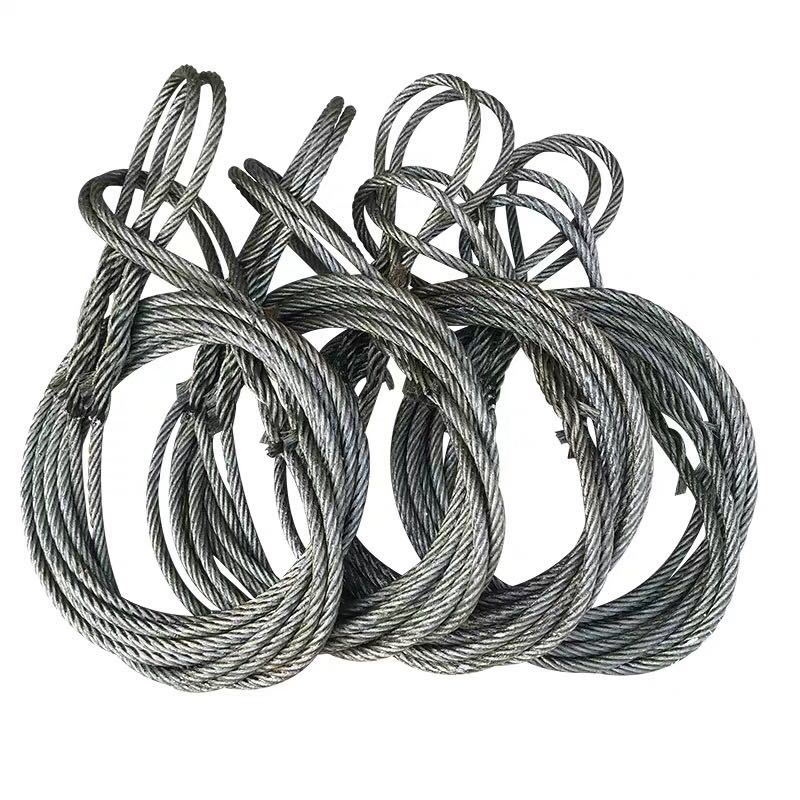
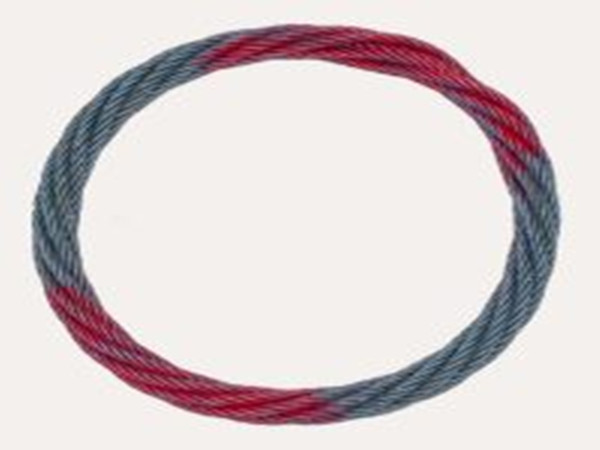
An endless grommet wire rope sling is manufactured from a single continuous-loop strand of wire rope, hand-tucked and laid helically around a core to form a closed, seamless body. This construction eliminates termination points. Because the strand runs continuously without interruption, load is distributed across the full circumference of the sling body rather than concentrated at a single end fitting.
This uniform load distribution is the defining structural advantage of the grommet design. Under tension, every wire in the cross-section contributes proportionally to load-bearing capacity. The absence of swaged ferrules or mechanical eyes means there is no localized stress riser—the failure mode most commonly associated with fatigue fractures in conventional slings. For applications involving repeated loading cycles or dynamic shock loads, this translates directly into extended service life.
Grommet slings also exhibit superior flexibility relative to their diameter. The helical, continuous-strand geometry allows the sling body to conform to irregular load profiles, sharp edges (with appropriate edge protection), and curved contact surfaces without introducing bending-induced wire breakage at a fixed termination zone.
1.2 Termination Design and Load Path in Standard Eye Slings
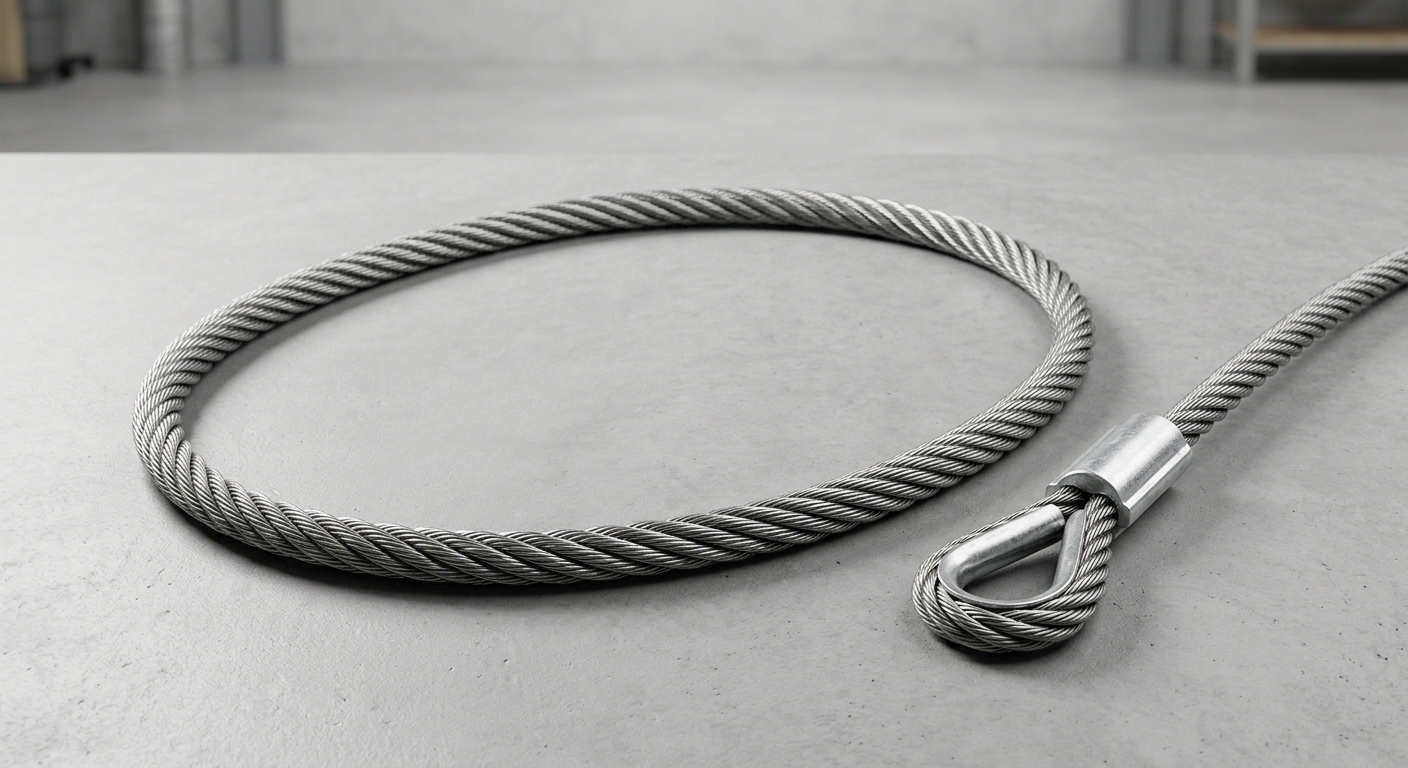
Standard eye slings are constructed with a defined directional load path: wire rope body, terminated at each end with a formed eye secured by a swaged ferrule, mechanical splice, or flemish eye. This design is optimized for linear tension between two fixed attachment points—hook to hook, or hook to load shackle.
The termination method introduces a stress concentration zone at the eye-to-body transition. Under cyclic loading, this is the region most susceptible to fatigue cracking. Swaged terminations, while highly efficient in static WLL, are sensitive to angular loading beyond their rated alignment tolerance. Misaligned loading accelerates wear at the ferrule shoulder and reduces effective service life.
That said, the directional load path is also an operational asset. Standard eye slings are dimensionally predictable, easy to inspect at the termination points, and compatible with a wide range of hook and shackle hardware without requiring additional rigging components.
Specification Comparison: Grommet Sling vs. Standard Eye Sling
| Parameter | Endless Grommet Wire Rope Sling | Standard Eye Wire Rope Sling |
|---|---|---|
| Construction Type | Continuous single-strand loop | Multi-wire rope with formed eyes |
| Método de Terminação | None (seamless) | Swaged ferrule / Flemish eye |
| WLL Range (typical) | 1.0 – 500+ tonnes | 0.5 – 300+ tonnes |
| Flexibility Rating | High | Medium |
| D/d Ratio Requirement | ≥ 10:1 (body to wire) | ≥ 10:1 (at saddle) |
| Load Distribution | 360° uniform | Linear/directional |
| Inspection Focus | Wire breaks, distortion | Eye termination, ferrule integrity |
| Typical Weight per Meter | Higher (multi-strand body) | Lower (single rope body) |
2. Performance Benchmarks: Where Each Sling Type Excels
2.1 Load Capacity, D/d Ratio, and Fatigue Life Comparison
Working load limits for grommet slings are calculated based on the aggregate cross-sectional wire area of the continuous loop. Because the strand body effectively doubles back on itself, a grommet sling of a given nominal diameter can achieve a higher WLL than a single-body eye sling of equivalent rope diameter—provided the D/d ratio (the ratio of the fitting or load radius to the wire rope diameter) is maintained above the minimum threshold of 10:1.
D/d ratio compliance is critical for both sling types, but grommet slings are more sensitive to tight-radius bending over sharp-edged hardware. When the bending radius falls below the minimum, wire breakage initiates at the outer arc of the bend. Edge protection—corner pads, softeners, or radius saddles—is therefore non-negotiable in basket hitch configurations around structural steel flanges or machinery housings.
Fatigue life testing consistently demonstrates that grommet slings outperform eye slings in high-cycle applications. The absence of stress-concentrating terminations means crack initiation is deferred, and wire breaks, when they occur, are distributed across the body rather than localized at a single zone.
2.2 Rigging Configuration Versatility
Grommet slings are inherently multi-configuration tools. Their endless loop geometry supports:
- Vertical hitch: Loop through the hook with the load suspended from the body
- Basket hitch: Load cradled in the loop, both legs to the hook—WLL doubles relative to vertical
- Choker hitch: Loop passed through itself around the load—WLL reduces to approximately 75–80% of vertical rating
Standard eye slings offer the same three configurations, but the eye terminations constrain the choker geometry. Wrapping a choker with a standard eye sling places bending stress directly at the ferrule shoulder. Grommet slings, lacking this constraint, allow the choker choke point to migrate to the most geometrically favorable position along the body, reducing peak stress concentration.
For multi-leg crane lifts, grommet slings can be paired with master links or equalizing beams to create balanced four-point rigging arrangements without requiring additional hardware at each attachment.
3. Compliance, Standards & Safety Considerations
3.1 Applicable Standards: ASME B30.9, EN 13414, and ISO 2408
Both sling types are governed by overlapping but distinct sections of international rigging standards. In North American markets, ASME B30.9 (Slings) provides the primary compliance framework, covering WLL calculation methods, proof load requirements (typically 2× WLL), and marking requirements. Grommet slings fall under the wire rope sling provisions of B30.9, with specific guidance on endless sling configurations.
In European and offshore markets, EN 13414-1 governs steel wire rope slings, with Part 2 addressing grommets and endless slings specifically. ISO 2408 defines the underlying wire rope construction standards that both sling families must reference for material certification.
For offshore crane operations—where DNV-ST-E271 or equivalent class society approval may be required—both sling types can achieve certification, but documentation requirements differ. Grommet slings require certification of the strand lay, tuck count, and proof load test certificate. Procurement teams should confirm that suppliers provide traceable mill certificates and third-party test documentation as standard deliverables.
3.2 Inspection Criteria and Discard Conditions
Inspection protocols differ meaningfully between sling types:
Grommet Slings — Discard Conditions:
- Broken wire count exceeding 4 randomly distributed wires in any 30× body diameter length
- Core exposure or strand separation visible at any point
- Kinking, bird-caging, or permanent deformation exceeding 10% of nominal diameter
- Corrosion reducing effective wire cross-section
Standard Eye Slings — Discard Conditions:
- Broken wires at or near the ferrule/eye transition (lower threshold: 2 broken wires in the termination zone)
- Ferrule cracking, slippage, or deformation
- Eye elongation exceeding 5% of nominal eye length
- Rope body criteria identical to grommet sling above
The grommet sling’s distributed body makes visual inspection more labor-intensive—the full loop circumference must be examined. Standard eye slings concentrate inspection effort at the termination points, making go/no-go decisions faster in field conditions.
4. Application Scenarios: Crane Operations & Heavy Equipment Transport
4.1 Grommet Sling Advantages in Crane Lifts and Precision Rigging
In crane operations involving irregular or asymmetric loads—turbine casings, pressure vessels, large fabricated assemblies—the grommet sling’s 360° contact surface provides a critical advantage. The continuous loop conforms to the load profile, distributing contact pressure evenly and reducing the risk of localized surface damage or load rotation during the lift.
Load rotation resistance is particularly valuable in precision rigging where angular displacement during the lift can cause collision with adjacent structures or misalignment at the set-down point. The grommet sling’s symmetric geometry, combined with proper tag-line management, provides inherently stable lift dynamics.
For heavy equipment transport—skidding, tandem lifts, or transferring loads between cranes—grommet slings can be configured rapidly into basket or multi-leg arrangements without swapping hardware, reducing rigging time and minimizing crane hook-to-hook cycle duration.
4.2 When Standard Eye Slings Remain the Preferred Choice
Standard eye slings retain clear operational superiority in applications requiring fixed attachment points and rapid deployment. Where loads have engineered lift points—pad eyes, trunnions, or certified lifting lugs—the eye sling connects directly to the shackle at the lift point with dimensional predictability and minimal rigging complexity.
In production environments where slings are deployed and recovered multiple times per shift, the eye sling’s defined geometry accelerates inspection and replacement decisions. Hook compatibility is straightforward; there is no ambiguity about load path orientation.
For vertical single-leg lifts of uniform loads with certified lift points, the standard eye sling remains the most cost-efficient and operationally simple solution. The grommet sling’s advantages are not relevant in this scenario and do not justify the additional unit cost.
Perguntas frequentes
Q1: Can a Grommet Sling achieve the same Working Load Limit as a Standard Eye Sling of the same wire rope diameter?
Yes—and in most configurations, it exceeds it. Because the grommet’s continuous strand effectively doubles the load-bearing cross-section at any given point in the loop, the WLL for a vertical hitch is typically higher than that of a single-body eye sling of equivalent rope diameter. In a basket hitch configuration, the WLL advantage is further amplified.
Q2: Are Endless Grommet Wire Rope Slings compliant with offshore and heavy-lift crane certification requirements?
Yes, provided they are manufactured and documented to the applicable standard (EN 13414-2 for European/offshore markets; ASME B30.9 for North American projects). Offshore certification additionally requires class society-approved proof load testing and traceable material certification. Confirm supplier documentation scope before procurement.
Q3: What are the total cost-of-ownership differences between Grommet Slings and Standard Eye Slings over a project lifecycle?
Grommet slings carry a higher initial unit cost due to construction complexity. However, their extended fatigue life in high-cycle applications and multi-configuration versatility reduce replacement frequency and hardware inventory requirements. For long-duration heavy-lift projects or repeated crane operations, the total cost-of-ownership typically favors the grommet sling. For short-duration or single-configuration work, the standard eye sling offers lower upfront cost with acceptable lifecycle performance.
Conclusão
The answer to whether a grommet sling can replace a standard sling is conditional—and that conditionality is the core procurement insight. Endless Grommet Wire Rope Slings deliver measurable advantages in load distribution uniformity, fatigue resistance, rigging configuration flexibility, and performance under dynamic or irregular load conditions. These advantages are most consequential in crane operations involving complex load profiles, multi-leg rigging arrangements, and high-cycle heavy equipment transport workflows.
Standard eye slings retain their position as the operationally optimal choice for fixed-attachment, single-configuration, rapid-deployment scenarios where their directional load path and straightforward inspection protocol align precisely with the task demands.
The defensible procurement decision is not a binary replacement—it is a specification that assigns each sling type to the application where its structural design delivers the greatest performance and compliance value. Rigging engineers who understand this distinction will specify with greater precision, reduce lifecycle risk, and optimize total cost across the project portfolio.