

Resumo
Bow Shackle systems are widely used in construction, marine, oil and gas, and heavy manufacturing sectors. However, incorrect selection, installation, and handling can lead to dropped loads, equipment damage, project delays, and serious safety risks.
This guide covers five common Bow Shackle rigging mistakes, explaining their technical causes, applicable standards, and corrective practices. Designed for procurement managers, rigging supervisors, and safety professionals, it provides a practical framework for improving lifting safety, reducing preventable failures, and supporting compliant rigging operations.
1. Why Bow Shackle Rigging Errors Are More Costly Than They Appear
1.1 The Real-World Consequences of Bow Shackle Failures
The visible cost of a bow shackle rigging failure — such as a damaged crane hook, deformed shackle body, or dropped load — represents only a small portion of the total operational impact. The actual consequences may include emergency equipment replacement, unexpected project downtime costing tens of thousands of dollars per day in heavy industries, third-party property damage claims, and worker compensation liabilities.
In high-risk environments such as offshore platforms, shipyards, and steel erection projects, a single lifting failure involving a bow shackle can trigger regulatory investigations, mandatory shutdowns, and reputational damage that affects future contract opportunities.
The challenge is that bow shackle failures rarely provide obvious warning signs before a critical event occurs. Overloaded shackles may gradually deform before fracture, while improperly secured pins can loosen after repeated loading cycles. These failure modes often remain unnoticed until they result in catastrophic consequences. Therefore, proactive selection, correct installation, and scheduled inspection of Bow Shackle systems are essential for preventing avoidable rigging incidents.
1.2 Industry Standards You Cannot Afford to Ignore
Two major international standards define the design, testing, marking, and safe use requirements for Bow Shackle products in industrial lifting applications:
ASME B30.26 (United States): Covers rigging hardware including shackles, requiring proof load testing, Working Load Limit (WLL) marking, and product traceability. Using non-compliant Bow Shackles on OSHA-regulated worksites may create significant safety and legal risks.
EN 13889 (European Union): Specifies requirements for forged steel shackles used in general lifting operations, including dimensional tolerances, mechanical properties, marking, and certification requirements. CE-marked Bow Shackles must comply with this standard.
Both standards emphasize the same principle: the Working Load Limit (WLL) marked on a Bow Shackle is valid only under the specific loading conditions for which it was designed. Angular loading, shock loading, and side loading can significantly reduce the effective capacity of the shackle.
For procurement teams, selecting Bow Shackles based only on catalog WLL values without evaluating actual application factors — including sling angles, load direction, and operating environment — can result in unsafe specifications and compliance risks.
2. The 5 Most Critical Bow Shackle Rigging Mistakes
2.1 Mistakes #1–#3: Selection and Load Errors
Mistake #1: Substituting Bow Shackles for D-Shackles (or Vice Versa)
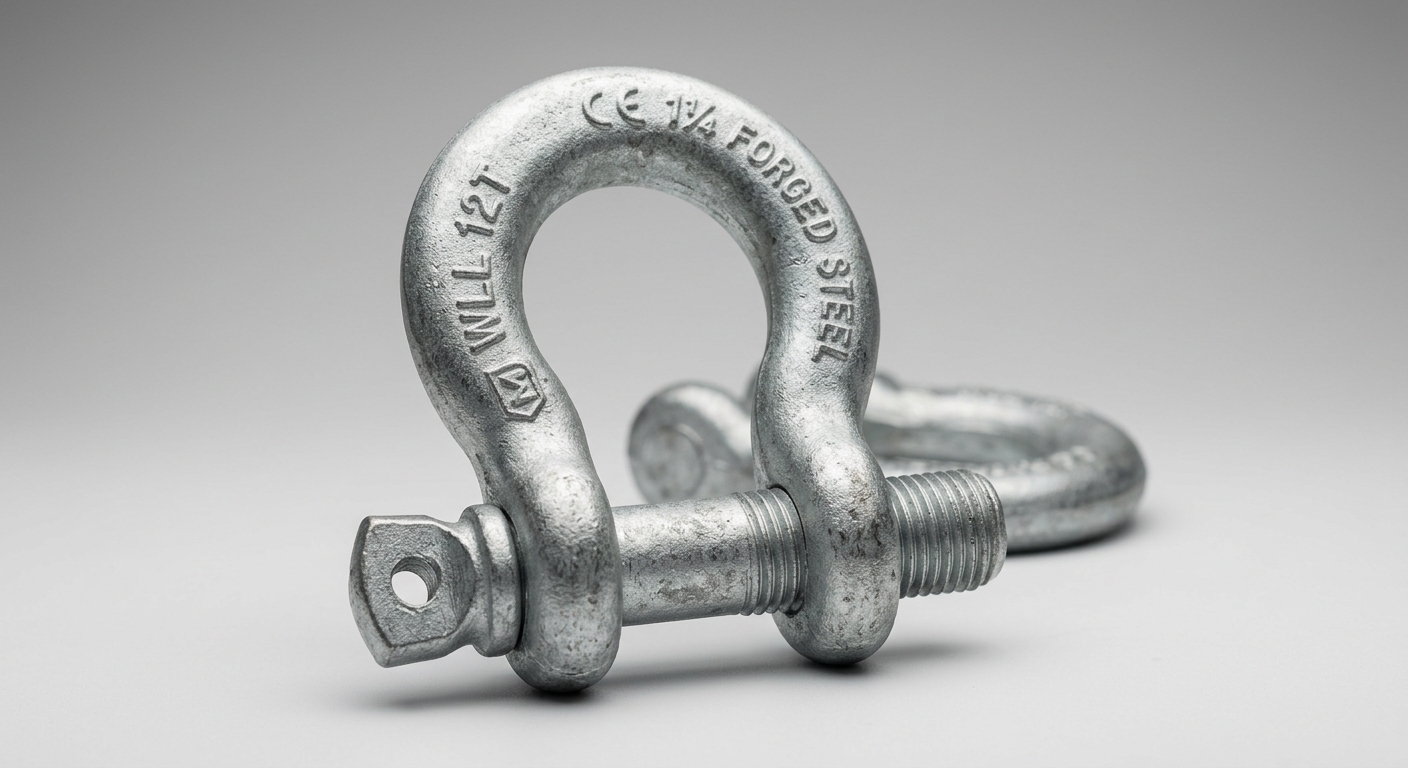
Bow Shackles, also known as anchor shackles, feature a wide rounded bow design that provides additional clearance for multi-leg slings, eye fittings, and loads with changing directional forces. In comparison, D-shackles (chain shackles) have a narrower body designed primarily for straight, in-line loading applications.
Using a D-shackle in a multi-point or angular rigging configuration can concentrate excessive stress on the shackle side walls, which are not designed to withstand these loading conditions. Conversely, using a Bow Shackle where the compact geometry of a D-shackle is required may introduce unnecessary movement and reduce connection stability.
The correct approach is to match Bow Shackle geometry with the actual load configuration. Selecting the wrong shackle type can create hidden stress points that compromise lifting safety even when the rated WLL appears sufficient.
Mistake #2: Ignoring WLL Reduction Under Angular Loading
A Bow Shackle rated at 4.75 tonnes Working Load Limit (WLL) at 0° in-line loading does not maintain the same capacity when used in angled sling configurations. As the included angle between sling legs increases, the load applied to each connection point changes and the effective WLL decreases.
For example, at a 60° included angle (30° from vertical per sling leg), the Bow Shackle capacity is reduced to approximately 86% of the marked WLL. At a 120° included angle, the available capacity may decrease to around 50%.
A common rigging mistake is applying the catalog WLL directly to multi-leg lifting arrangements without calculating the appropriate angle factor. This practice can unintentionally overload Bow Shackles during routine lifting operations and significantly increase failure risk.
Mistake #3: Allowing Side Loading on the Shackle Body
Bow Shackles are engineered to carry loads along their primary load axis — through the pin and the bow section. Applying lateral forces perpendicular to this axis can significantly reduce structural performance, causing stress concentration, permanent deformation, and potential shackle failure.
Side loading commonly occurs when a Bow Shackle is used as a pivot point, when a sling shifts during lifting, or when the shackle is incorrectly positioned in a multi-point rigging arrangement. Under these conditions, the applied forces are transferred through areas that were not designed for primary load bearing.
To prevent side loading, operators should maintain proper shackle alignment throughout the lifting cycle or use suitable alternatives such as swivel hoist rings when rotational movement is required. Proper orientation ensures that the Bow Shackle performs within its certified load capacity and intended design parameters.
| Mistake | Trigger Scenario | Risk Level | WLL Impact | Standard Reference |
|---|---|---|---|---|
| #1: Wrong shackle type | Multi-leg load on D-shackle | High | Structural overload | ASME B30.26 / EN 13889 |
| #2: Ignoring angle factor | Multi-leg sling at wide included angle | Critical | Up to –50% WLL | ASME B30.26 §26-2.2 |
| #3: Side loading | Shackle used as pivot or misaligned | High | Up to –50% WLL | EN 13889 §6.3 |
| #4: Loose or missing pin lock | Vibration, repeated load cycles | Critical | Complete loss of connection | ASME B30.26 §26-3.1 |
| #5: No periodic inspection | Aging fleet, corrosive environments | High | Undetected degradation | EN 13889 §8 / OSHA 1926.251 |
2.2 Mistakes #4–#5: Installation and Inspection Failures
Mistake #4: Improperly Secured Pins
Proper pin installation is critical to maintaining the connection integrity of Bow Shackles during lifting operations. The screw pin must be fully threaded into the shackle body and then backed off approximately one quarter-turn to prevent thread seizure under load conditions. However, the pin must still be protected against unintended rotation during operation.
For screw pin Bow Shackles used in environments involving vibration, shock loading, or repeated dynamic movement, a mousing wire installed through the pin hole and secured around the bow is required to prevent accidental loosening. Bolt-type Bow Shackles require the nut to be tightened according to the manufacturer’s specified torque value and secured with a cotter pin through the bolt.
Failure to install the required locking device — such as missing cotter pins or mousing wire — remains one of the most common causes of in-service pin ejection. Once the pin disengages, the Bow Shackle connection can fail immediately, resulting in uncontrolled load release and serious workplace safety risks.
Mistake #5: Neglecting Scheduled Inspection and Retirement Criteria
Unlike consumable components, Bow Shackles do not have a fixed expiration date. However, repeated loading cycles, corrosion exposure, and mechanical wear gradually reduce their structural reliability. Regular inspection is therefore essential to identify damage before it develops into a critical lifting failure.
According to EN 13889 and ASME B30.26 requirements, Bow Shackles should be removed from service when any of the following conditions are identified: visible cracks or fractures, wear exceeding 10% of the original cross-sectional dimension, deformation of the bow or pin, corrosion pitting that reduces load-bearing capacity, or missing and illegible Working Load Limit (WLL) markings.
Many industrial operations continue using Bow Shackles without documented inspection schedules or retirement procedures, creating hidden safety risks and compliance gaps frequently identified during professional audits. Establishing a structured inspection program ensures that damaged shackles are removed before they compromise lifting operations.
3. How to Use Bow Shackles Correctly: A Step-by-Step Safety Protocol
3.1 Proper Selection Criteria for Industrial Applications
Correct bow shackle selection requires matching three variables to the application:
- Load type and geometry: Dynamic or shock loads require a design factor of 5:1 (WLL = MBL ÷ 5) minimum. Multi-leg configurations require angular load factor calculations before specifying WLL.
- Material grade: Alloy steel bow shackles (Grade 6 or Grade 8) are standard for heavy industrial lifting. For marine, food processing, or chemical environments, Grade 316 stainless steel shackles resist chloride corrosion and product contamination. Note that stainless steel shackles typically carry lower WLL ratings than equivalent-size alloy steel units.
- Operating temperature: Standard alloy steel shackles are rated for –40°C to +200°C. Applications outside this range require material certification for low-temperature toughness (e.g., Charpy impact test results) or high-temperature creep resistance.
3.2 Installation, Torque, and Pre-Use Inspection Checklist
Before every lift, verify the following:
- WLL marking is legible and matches or exceeds the calculated load requirement including angle factors.
- Pin is fully engaged — all threads are seated, with no cross-threading.
- Pin security device is in place — mousing wire for screw pins in dynamic applications; cotter pin for bolt-type shackles.
- Bow is oriented correctly — the load bears on the bow, not the pin; the bow is not side-loaded.
- No visible damage — inspect for cracks, corrosion, deformation, or wear on bow, pin, and thread engagement zone.
- Shackle is from a traceable lot — confirm manufacturer identification and batch/heat number are present for audit compliance.
4. Sourcing Bow Shackles That Meet Safety and Compliance Requirements
4.1 Key Specifications Procurement Teams Must Verify
Purchasing decisions based solely on price or catalog WLL values expose organizations to significant compliance and liability risk. Procurement teams should require the following from suppliers:
- Forging process certification: Drop-forged alloy steel construction eliminates the porosity and inconsistent grain structure associated with cast shackles. Request material mill certificates confirming chemical composition and mechanical properties (yield strength, tensile strength, elongation).
- Third-party test reports: Proof load test certificates (typically 2× WLL) from an accredited laboratory confirm that individual production batches meet rated capacity. CE marking under EN 13889 or compliance documentation referencing ASME B30.26 should be standard deliverables, not optional extras.
- Batch traceability system: Each shackle should carry a heat number or batch code that links back to material certificates and test records. This is non-negotiable for ISO 9001-certified operations and is increasingly required by end-user audit protocols in oil and gas and construction sectors.
- Surface treatment specification: Hot-dip galvanizing or electroplating provides corrosion protection for outdoor and marine applications. Verify that the coating process does not introduce hydrogen embrittlement risk in high-strength alloy steel components.
Perguntas frequentes
Q1: What is the difference between a bow shackle and a D-shackle, and when should each be used in rigging?
A bow shackle has a wide, rounded body that distributes load across a broader contact area, making it suitable for multi-leg slings, eye-to-eye connections, and applications where the load direction may vary. A D-shackle has a narrower, more compact body optimized for straight, in-line loads. Use bow shackles when connecting multiple sling legs or when lateral load movement is possible; use D-shackles for direct, single-direction connections where compactness is required.
Q2: How do I calculate the correct WLL for a bow shackle under angular or multi-leg loading?
Multiply the catalog WLL by the appropriate angle factor. For a two-leg sling: at 0° included angle, factor = 1.0; at 60°, factor ≈ 0.866; at 90°, factor ≈ 0.707; at 120°, factor = 0.5. Always design to the reduced WLL, not the catalog value. For dynamic or shock loading, apply an additional design factor per your applicable standard.
Q3: What are the mandatory inspection intervals and rejection criteria under ASME or EN standards?
ASME B30.26 requires inspection before each use (visual) and periodic formal inspection at intervals determined by frequency of use and operating conditions — typically quarterly for heavy-use applications. EN 13889 aligns with this approach. Rejection criteria include: cracks, deformation, wear >10% of original section, corrosion pitting, illegible markings, or any pin that does not seat and secure correctly.