

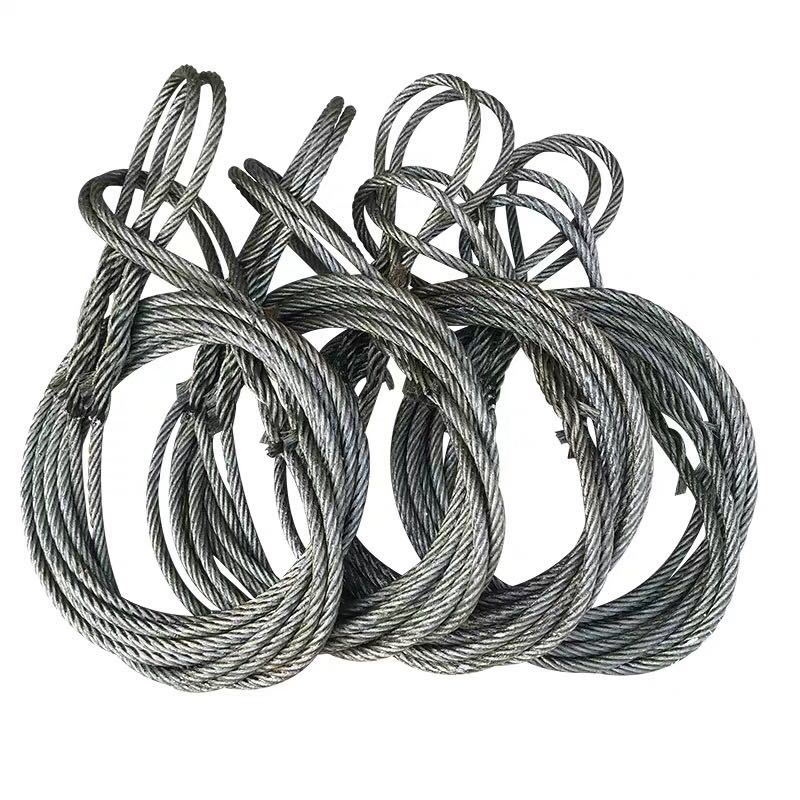
Procurement teams often treat grommet slings as commodity items—specifying diameter and working load limit, then selecting the lowest-cost supplier. This approach consistently produces higher total costs through accelerated replacement cycles, unplanned downtime, and increased inspection overhead. The reality is that two wire rope grommet slings with identical diameter and rated capacity can differ by a factor of three or more in actual service life, depending on construction, material, coating, and how they are rigged and maintained. Understanding which variables drive longevity—and which are cosmetic—is the foundation of a defensible procurement specification.
This article examines the engineering, material, and operational factors that determine grommet sling lifespan. It is written for rigging engineers, procurement managers, and HSE professionals who need to make specification decisions that reduce replacement frequency, minimize downtime, and lower total cost of ownership across multi-year operational cycles.
The Anatomy of a Grommet Sling and Why Construction Determines Longevity
Wire Rope Grade, Lay Type, and Core Configuration
The wire rope used to form a grommet sling is not a single variable—it is a combination of strand construction, rope grade, and core type, each of which independently affects fatigue resistance and crush load tolerance.
Strand construction governs flexibility and contact surface area. A 6×19 construction (six strands of 19 wires each) provides a larger individual wire diameter, which resists abrasion more effectively in high-contact applications. A 6×37 construction uses finer wires, delivering greater flexibility and superior fatigue resistance under repeated bending—making it the preferred choice for applications with tight D/d ratios or frequent load cycles.
Rope grade determines tensile strength at the wire level. The three commercial grades—IPS (Improved Plow Steel), EIP (Extra Improved Plow Steel), and EEIP (Extra Extra Improved Plow Steel)—represent increasing tensile strength tiers. Specifying EIP or EEIP over IPS for a given diameter allows a smaller, lighter sling to meet the same WLL, but more importantly, the higher-grade wire sustains more fatigue cycles before reaching discard criteria.
Core configuration is frequently underestimated. An Independent Wire Rope Core (IWRC) provides internal support under radial compression loads, which is critical in choker and basket hitches where the sling body contacts load edges. A fiber core (FC) compresses more readily under crush loading, accelerating internal wire fatigue in high-cycle applications. For heavy industrial use, IWRC is the technically correct specification.
The Endless-Loop Splice — Where Most Failures Begin
A grommet sling is formed by splicing a single wire rope length into a continuous loop. The tuck splice is the mechanical heart of the assembly—and the zone where manufacturing quality most directly determines service life.
A properly executed splice requires a minimum number of tucks (typically five full tucks per strand under EN 13414-2), with uniform tension distribution across all tucked strands. Suppliers who reduce tuck count to accelerate production create splice zones with uneven load transfer, where individual strands carry disproportionate tension during load cycles. This produces progressive strand failure that begins at the splice and propagates under normal working loads.
Buyers should require documented splice procedures and proof load test certificates for each batch. Visual inspection of the splice zone before first use—checking for protruding wire ends, uneven strand seating, and sleeve deformation—is a practical first-line quality check that costs nothing.
Material and Coating Variables That Buyers Frequently Overlook
Galvanized vs. Stainless vs. Ungalvanized Wire Rope
Surface finish is a service-life multiplier in corrosive environments, yet many specifications default to ungalvanized wire rope based on initial cost. In outdoor, marine, or chemically active environments, this decision compresses service life dramatically.
Ungalvanized (bright) wire rope offers the highest fatigue life in clean, dry indoor environments because the drawing process produces a smooth wire surface with optimal metallurgical properties. However, without corrosion protection, even moderate humidity accelerates inter-strand corrosion, which increases friction between wires, reduces flexibility, and initiates pitting fatigue.
Hot-dip galvanized wire rope provides robust corrosion protection suitable for outdoor and light marine environments. The zinc coating adds measurable weight and slightly reduces fatigue life compared to bright rope of equivalent grade, but in corrosive service, this trade-off consistently produces longer operational intervals.
Stainless steel (Grade 304 or 316) is the correct specification for marine splash zones, food processing, and chemical environments where zinc coatings are inadequate or prohibited. Grade 316 provides superior chloride resistance over 304. Note that stainless wire rope has lower tensile strength than carbon steel at equivalent diameter, requiring careful WLL recalculation when substituting.
Protective Sleeves, Thimbles, and Surface Treatments
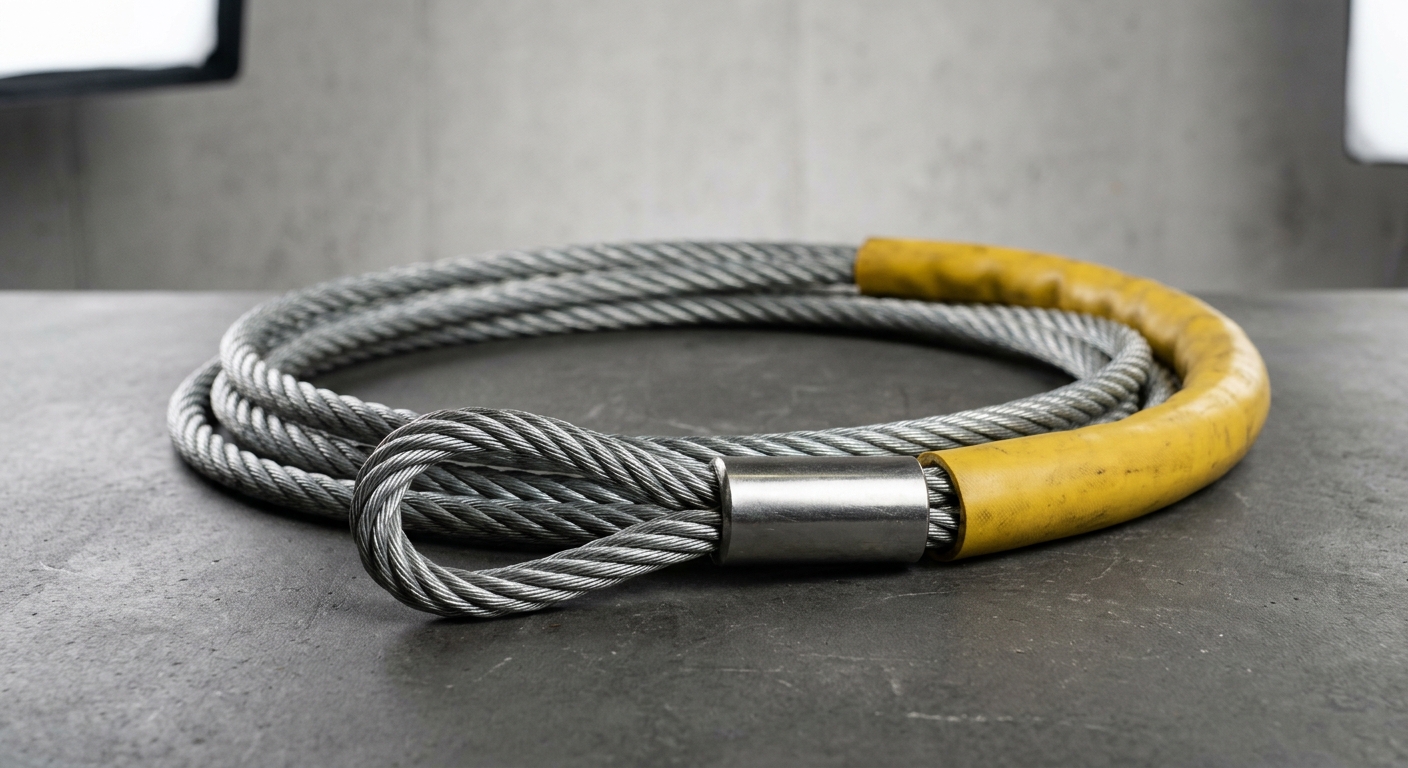
Abrasion at contact points—load edges, shackle pins, and hook throats—is responsible for a significant proportion of premature wire breakage in grommet slings. Protective sleeves fabricated from nylon or polyurethane distribute contact stress across a larger wire surface area, reducing localized wire fatigue at high-pressure contact zones.
Corner thimbles, where fitted, prevent the sling from bending below its minimum D/d ratio at attachment points. This single addition can extend service life by 40–60% in applications where the sling terminates directly on a small-diameter shackle pin without a thimble.
Grommet Sling Material & Construction Comparison Matrix
| Wire Grade | Core Type | Surface Finish | Typical WLL Range | Recommended Environment | Fatigue Life Index | 준수 표준 |
|---|---|---|---|---|---|---|
| IPS | FC | Ungalvanized | 0.5–8 t | Indoor dry | Low | EN 13414-2 |
| EIP | IWRC | Ungalvanized | 0.8–12 t | Indoor dry | Medium | ASME B30.9 |
| EIP | IWRC | Hot-dip Galvanized | 0.8–12 t | Outdoor / general | Medium–High | EN 13414-2 / AS 3569 |
| EEIP | IWRC | Hot-dip Galvanized | 1.0–16 t | Outdoor / heavy duty | High | EN 13414-2 |
| EIP | IWRC | Stainless 304 | 0.6–10 t | Marine / light chemical | Medium | ASME B30.9 |
| EIP | IWRC | Stainless 316 | 0.6–10 t | Marine / chemical | High | EN 13414-2 / AS 3569 |
Compliance Standards and Load Ratings — What the Specs Actually Tell You
Reading EN 13414-2, ASME B30.9, and AS 3569 for Procurement
Certification to a recognized standard is not a formality—it encodes specific manufacturing and testing requirements that directly affect service life. Three parameters deserve particular attention during supplier qualification:
Design factor (minimum 5:1 for wire rope slings under EN 13414-2 and ASME B30.9) defines the ratio between minimum breaking force and rated WLL. Slings manufactured to lower design factors may appear cost-competitive but provide reduced margin against dynamic loading, shock loads, and the cumulative strength reduction that occurs over service life.
Proof load ratio requires each sling to be tested at a defined multiple of WLL before shipment—typically 2× WLL. This test validates splice integrity and identifies manufacturing defects before the sling enters service. Suppliers who cannot provide batch proof load certificates should be treated as unqualified.
Marking requirements under all three standards mandate permanent identification of WLL, sling type, length, and manufacturer traceability. Unmarked or illegibly marked slings are a compliance failure and a practical inspection liability.
WLL, SWL, and the Safety Factor Misunderstanding
The terms Working Load Limit (WLL) and Safe Working Load (SWL) are frequently used interchangeably in commercial documentation, but they carry different technical implications. WLL is the manufacturer-certified maximum load for a specific configuration under defined conditions. SWL is an operational designation that may incorporate additional site-specific derating factors applied by the rigging engineer.
Using a sling at its full rated WLL in every lift—without accounting for hitch configuration, dynamic loading, or accumulated service cycles—systematically compresses service life. A choker hitch reduces effective WLL to approximately 75–80% of the vertical hitch rating; a basket hitch at less than 60° sling angle reduces effective WLL below the vertical rating. Specifying a sling with adequate WLL margin for the actual hitch configuration used is a direct lifespan investment.
Operational and Maintenance Practices That Extend or Shorten Service Life
Rigging Geometry, D/d Ratio, and Bend Radius Impact
The D/d ratio—the ratio of the diameter around which the sling bends (D) to the diameter of the sling body (d)—is the single most controllable operational variable affecting wire fatigue. Wire rope experiences permanent deformation when bent below its minimum D/d threshold. For most grommet slings, the minimum recommended D/d ratio is 25:1 for the sling body contacting a load edge, and 10:1 at the attachment point with a thimble fitted.
Operating below these thresholds does not cause immediate failure; it accumulates fatigue damage that reduces the number of remaining safe load cycles. Rigging teams who consistently use undersized shackles or allow sharp-edge contact without corner protection are shortening sling life invisibly—until a wire count inspection reveals discard-level damage.
Inspection Intervals, Retirement Criteria, and Storage Protocol
ASME B30.9 and EN 13414-2 define specific discard criteria that remove subjectivity from retirement decisions:
- Broken wires: Six or more randomly distributed broken wires in one rope lay length, or three or more broken wires in one strand in one lay length
- Corrosion: Any visible pitting, inter-strand corrosion, or reduction in wire diameter exceeding 1/3 of original
- Deformation: Kinking, crushing, birdcaging, or any geometric distortion of the rope structure
- Splice damage: Any visible strand displacement, protruding wire tucks, or sleeve deformation
Storage protocol is equally consequential. Grommet slings stored coiled on damp floors, in contact with dissimilar metals, or in environments with chemical vapors develop inter-strand corrosion that is invisible until the sling is loaded. Hanging storage on dry, ventilated racks, with periodic light lubrication of the rope body, preserves the fatigue life that specification and manufacturing invested in the product.
자주 묻는 질문
How many load cycles can a wire rope grommet sling typically handle before retirement? There is no universal cycle count because fatigue life depends on rope grade, D/d ratio, load magnitude relative to WLL, and environmental exposure. Under controlled conditions with proper D/d ratios and loads at 50% WLL, EIP/IWRC slings routinely exceed 10,000 cycles before reaching wire break discard criteria. Aggressive rigging geometry or consistent loading above 80% WLL can reduce this to fewer than 2,000 cycles.
What is the difference in lifespan between a galvanized and a stainless steel grommet sling in a coastal environment? In a marine splash zone with regular saltwater exposure, hot-dip galvanized slings typically require retirement within 12–24 months due to zinc depletion and subsequent base metal corrosion. Grade 316 stainless steel slings in equivalent service consistently achieve 4–7 years before reaching corrosion-based discard criteria, making the higher initial cost cost-effective over a multi-year operational horizon.
Which construction standard should I require from a supplier to ensure minimum 5-year service life under daily use? Specify EN 13414-2 or ASME B30.9 certification with documented proof load testing, EIP or EEIP rope grade, IWRC core, and surface finish matched to your environment. Require batch traceability documentation and a splice procedure record. No standard guarantees a specific service duration, but these parameters together create the conditions under which 5-year service life is achievable with proper maintenance.
결론
A grommet sling’s lifespan is not a fixed number stamped on a tag—it is the compounded outcome of decisions made at specification, procurement, rigging, and inspection stages. Wire rope grade determines the fatigue margin available at manufacture. Core configuration determines how that margin holds up under compression loading. Coating and surface finish determine how the environment erodes structural integrity over time. Splice quality determines whether the assembly reaches its rated life or fails prematurely at its weakest point. Compliance certification provides the independent verification that these variables meet minimum performance thresholds.
Buyers who align these factors with their actual operating environment—and who enforce proper D/d ratios, hitch configurations, and inspection protocols in the field—consistently achieve longer service intervals and lower total lifecycle cost than those who optimize for purchase price alone. The cost of a correctly specified grommet sling is always lower than the cost of replacing an under-specified one ahead of schedule.