

요약
Steel wire rope remains the dominant load-bearing medium in offshore lifting operations — from crane hoisting on jack-up rigs to mooring pendants on FPSOs. Its continued prevalence is not incidental. When correctly specified, steel wire rope delivers a combination of tensile strength, structural flexibility, and fatigue tolerance that alternative synthetic or hybrid solutions rarely replicate at equivalent cost and certification maturity.
However, the offshore environment imposes demands that expose poorly specified rope rapidly: cyclic dynamic loading from wave-induced vessel motion, continuous salt spray and splash-zone immersion, and multi-layer drum spooling on offshore cranes all accelerate degradation mechanisms that are negligible in onshore applications. Suitability, therefore, is never a blanket answer — it is a function of precise grade selection, construction geometry, corrosion protection strategy, and a disciplined inspection regime aligned with recognized offshore standards.
This article provides procurement engineers, rigging specifiers, and lifting equipment inspectors with a structured evaluation framework across four critical performance dimensions: mechanical strength, fatigue resistance, corrosion protection, and compliance-driven inspection. Each section maps technical requirements to commercially available 강선 로프 options, enabling informed specification decisions rather than generic procurement.
1. Mechanical Strength Requirements for Offshore Lifting
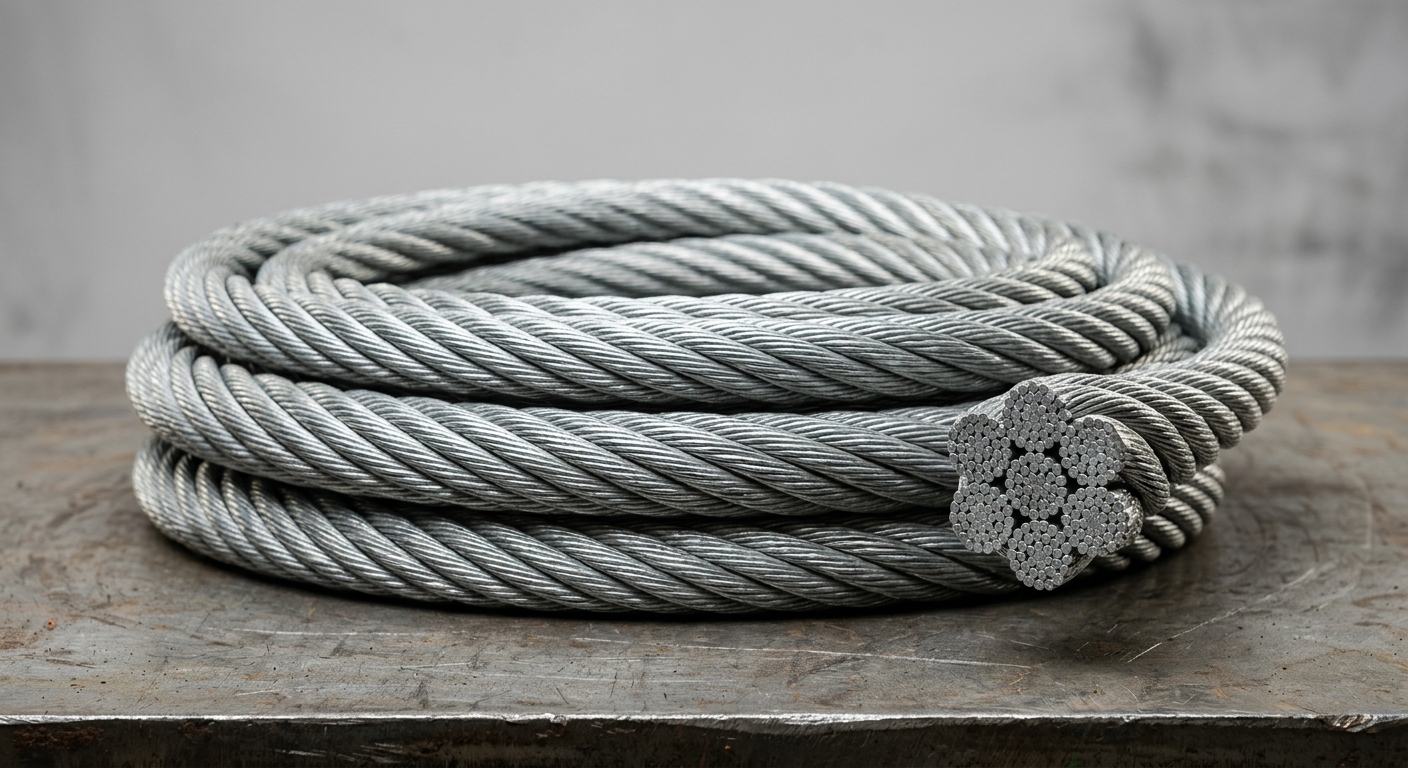
Offshore lifting imposes load conditions fundamentally more severe than equivalent onshore operations. Static rated loads are only part of the equation — dynamic amplification, proof load testing requirements, and regulatory safety factors collectively define the minimum performance envelope that steel wire rope must satisfy.
1.1 Breaking Force, Safety Factors & Grade Selection
The minimum breaking force (MBF) of a steel wire rope is determined by wire tensile grade, rope diameter, and construction efficiency. For offshore crane and derrick applications, two wire grades dominate specification: Grade 1770 MPa and Grade 1960 MPa. The higher-grade 1960 MPa wire delivers greater MBF per unit diameter, reducing rope weight — a meaningful advantage when managing suspended load on offshore cranes with strict deck load limits.
Core type significantly influences MBF. An Independent Wire Rope Core (IWRC) increases MBF by approximately 7.5% compared to a fibre core of equivalent construction, while also improving resistance to crushing on multi-layer drum spooling. For offshore lifting, IWRC is effectively mandatory.
Offshore standards universally mandate a minimum design safety factor of 5:1 (working load limit to MBF) for crane lifting ropes, with some DNVGL-OS-E101 applications requiring 6:1 for personnel transfer or safety-critical lifts. Specifiers must calculate working load limits from certified MBF values — never from nominal catalog figures — and account for termination efficiency losses at swaged sockets or spelter fittings, which typically reduce effective strength by 5–10%.
1.2 Dynamic Load Amplification in Marine Environments
Static load calculations are insufficient for offshore lifting. Wave-induced vessel motion generates shock loads that can multiply the static hook load by a Dynamic Amplification Factor (DAF) of 1.3 to 2.0, depending on sea state, crane boom length, and lift height. API Spec 2C and DNVGL standards require DAF to be applied to the design load before calculating required MBF.
Practical implication: a 10-tonne static lift in Sea State 4 conditions may impose an effective dynamic load exceeding 18 tonnes on the rope. This necessitates either a larger rope diameter, a higher tensile grade, or an increased safety factor in the design basis. Procurement teams must obtain DAF values from the crane OEM or a certified lifting engineer before finalizing rope specifications.
2. Fatigue Resistance & Construction Selection
Repetitive bending over sheaves and multi-layer drum spooling are the primary fatigue mechanisms for offshore crane ropes. Construction geometry — strand count, wire count per strand, and lay configuration — directly determines fatigue life, and selecting the wrong construction for a high-cycle application accelerates discard-condition failures.
2.1 Rope Construction and Bending Fatigue Performance
The 6×36 IWRC construction (Warrington-Seale or Filler wire variants) represents the standard workhorse for offshore crane main hoist applications. Its high wire count per strand reduces individual wire diameter, improving bending flexibility and extending fatigue life over sheaves. The critical parameter is the D/d ratio — the ratio of sheave or drum groove diameter to rope diameter. ISO 16625 and DNVGL recommendations specify minimum D/d ratios of 18:1 to 25:1 for crane ropes; operating below these thresholds accelerates bending fatigue exponentially.
8-strand IWRC constructions offer improved flexibility and crush resistance for multi-layer spooling applications, making them preferred for offshore winches with deep drum capacity. Spiral strand, by contrast, offers high axial stiffness and excellent fatigue performance under tension-tension cycling, making it suitable for static guy wires and taut mooring pendants — but its rigidity makes it unsuitable for running rope applications over sheaves.
2.2 Rotation-Resistant Ropes for Crane & Derrick Applications
Single-part hoist lines on offshore cranes require rotation-resistant rope constructions to prevent load spinning and structural instability. The 18×7 and 35×7 multi-strand constructions are the industry standards, engineered so that outer and inner strand layers have opposing lay directions, generating counteracting torques that minimize net rope rotation under load.
However, rotation-resistant ropes demand careful handling discipline. They are more susceptible to birdcaging if subjected to sudden load release, and their multi-layer strand architecture requires precise fleet angle control during drum spooling. For offshore derrick applications with long free-hanging lifts, 35×7 construction is preferred for its superior torque balance, while 18×7 suits shorter lift heights with moderate cycle frequency.
3. Corrosion Exposure & Material Protection Strategies
The offshore splash zone — the tidal and wave-action zone between waterline and deck level — subjects steel wire rope to continuous salt water wetting, oxygen exposure, and abrasive particle impingement. Without adequate corrosion protection, internal wire corrosion can reduce MBF by 20–40% within a single inspection interval, with no visible external indication.
3.1 Galvanizing, Stainless Steel & Polymer-Coated Options
Hot-dip galvanized wire (Class A or Class B per EN 10264) provides the standard corrosion protection for offshore steel wire rope. Class B galvanizing offers approximately twice the zinc coating mass of Class A, extending corrosion protection life in continuous splash-zone exposure. For the most aggressive environments — subsea running lines or permanently immersed applications — AISI 316 stainless steel wire rope eliminates galvanic corrosion risk entirely, though at a significant cost premium and with slightly lower tensile strength per diameter.
Compacted strand construction, where individual strands are drawn through a die to reduce interwire voids, limits moisture and chloride ingress pathways, extending both fatigue and corrosion service life. This construction is increasingly specified for offshore crane ropes where extended re-lubrication intervals are operationally necessary.
3.2 Lubrication Systems and Corrosion Inhibition
Factory-applied lubricant (core impregnation and surface coating) provides initial corrosion protection but is progressively depleted by mechanical flexing and wash-out in splash-zone environments. Field re-lubrication intervals for offshore crane ropes typically range from 250 to 500 operating hours, depending on exposure severity and rope construction.
Compatible lubricants must penetrate to the rope core without displacing existing fill, resist wash-off in salt water, and remain effective across the temperature range encountered in tropical and arctic offshore operations. Petroleum-based penetrating lubricants with corrosion-inhibiting additives are standard; biodegradable formulations are increasingly required for environmentally sensitive offshore zones.
Rope Construction Comparison for Offshore Lifting Applications
| Construction | Typical MBF (32mm, 1960MPa) | Fatigue Performance | Corrosion Protection Option | Typical Offshore Application | Key Standard |
|---|---|---|---|---|---|
| 6×36 IWRC | ~680 kN | High (bending) | Galvanized / Compacted | Crane main hoist | ISO 2408, API 9A |
| 8-Strand IWRC | ~700 kN | Very High (bending + crush) | Galvanized / Compacted | Offshore winch, multi-layer drum | EN 12385-4 |
| 35×7 Rotation-Resistant | ~650 kN | Moderate (tension-tension) | Galvanized | Single-part crane hoist, derrick | DNVGL-OS-E101 |
| Spiral Strand | ~900 kN | High (tension-tension) | Galvanized / SS 316 | Guy wires, mooring pendants | EN 12385-10 |
4. Inspection Protocols, Compliance Standards & Discard Criteria
4.1 Applicable Standards: ISO, API & DNVGL Requirements
Three primary regulatory frameworks govern steel wire rope fitness-for-service in offshore lifting. ISO 4309 provides the global baseline for crane rope inspection, defining broken wire count thresholds, diameter reduction limits, and corrosion discard criteria across rope construction categories. API Spec 9A governs wire rope material and manufacturing requirements for petroleum industry applications, establishing traceability, test certification, and marking requirements. DNVGL-OS-E101 addresses offshore crane equipment holistically, incorporating rope inspection intervals and discard criteria within the broader crane certification framework.
Third-party certification by a recognized classification society (DNV, Lloyd’s, Bureau Veritas) is typically required for offshore crane ropes, with rope test certificates traceable to heat numbers and manufacturing batch records. Procurement documentation must include mill certificates, dimensional inspection reports, and proof load test records.
4.2 Visual, MRT & Discard Criteria for Offshore Ropes
Visual inspection remains the baseline method but is insufficient alone for offshore crane ropes. Magnetic Rope Testing (MRT) — electromagnetic non-destructive evaluation — detects both surface and internal broken wires, cross-sectional area loss from corrosion, and localized defects invisible to surface inspection. DNVGL and major offshore operators increasingly mandate MRT at defined intervals for safety-critical lifting ropes.
ISO 4309 discard criteria include: broken wire counts exceeding defined thresholds per rope lay length (typically 6 visible broken wires in one lay length for 6-strand rope), diameter reduction exceeding 3% of nominal from external wear or internal corrosion, valley breaks at strand contact points, and evidence of kinking, birdcaging, or core protrusion. Any single criterion triggers immediate removal from service.
자주 묻는 질문
Q1: What minimum breaking force and safety factor should steel wire rope meet for offshore crane lifting operations?
Offshore crane ropes must be selected with a minimum safety factor of 5:1 (MBF to WLL) per DNVGL-OS-E101 and API Spec 2C, with the design load calculated after applying the applicable Dynamic Amplification Factor. For safety-critical or personnel lifts, a 6:1 factor is required. Grade 1960 MPa IWRC constructions are recommended to maximize MBF within manageable rope diameters.
Q2: How frequently should steel wire rope be inspected and lubricated in a saltwater splash-zone environment?
Inspection frequency for offshore crane ropes is typically defined as pre-use visual checks, monthly detailed inspections, and annual third-party certification inspections with MRT. Re-lubrication intervals range from 250 to 500 operating hours depending on construction and exposure. Splash-zone environments demand the shorter end of this range with water-resistant, penetrating lubricant formulations.
Q3: When should rotation-resistant wire rope be specified instead of standard 6-strand constructions for offshore applications?
Rotation-resistant constructions (18×7 or 35×7) are mandatory for single-part hoist lines on offshore cranes where free-hanging loads would spin under torque from standard 6-strand rope. They are not appropriate for multi-part reeving systems or applications where fleet angle control is compromised, as their sensitivity to birdcaging and core damage increases under such conditions.
결론
Steel wire rope is unambiguously suitable for offshore lifting operations — provided specification decisions are driven by systematic engineering assessment rather than generic procurement. The suitability verdict rests on four interdependent pillars: selecting the correct tensile grade and IWRC construction to meet dynamic load-amplified MBF requirements with mandatory safety factors; choosing construction geometry — 6×36, 8-strand, or rotation-resistant — matched to the fatigue duty cycle and D/d ratio of the specific crane or winch; applying appropriate corrosion protection through galvanizing grade, stainless steel wire, or compacted strand geometry combined with a disciplined re-lubrication program; and maintaining compliance with ISO 4309, API Spec 9A, and DNVGL-OS-E101 through documented inspection intervals and MRT-supported discard criteria.
Offshore operators who treat steel wire rope as a commodity consumable consistently face premature discard, unplanned downtime, and elevated safety risk. Those who treat it as a precision-engineered component — specified, maintained, and inspected with the same rigor as the crane itself — realize service lives that validate the material’s continued dominance in offshore lifting applications.