

Абстракт
Rigging hardware failures don’t just damage equipment — they create catastrophic safety incidents, project delays, and significant liability exposure. For procurement engineers, project managers, and site supervisors operating across industrial, construction, and marine sectors, the selection of the right rigging components is a technical and commercial decision with zero margin for error.
This article examines the core hardware categories that form a complete lifting assembly: shackles, wire rope fittings, master links, thimbles, and associated accessories. It addresses how these components interact under load, the engineering principles behind working load limit (WLL) calculations, compliance certifications required for regulated environments, and the material specifications that determine suitability for marine lifting applications. Whether you’re specifying hardware for a single heavy lift or building a procurement framework for an ongoing offshore project, the principles covered here will help you match components to operational demands with precision.
1. Core Rigging Hardware Components and How They Work Together
1.1 Shackles for Lifting: Types, Load Ratings, and Connection Logic
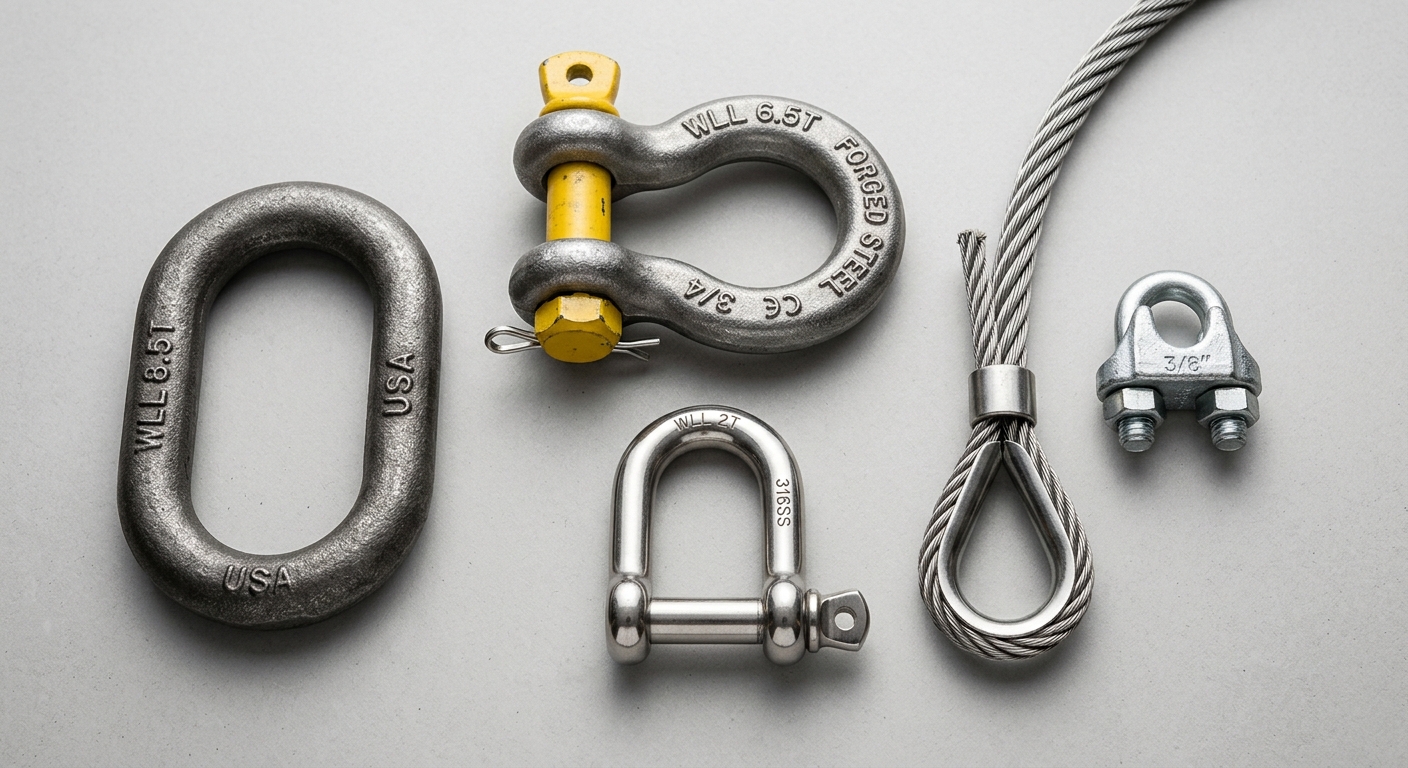
Shackles are the most frequently specified connectors in any rigging assembly, and the geometry of the shackle directly determines its load behavior. The two primary configurations — bow (omega) shackles and dee (chain) shackles — serve distinct connection roles.
Bow shackles feature a rounded body that accommodates multi-directional loading and allows multiple sling legs to connect at a single point. This makes them the standard choice for multi-leg lifts, where off-axis loads are inevitable. Dee shackles, by contrast, have a narrower U-shaped body optimized for in-line loading and are typically used to connect a single sling to a hook or anchor point.
WLL stamping conventions require that every certified shackle carry a forged or embossed WLL marking, a manufacturer identification, and a grade designation. Procurement teams should treat self-declared WLL labels on unmarked hardware as non-compliant. Under dynamic loading conditions — crane picks, vessel lifts, or shock-loaded assemblies — the pin-locking mechanism becomes critical. Screw-pin shackles are adequate for static or semi-permanent rigging, but bolt-type (safety pin) shackles with a threaded nut and cotter pin are mandatory where rotation or vibration could back out a plain screw pin.
For lifting hardware procurement, WLL ranges for standard bow shackles span from 0.5 tonnes (small rigging accessories) up to 150+ tonnes for heavy industrial and offshore applications, with alloy steel grades providing superior strength-to-weight ratios compared to carbon steel alternatives.
1.2 Wire Rope Fittings Selection: Terminals, Thimbles, and Clips
Wire rope fittings determine how effectively the rope’s rated breaking strength is transferred to the rigging system. The two dominant termination methods — swaged (mechanical press) fittings and field-installable mechanical fittings — differ significantly in efficiency rating and application suitability.
Swaged terminals achieve efficiency ratings of 95–100% of the wire rope’s minimum breaking force (MBF), making them the preferred choice for permanent, high-cycle, or offshore assemblies where maximum load transfer is required. Mechanical fittings, including wedge sockets and spelter sockets, offer field-replaceability and are widely used in construction crane applications where rope ends must be re-terminated on site.
Wire rope clips (Crosby-style U-bolt clips) are common for temporary or site-assembled terminations but carry a reduced efficiency rating of approximately 80% when correctly installed. The number of clips, torque specifications, and re-torquing intervals are defined by the rope diameter — a 20mm wire rope requires a minimum of five clips installed with the U-bolt on the dead end, not the live end.
Thimbles are the often-overlooked component that protects the rope eye from crushing and abrasion at the connection point. Open thimbles suit general lifting; closed (swaged) thimbles are specified for permanent terminations. Compatibility between thimble groove radius and wire rope construction (6×19, 6×36, spiral strand) directly affects fatigue life at the termination point.
2. Matching Rigging Components to Load Requirements
2.1 Calculating Working Load Limits and Safety Factors
The WLL of any rigging assembly is not the WLL of its strongest component — it is governed by the weakest link in the system, adjusted for configuration and angle. The standard safety factor for lifting hardware in most industrial and construction applications is 4:1 (minimum breaking load to WLL), while offshore and personnel-critical lifts typically require 5:1 or higher per DNV and IMCA guidelines.
Sling angle is the most frequently underestimated de-rating factor. A two-leg sling at 60° included angle reduces each leg’s effective contribution to approximately 87% of its rated WLL. At 120° included angle, each leg is loaded to 100% of its WLL while the vertical load capacity drops to 50% of the two-leg combined rating. Hardware specified at the top of its WLL range without accounting for sling angle introduces unacceptable risk.
For procurement specifications, always define the maximum intended load, the lift configuration (single point, two-leg, four-leg), and the maximum sling angle before selecting component WLL ratings. This prevents the common error of specifying hardware based on the load weight alone.
2.2 Multi-Leg Rigging Configurations and Hardware Compatibility
Multi-leg lifting assemblies introduce interoperability requirements that single-point lifts do not. A four-leg bridle sling requires a master link or equalizer ring at the apex to consolidate load from all legs to a single crane hook connection. The master link must be rated for the total suspended load, not the per-leg load.
Equalizer beams and triangular plate links are used where load equalization across unequal leg lengths is required. Hardware interoperability — ensuring that shackle bow width accommodates master link thickness, that pin diameter matches the link bore, and that all components share compatible grade designations — must be verified before assembly. Mixing Grade 80 alloy steel chain components with Grade 316 stainless shackles is technically permissible if both components are rated for the applied load, but the assembly WLL must be calculated against the lower-rated component, and the combination must be documented in the lift plan.
📊 Rigging Hardware Specification Comparison
| Component Type | Material Grade | WLL Range | Applicable Standard | Typical Application |
|---|---|---|---|---|
| Bow Shackle | Alloy Steel Grade 6 | 0.5 – 150 t | EN 13889, ASME B30.26 | Multi-leg lifts, crane hooks |
| Dee Shackle | Alloy Steel Grade 6 | 0.3 – 85 t | EN 13889 | In-line, single-sling connections |
| Bow Shackle | Grade 316 Stainless | 0.5 – 25 t | EN 13889 | Marine, offshore, subsea |
| Wire Rope Clip | Hot-Dip Galvanized | Per rope dia. | DIN 1142, ASME B30.26 | Temporary field terminations |
| Wire Rope Thimble | Grade 316 Stainless | Per rope dia. | DIN 6899 | Offshore, coastal, marine |
| Eye Bolt (Shoulder) | Alloy Steel | 0.2 – 20 t | ASME B18.15 | Machinery lifting points |
| Turnbuckle | Hot-Dip Galvanized / SS | 0.5 – 10 t | DIN 1480, ASTM F1145 | Tension adjustment, lashing |
| Master Link | Alloy Steel Grade 8 | 2 – 100 t | EN 1677-4 | Multi-leg sling apex |
3. Compliance Standards and Material Specifications for Industrial and Marine Use
3.1 Key Certifications and Regulatory Standards
Certified rigging hardware for regulated lifting environments must comply with internationally recognized standards that define proof load testing, material traceability, and marking requirements. The primary standards governing shackles and wire rope fittings include:
- EN 13889 (Europe): Covers forged steel shackles for general lifting, specifying dimensions, mechanical properties, and proof load requirements.
- ASME B30.26 (North America): Addresses rigging hardware including shackles, turnbuckles, eye bolts, and hooks with mandatory WLL marking and inspection criteria.
- EN 1677 series: Covers components for slings — master links, connecting links, and hooks — with individual part standards for each component type.
- DNV / ABS / Lloyd’s Register approval: Required for lifting hardware used on certified vessels, offshore platforms, and marine crane systems. These classification society approvals require third-party witnessed proof load testing and full material traceability.
For procurement documentation, a compliant certification package should include: a material test certificate (MTC) per EN 10204 3.1 or 3.2, proof load test records, dimensional inspection reports, and — for offshore applications — the relevant classification society certificate number.
3.2 Corrosion Resistance and Material Selection for Marine Lifting Applications
Material selection for marine lifting applications must balance mechanical strength, corrosion resistance, and lifecycle cost. The three primary material options each present distinct trade-offs:
Grade 316 Stainless Steel offers superior corrosion resistance in chloride-rich environments (seawater, splash zones, chemical exposure) with no requirement for surface coating maintenance. However, it has lower tensile strength than alloy steel at equivalent dimensions, meaning larger cross-sections are required to achieve equivalent WLL ratings. It is the standard specification for subsea, offshore deck, and coastal marine hardware.
Hot-Dip Galvanized Alloy Steel provides high strength with moderate corrosion protection. The zinc coating is effective in atmospheric marine environments but degrades in full immersion or high-abrasion applications. Maintenance intervals of 3–5 years for re-coating or replacement are typical in active marine environments. Cost-effective for onshore industrial and construction applications.
Alloy Steel (uncoated or painted) is specified for indoor industrial lifting where corrosion is not a factor. It offers the highest WLL-to-weight ratio and is the standard for overhead crane systems, manufacturing facilities, and controlled environments.
4. Procurement Considerations and Commercial Value
4.1 Sourcing Criteria: Traceability, Certification Packages, and MOQ
For project-based procurement of rigging hardware, traceability is a non-negotiable requirement in regulated industries. Each batch of hardware should be traceable from the raw material heat number through to the finished component, enabling full documentation for third-party inspection, insurance purposes, and incident investigation if required.
Key supplier evaluation criteria include: availability of EN 10204 3.1/3.2 material certificates, compliance with specified international standards, capacity for batch certification aligned to project purchase order numbers, and demonstrated quality management systems (ISO 9001 as a baseline). For offshore and marine projects, supplier approval by the relevant classification society (DNV, ABS, Bureau Veritas) is typically a contractual requirement.
Minimum order quantities vary significantly by component type and grade. Standard galvanized shackles and wire rope clips are typically available in single-unit quantities for MRO procurement, while specialized Grade 316 stainless or high-tonnage alloy steel components may carry MOQs of 10–50 units. Volume pricing thresholds for project procurement generally activate at quantities that justify batch certification costs.
4.2 Total Cost of Ownership vs. Unit Price in Rigging Hardware Selection
The unit price differential between certified and uncertified rigging hardware — often 30–60% — is consistently outweighed by the risk exposure of using non-compliant components. A single rigging failure in an industrial or offshore environment carries potential costs including: equipment damage, personnel injury liability, regulatory investigation, project downtime, and insurance implications.
Certified hardware with documented traceability also reduces replacement cycle costs by enabling condition-based inspection rather than precautionary replacement. A Grade 316 stainless shackle with proper maintenance documentation may remain in service for 10+ years in a marine environment, while an uncertified galvanized alternative may require annual replacement. Lifecycle cost analysis consistently favors certified, traceable hardware for any application where the hardware is in regular service.
Често задавани въпроси
1. How do I verify that a shackle’s WLL rating is certified and not self-declared by the manufacturer?
Request the EN 10204 3.1 or 3.2 material test certificate and the proof load test record. Certified shackles will carry forged markings including the WLL, manufacturer code, and grade designation. Cross-reference the manufacturer code against the certification documentation. For offshore or marine applications, require the classification society certificate number and verify it against the issuing body’s registry.
2. What wire rope fittings are approved for offshore and marine lifting operations under DNV or ABS classification?
DNV and ABS approve specific fitting types and manufacturers through their product type approval programs. Swaged terminals, spelter sockets, and wedge sockets from approved manufacturers carry a type approval certificate number. When specifying fittings for classified offshore lifts, require the type approval certificate and confirm the fitting’s rated capacity covers the intended application with the required safety factor.
3. Can different-grade rigging components be used together in the same lifting assembly?
Yes, with important qualifications. The assembly WLL is limited by the lowest-rated component. Mixing Grade 80 alloy steel hooks with Grade 316 stainless shackles is mechanically permissible if both are rated for the applied load. However, the combination must be documented in the lift plan, and physical compatibility (pin diameter, bore size, load geometry) must be verified. Never assume interoperability based on WLL rating alone.
Заключение
Selecting rigging hardware for industrial, construction, or marine lifting applications requires aligning four variables simultaneously: component WLL ratings matched to the actual load and configuration, material grades suited to the operating environment, compliance certifications meeting the regulatory requirements of the project, and hardware interoperability across the complete assembly.
Shackles, wire rope fittings, master links, and associated components are not interchangeable commodities — each specification decision affects the integrity of the entire lifting system. The cost differential between certified and uncertified hardware is marginal against the liability and downtime exposure of a rigging failure.
Working with a verified supplier who provides full traceability documentation, classification society approvals where required, and technical support for component selection is the most reliable way to ensure that your lifting setup meets both the load requirements and the compliance standards of your operating environment.