

Abstract
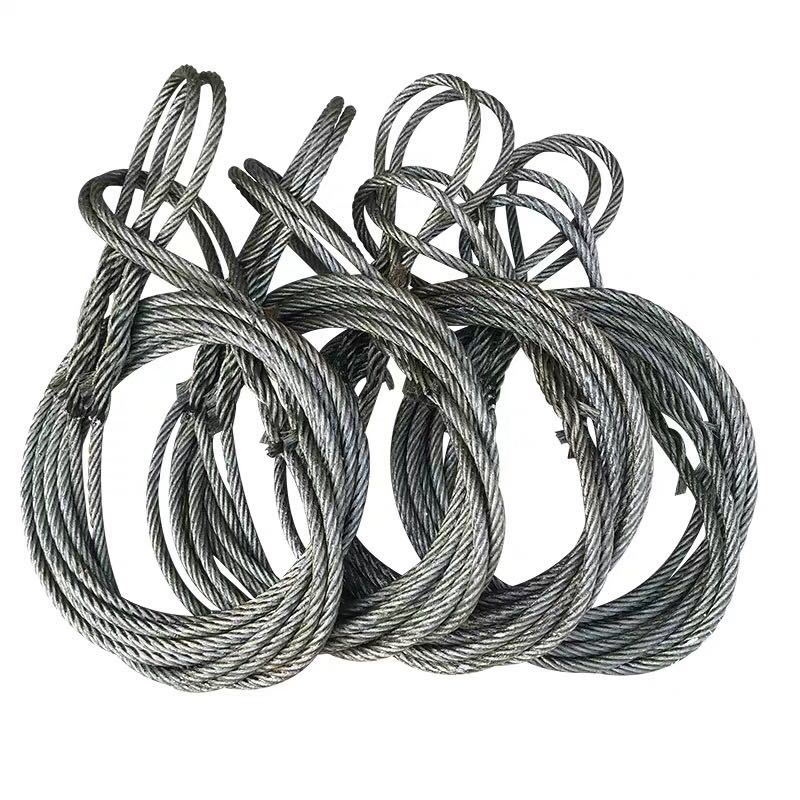
Geperste staalkabelslingers are engineered for high-load, high-cycle industrial lifting environments where standard slings consistently fall short in performance, safety margin, or service life. Unlike hand-tucked or mechanically spliced alternatives, pressed wire rope slings use a swaged termination process that delivers full minimum breaking load (MBL) retention, superior fatigue resistance, and consistent dimensional integrity under repeated stress cycles.
This article defines the technical characteristics that distinguish pressed wire rope slings from competing sling types, outlines the specific operational conditions and industry sectors that justify their selection, and provides procurement-ready guidance on configuration options, compliance standards, and total cost of ownership. Whether you are specifying lifting equipment for a steel mill, offshore platform, or heavy civil construction project, understanding when and why to select a pressed wire rope sling is critical to both operational safety and procurement efficiency.
What Is a Pressed Wire Rope Sling and How Does It Differ from Standard Slings?
Construction & Termination Technology
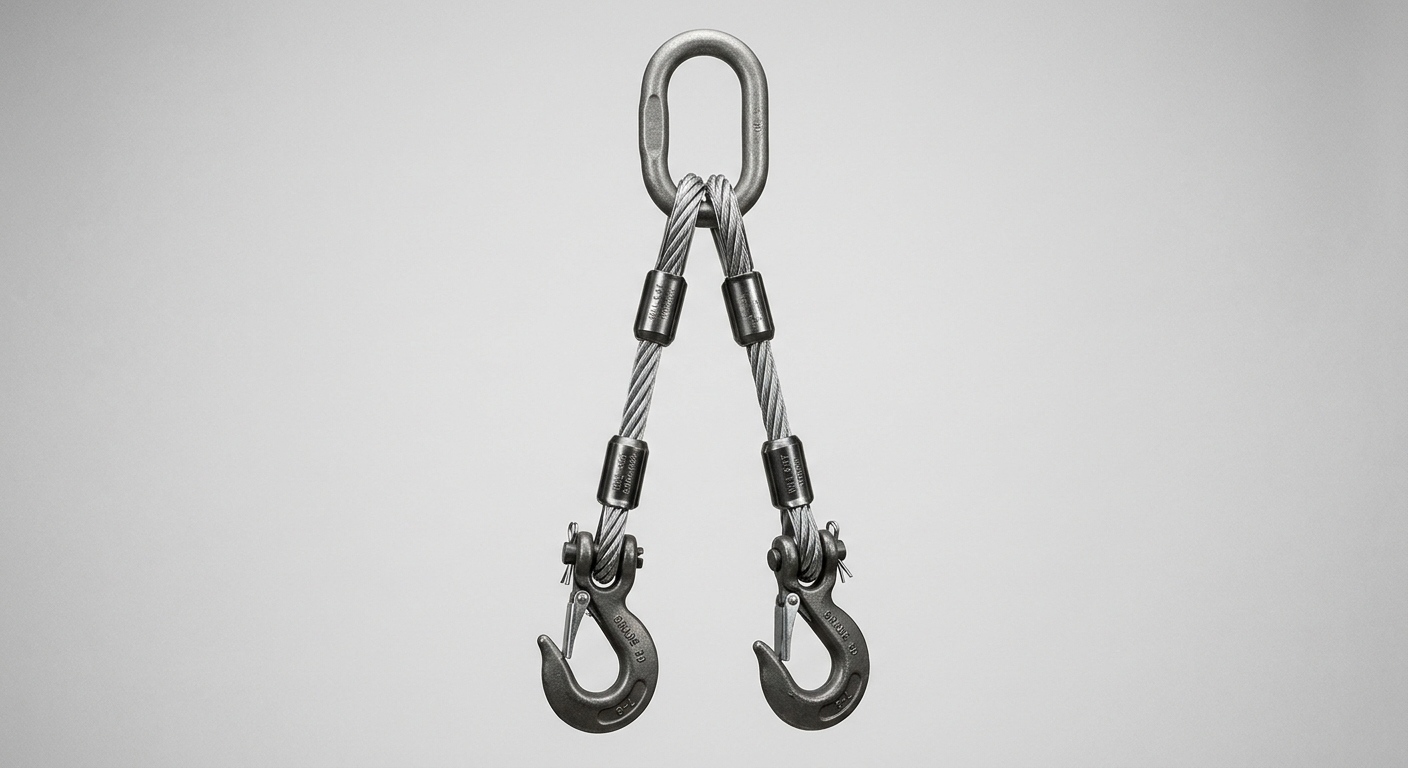
A pressed wire rope sling is manufactured by threading a wire rope through a metal sleeve — typically steel or aluminum — and mechanically compressing (swaging) that sleeve under high hydraulic pressure. This cold-forming process locks the rope strands within the fitting, creating a termination that achieves 100% MBL retention — meaning the sling’s rated break strength equals the full capacity of the parent wire rope, with no reduction from the end fitting.
This is a fundamental advantage over hand-tucked splices, which typically achieve 75–90% efficiency, and over some mechanical splice designs that may introduce stress concentrations at the termination zone.
Core construction options directly affect performance:
- IWRC (Independent Wire Rope Core): Provides higher crush resistance, better torque stability, and greater WLL capacity. Preferred for heavy industrial and offshore applications.
- Fiber Core (FC): Offers greater flexibility and is suitable for lighter-duty or less abrasive environments, though it provides lower resistance to radial compression.
The pressed sleeve itself is available in carbon steel (for general use), galvanized steel (for corrosion-exposed environments), and stainless steel (for chemical or marine service).
Key Performance Differentiators
Compared to hand-tucked or mechanically spliced slings, pressed wire rope slings deliver measurable advantages in three critical performance categories:
- Fatigue Resistance: The swaged termination distributes load uniformly across all wire strands, reducing localized stress cycling that causes premature wire breaks near the end fitting.
- Fleet Angle Tolerance: The rigid, compact sleeve geometry maintains alignment under angular loading, reducing wear at the connection point.
- Abrasion Performance: The outer wire strands retain their structural contribution through the termination zone, unlike tucked splices where strands are redirected and subject to internal abrasion.
| Sling Type | Beëindigingsmethode | Break Strength Efficiency | Flexibility | Typical WLL Range | Best-Fit Application |
|---|---|---|---|---|---|
| Geperste draadkabelsling | Swaged/Pressed Sleeve | ~100% | Moderate | 1T – 500T+ | Heavy industrial, offshore, steel mills |
| Hand-Tucked Splice | Manual tuck splice | 75–90% | High | 0.5T – 50T | General rigging, lighter lifts |
| Mechanical Splice | Wedge/clip fitting | 80–95% | Moderate | 1T – 100T | Construction, field assembly |
| Chain Sling | Alloy chain links | N/A (rated by chain grade) | High | 1T – 100T+ | High-heat, abrasive environments |
| Synthetic Web Sling | Sewn/bonded webbing | 100% (by design) | Very High | 0.5T – 30T | Light assembly, painted/finished surfaces |
When Should You Specify a Pressed Wire Rope Sling? (Core Selection Criteria)
Load Conditions & Rigging Configurations
The primary trigger for specifying a pressed wire rope sling is load magnitude combined with cycle frequency. When lifts exceed the practical WLL range of synthetic alternatives — typically above 10–15 tonnes in multi-leg configurations — or when the same sling will be used repeatedly across shifts, pressed wire rope slings become the technically justified choice.
Key load-related selection criteria include:
- Single-leg vertical lifts: Suitable for straightforward picks where the full WLL of the sling is applied directly. Pressed terminations ensure no capacity is lost at the end fitting.
- Multi-leg bridle configurations (2, 3, or 4-leg): Load is distributed across legs, but each leg must be rated for the maximum tension it can experience at the specified sling angle. Bridle slings with pressed fittings are preferred because all legs must carry equal load assurance.
- D/d ratio compliance: The ratio of the bearing surface diameter (D) to the wire rope diameter (d) must meet minimum values — typically D/d ≥ 25 for standard wire rope slings — to avoid excessive bending stress at contact points. IWRC constructions tolerate tighter D/d ratios better than fiber core.
- Dynamic vs. static loads: Shock loading, crane acceleration/deceleration, and offshore wave-induced motion require a minimum design factor of 5:1 (WLL to MBL). Pressed terminations maintain this margin without fatigue-induced degradation at the splice zone.
Operating Environments & Industry Applications
Pressed wire rope slings are the standard specification across industries where environmental severity and load criticality converge:
- Steel mills & metal processing: High ambient temperatures, abrasive contact with billets and coils, and repetitive cycling demand IWRC slings with pressed fittings rated for heat exposure.
- Offshore oil & gas: DNV/DNVGL-certified slings with stainless or hot-dip galvanized sleeves are required for subsea and topside lifting in salt-spray environments.
- Heavy construction & civil infrastructure: Lifting precast concrete elements, structural steel, and bridge components requires high-WLL multi-leg bridles with certified pressed terminations.
- Shipbuilding & dry dock operations: Large, awkward loads with variable lift points require flexible multi-leg configurations with consistent termination strength.
- Mining & quarrying: Abrasion, shock load from blasted rock, and dusty conditions favor the durability of pressed wire rope over synthetic alternatives.
Configuration Options and Specification Parameters
End Fittings, Leg Counts & Custom Lengths
Pressed wire rope slings are available in a wide range of end-fitting combinations to match specific rigging hardware:
- Upper end fittings: Oblong master links (single or multi-leg), shackle-ready loops, or eye-and-eye configurations for direct crane hook connection.
- Lower end fittings: Clevis hooks (with safety latch), shackle connections, swivel hooks, or open hooks — selected based on load attachment geometry and release requirements.
- Leg count: Single-leg, 2-leg, 3-leg, and 4-leg bridle assemblies are standard. Asymmetric leg lengths are available for off-center load attachment points.
- Length tolerances: Standard lengths are typically supplied to ±1% tolerance. Custom lengths for project-specific lifts require engineering review and extended lead times.
- Coating & material options: Bright (uncoated) for dry indoor use; hot-dip galvanized for general outdoor/marine exposure; stainless steel wire with stainless fittings for chemical and subsea service.
Compliance Standards & Certifications to Verify
Before approving any pressed wire rope sling for industrial or offshore use, procurement and engineering teams must confirm compliance with applicable standards:
- ASME B30.9 (USA): Covers sling design, manufacture, inspection, and use. Requires proof load testing and permanent identification markings on each sling.
- EN 13414-1 (Europe): Specifies safety requirements for steel wire rope slings, including termination efficiency and marking requirements.
- ISO 2415: Provides international guidance on wire rope sling construction and performance classification.
- DNV/Bureau Veritas/Lloyd’s Register certification: Mandatory for offshore lifting equipment in most jurisdictions. Third-party witnessed proof load tests and material traceability are required.
Commercial and Operational Value for Procurement Teams
Total Cost of Ownership vs. Initial Price
Pressed wire rope slings carry a higher unit cost than hand-tucked or synthetic alternatives. However, total cost of ownership (TCO) analysis consistently favors pressed slings in high-utilization environments:
- Service life: Pressed terminations extend sling service life by 30–60% compared to mechanically spliced alternatives in equivalent duty cycles, based on documented inspection intervals in steel and offshore industries.
- Inspection intervals: Pressed slings exhibit predictable wear patterns — primarily outer wire abrasion and corrosion — that are straightforward to assess during mandatory periodic inspections. Tucked splices, by contrast, can develop internal strand breaks that are difficult to detect visually.
- Replacement frequency: Fewer replacements per operating year reduce both direct procurement costs and crane downtime associated with sling change-outs.
- Incident cost avoidance: A sling failure resulting in a dropped load carries regulatory, liability, and reputational costs that dwarf any unit price premium. The 100% MBL efficiency of pressed terminations directly supports safety margin compliance.
Supplier Qualification and Documentation Requirements
For procurement teams sourcing pressed wire rope slings for regulated industries, supplier qualification must include:
- Material traceability certificates: Wire rope and sleeve material heat numbers traceable to mill certificates.
- Proof load test reports: Each sling or batch tested to a specified multiple of WLL (typically 2× WLL for ASME B30.9; specific values per EN 13414-1).
- Third-party inspection reports: For offshore or critical lifts, independent verification by an accredited body (DNV, BV, SGS) is standard.
- Sling identification marking: Permanent tags or stamps showing WLL, sling angle rating, leg count, serial number, and manufacturer identity.
- Compliance declaration: Written confirmation of applicable standard(s) met, with revision reference.
Veelgestelde vragen
1. What is the maximum working load limit available for a pressed wire rope sling?
Pressed wire rope slings can be manufactured to WLLs exceeding 500 tonnes in multi-leg bridle configurations using large-diameter IWRC wire rope. Standard catalog slings typically range from 1 tonne to 150 tonnes. For lifts above this range, custom engineering with third-party certification is required.
2. How do I determine the correct sling configuration for a multi-leg lift?
The effective WLL of a multi-leg sling depends on the number of legs, the sling angle from vertical, and the load distribution. A 2-leg bridle at 60° from vertical, for example, applies a tension factor of 1.155 per leg. Always use the manufacturer’s angle correction tables or consult a qualified rigging engineer. Never assume a 4-leg sling carries four times the single-leg WLL — asymmetric loading means only 3 legs are assumed active in most standards.
3. What certifications should a pressed wire rope sling carry for offshore or heavy industrial use?
For offshore service, slings must typically carry DNV, Bureau Veritas, or Lloyd’s Register certification, with witnessed proof load testing and full material traceability. For general heavy industrial use, ASME B30.9 (North America) or EN 13414-1 (Europe/international) compliance is the baseline requirement. Always confirm the applicable regulatory framework for your jurisdiction and project specification.
Conclusie
The decision to specify a pressed wire rope sling is driven by a clear set of criteria: load magnitude, operational cycle frequency, environmental severity, and regulatory compliance requirements. When lifts are heavy, repetitive, or conducted in corrosive or abrasive conditions — as in steel mills, offshore platforms, shipyards, and mining operations — pressed wire rope slings deliver the termination efficiency, fatigue resistance, and service life that alternative sling types cannot match at equivalent safety margins.
For procurement teams, the value proposition extends beyond unit price. Longer service intervals, predictable inspection outcomes, and full documentation traceability reduce total operational risk and lifecycle cost. Specifying a pressed wire rope sling with verified ASME B30.9, EN 13414-1, or DNV certification is not a premium choice — it is the baseline for responsible lifting equipment procurement in demanding industrial environments.
To request technical specifications, configuration drawings, or certified test documentation for your project requirements, contact our engineering and sales team directly.