

요약
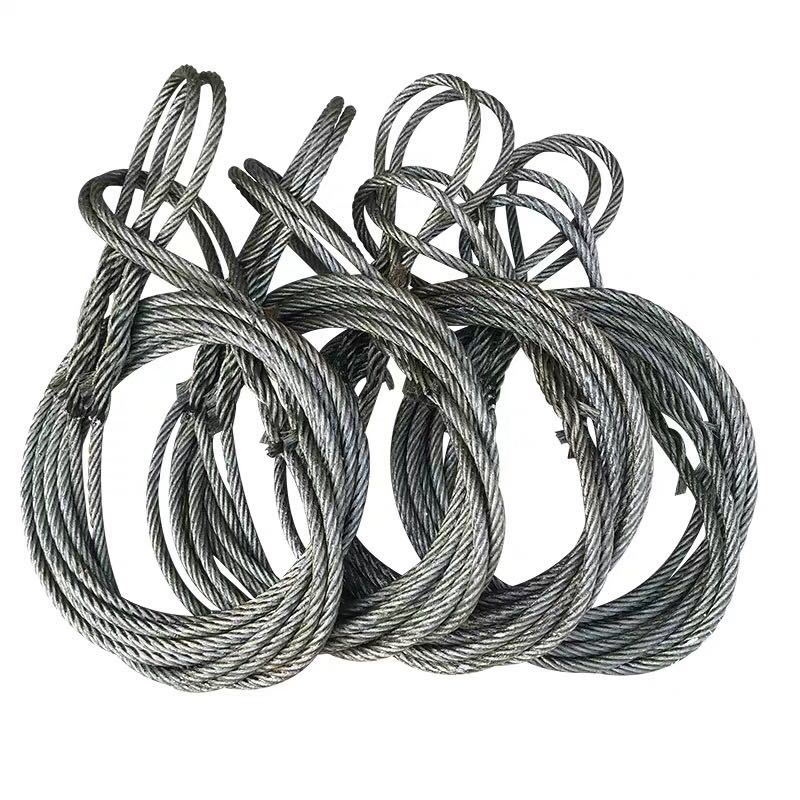
프레스드 와이어 로프 슬링 are among the most mechanically demanding components in any heavy lifting operation. A single swaged sleeve connects wire rope to load — and when that connection fails, the consequences are immediate and severe. Yet inspection programs for these slings are frequently underdocumented, inconsistently applied, or driven by habit rather than regulatory requirement.
This article addresses three core questions procurement managers and rigging supervisors face: How often must pressed wire rope slings be inspected? What specific defects trigger removal from service? And how do you build an inspection schedule that satisfies ASME B30.9, OSHA 1910.184, and EN 13414 simultaneously?
The answers are grounded in regulatory text — not generalizations. Whether you manage a fleet of slings across a steel fabrication facility or source lifting gear for offshore construction, the framework here gives you a defensible, auditable inspection program that protects both workers and procurement budgets.
Why Inspection Frequency Matters for Pressed Wire Rope Slings
The Cost of Under-Inspection in Industrial Lifting
Wire rope sling failures are rarely sudden surprises — they are the predictable result of deferred inspection. According to OSHA incident data, rigging failures account for a disproportionate share of struck-by and caught-in fatalities in general industry and construction. When a pressed wire rope sling fails mid-lift, the consequences extend beyond the immediate incident: crane downtime, load damage, regulatory investigation, and potential OSHA citation under 1910.184 or 1926.251.
The liability exposure is substantial. Employers who cannot produce inspection records face citations even when no injury occurs. More critically, insurance carriers increasingly require documented sling inspection logs as a condition of coverage for lifting operations. Under-inspection is not merely a safety gap — it is a commercial and legal vulnerability.
From a procurement standpoint, undetected sling degradation also distorts replacement cycles. Slings that should have been retired continue in service, accumulating risk, while slings removed prematurely inflate replacement costs. A structured inspection program directly improves asset utilization.
Factors That Accelerate Sling Degradation
Not all pressed wire rope slings degrade at the same rate. The following variables materially shorten service life and should inform how aggressively your inspection schedule is set:
- Load cycle frequency: High-cycle operations (multiple lifts per shift) accumulate fatigue damage far faster than intermittent use. A sling used 20 times daily requires more frequent assessment than one used weekly.
- Corrosive environments: Marine, chemical processing, and outdoor storage environments accelerate wire corrosion and pressed sleeve oxidation. Galvanized or stainless constructions extend service life but do not eliminate inspection obligations.
- Abrasive contact: Dragging slings across concrete, steel edges, or rough surfaces damages outer wire strands in ways that are not always visible at the pressed sleeve — the most structurally critical zone.
- Temperature extremes: High heat softens lubricant within the wire rope core; freezing conditions make wire brittle and increase susceptibility to kinking.
- Chemical exposure: Acids, alkalis, and solvents degrade both wire and pressed ferrule integrity. Any sling exposed to chemical splash should be inspected before its next use, regardless of schedule.
Inspection Frequency Standards — What the Regulations Actually Require
Regulatory Frameworks: ASME B30.9 / OSHA 1910.184 / EN 13414
Three primary standards govern wire rope sling inspection in most industrial jurisdictions. Each uses slightly different terminology but aligns on a tiered inspection model:
ASME B30.9 (United States, widely adopted internationally) mandates three inspection tiers:
- Initial inspection before first use — verify sling matches documentation, no transport damage.
- Frequent inspection — performed before each use by the operator or a designated competent person.
- Periodic inspection — conducted at regular intervals by a qualified inspector, with frequency determined by service conditions (monthly to annually).
OSHA 1910.184 (general industry) requires that slings be inspected prior to use each day and immediately following any incident that may have damaged the sling. It also requires removal from service when any defect listed in the standard is observed.
EN 13414 (European standard) introduces a formal “thorough examination” requirement at intervals not exceeding 12 months, with more frequent examinations specified when conditions warrant. It also mandates a documented risk assessment to justify the chosen interval.
How to Set a Site-Specific Inspection Schedule
Regulatory minimums define the floor, not the ceiling. A risk-based schedule accounts for your actual operating conditions.
| Inspection Type | Trigger Condition | Applicable Standard | Inspector Qualification | Documentation Required |
|---|---|---|---|---|
| Pre-Use / Initial | Before each use / first use | ASME B30.9, OSHA 1910.184 | Competent person (operator-level) | Recommended; mandatory post-incident |
| Frequent | Each shift or daily | ASME B30.9, OSHA 1910.184 | Competent person | Yes (for fleets >10 slings) |
| Periodic | Monthly to quarterly | ASME B30.9, EN 13414 | Qualified inspector | Yes — written record required |
| Annual / Thorough Examination | Every 12 months maximum | EN 13414, ASME B30.9 | Qualified/certified inspector | Yes — formal report with sling ID |
For high-intensity operations (daily multi-shift use, corrosive environments), periodic inspections should occur monthly. For low-intensity use (weekly lifts, indoor dry storage), quarterly may be defensible — provided the logic is documented.
Pressed Wire Rope Sling Inspection Checklist — Point by Point
Visual & Physical Inspection Criteria
The following defects, per ASME B30.9 Section 9-6.3, require immediate removal from service:
- Broken wires: Ten randomly distributed broken wires in one rope lay, or five broken wires in one strand within one rope lay.
- Kinking, crushing, or bird-caging: Any permanent deformation of the wire rope body that disrupts the geometric relationship between strands.
- Core protrusion: Wire rope core visible at the surface indicates internal structural failure.
- Abrasion: Loss of more than one-third of the original diameter of the outer wires.
- Heat damage: Discoloration, loss of lubrication, or brittle wire texture following heat exposure.
- Corrosion: Pitting corrosion on outer wires, or corrosion that inhibits free movement of wires within strands.
- Reduction in rope diameter: A reduction exceeding 1/64 inch from nominal diameter indicates internal wear or core failure.
Each inspection should be conducted along the full length of the sling body — not just at the pressed ends. Defects frequently concentrate at contact points with hooks, shackles, or load edges.
Pressed Sleeve & End Fitting Integrity Checks
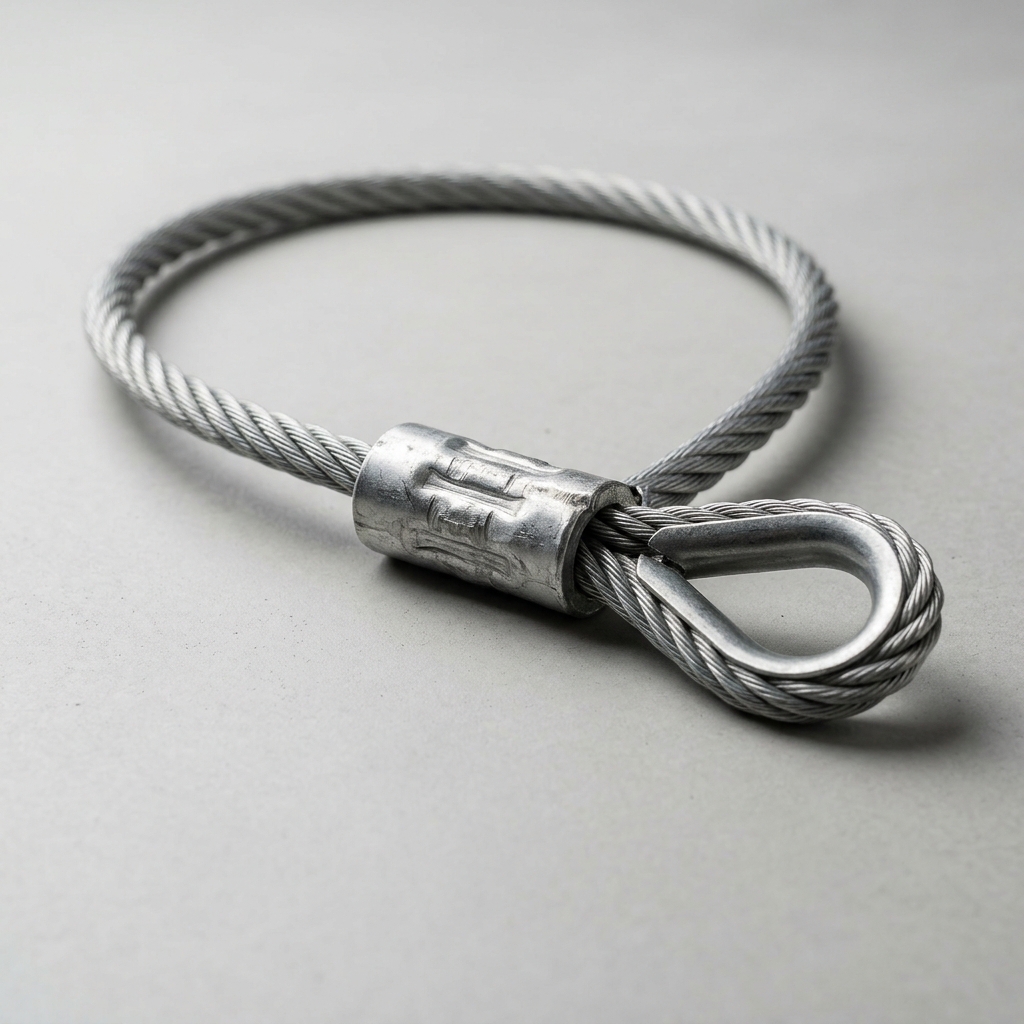
The pressed (swaged) sleeve is the highest-stress zone of the sling assembly and warrants specific inspection criteria beyond those applied to the rope body:
- Sleeve deformation: Any cracking, splitting, or visible elongation of the pressed ferrule is a discard criterion. Swaged sleeves that have been overloaded may show barrel-shaped bulging at the compression zone.
- Slippage indicators: A paint witness mark or scribe line across the sleeve-to-rope interface is best practice. Any displacement of this mark indicates the rope has pulled through the sleeve — immediate removal required.
- Thimble condition: Where thimbles are incorporated at the eye, inspect for distortion, cracking, or wear through. A deformed thimble compromises load distribution at the eye.
- Surface corrosion at sleeve: Galvanic corrosion between dissimilar metals (e.g., steel rope in an aluminum sleeve) can progress internally without obvious external signs. Inspect sleeve-to-rope interface edges carefully.
- End fitting alignment: The eye should remain in the plane of the sling body. Any lateral twist at the sleeve suggests torsional overload.
Document sleeve condition with photographs during periodic inspections. This creates a longitudinal record that reveals progressive degradation invisible in single-point inspections.
Commercial & Procurement Implications of Sling Inspection Programs
Documenting Inspection Records for Compliance Audits
Regulatory compliance in lifting operations is increasingly documentation-driven. ASME B30.9 and EN 13414 both require that periodic inspection results be recorded and retained. Minimum record content should include:
- Sling identification (serial number, WLL, construction type)
- Inspection date and inspector name/qualification
- Specific defects observed and disposition (continued service / removed from service)
- Next scheduled inspection date
For fleets exceeding 20 slings, digital asset management tools — even simple spreadsheet-based systems — significantly reduce audit preparation time and eliminate the risk of missing scheduled inspections. Color-coded tagging systems (quarterly tag rotation by color) provide a visible, at-a-glance compliance indicator on the shop floor without requiring database access at point of use.
When to Replace vs. Recertify — Total Cost of Ownership Perspective
The replacement-vs-recertification decision is fundamentally a total cost of ownership calculation. Key decision inputs:
- Sling age and cycle count: Slings approaching end of design life should be replaced rather than recertified, regardless of visual condition.
- Defect type: Broken wires and sleeve deformation are non-repairable — replacement only. Surface corrosion on a sling otherwise in good condition may justify professional cleaning and re-lubrication before return to service.
- Supplier recertification services: Reputable pressed wire rope sling manufacturers offer recertification programs that include destructive testing of sample slings from a batch, providing statistical confidence in fleet condition.
- Reactive vs. proactive replacement cost: Industry data consistently shows that reactive replacement (after failure or near-miss) costs 3–5× more than planned replacement when downtime, incident investigation, and regulatory response are included.
A formal inspection program is the mechanism that converts reactive replacement into planned replacement — and that conversion is where the measurable ROI of sling safety programs is found.
자주 묻는 질문
Q1: How often should pressed wire rope slings be inspected under OSHA regulations? OSHA 1910.184 requires slings to be inspected before use each day they are in service, and immediately after any incident that may have caused damage. There is no explicit annual requirement in OSHA 1910.184, but ASME B30.9 — which OSHA references — requires periodic inspections at intervals determined by service conditions, typically monthly to annually.
Q2: What are the discard criteria for a pressed wire rope sling with broken wires? Per ASME B30.9, a sling must be removed from service if it has ten or more randomly distributed broken wires in one rope lay, or five or more broken wires in a single strand within one rope lay. Any broken wires at or adjacent to the pressed sleeve are also cause for immediate removal, regardless of count.
Q3: Who is qualified to perform a periodic inspection on wire rope slings? ASME B30.9 requires periodic inspections to be performed by a “qualified person” — defined as one with a recognized degree, certificate, or professional standing in the relevant field, or who has demonstrated the ability to solve problems related to the subject matter. EN 13414 uses the term “competent person” with similar intent. In practice, this means a trained rigging inspector, not a general equipment operator.
결론
A structured inspection program is not a compliance formality — it is the operational mechanism that keeps pressed wire rope slings performing at their rated working load limit throughout their service life. The three pillars are non-negotiable: pre-use checks before every lift, periodic inspections at risk-calibrated intervals, and clear discard criteria applied without exception.
Aligning your program with ASME B30.9, OSHA 1910.184, or EN 13414 — whichever governs your jurisdiction — gives you a defensible framework that satisfies regulators, insurers, and internal safety audits. Pair that framework with documented records and a total-cost-of-ownership approach to replacement decisions, and sling inspection becomes a competitive operational advantage rather than a cost center.