

Abstrak
Choosing the right rigging hardware is essential for maintaining lifting safety, operational reliability, and compliance with industry standards. Incorrect load calculations, unsuitable components, or uncertified hardware can increase the risk of equipment damage, failed inspections, and costly downtime.
This guide helps procurement managers, safety professionals, and rigging specialists understand how to evaluate rigging hardware based on component types, Working Load Limit (WLL), material selection, certification requirements, and application conditions. From construction lifting and offshore operations to industrial hoisting systems, the following selection principles help buyers choose reliable hardware, reduce safety risks, and improve long-term equipment performance.
1. Understanding Rigging Hardware: Core Components & Load Principles
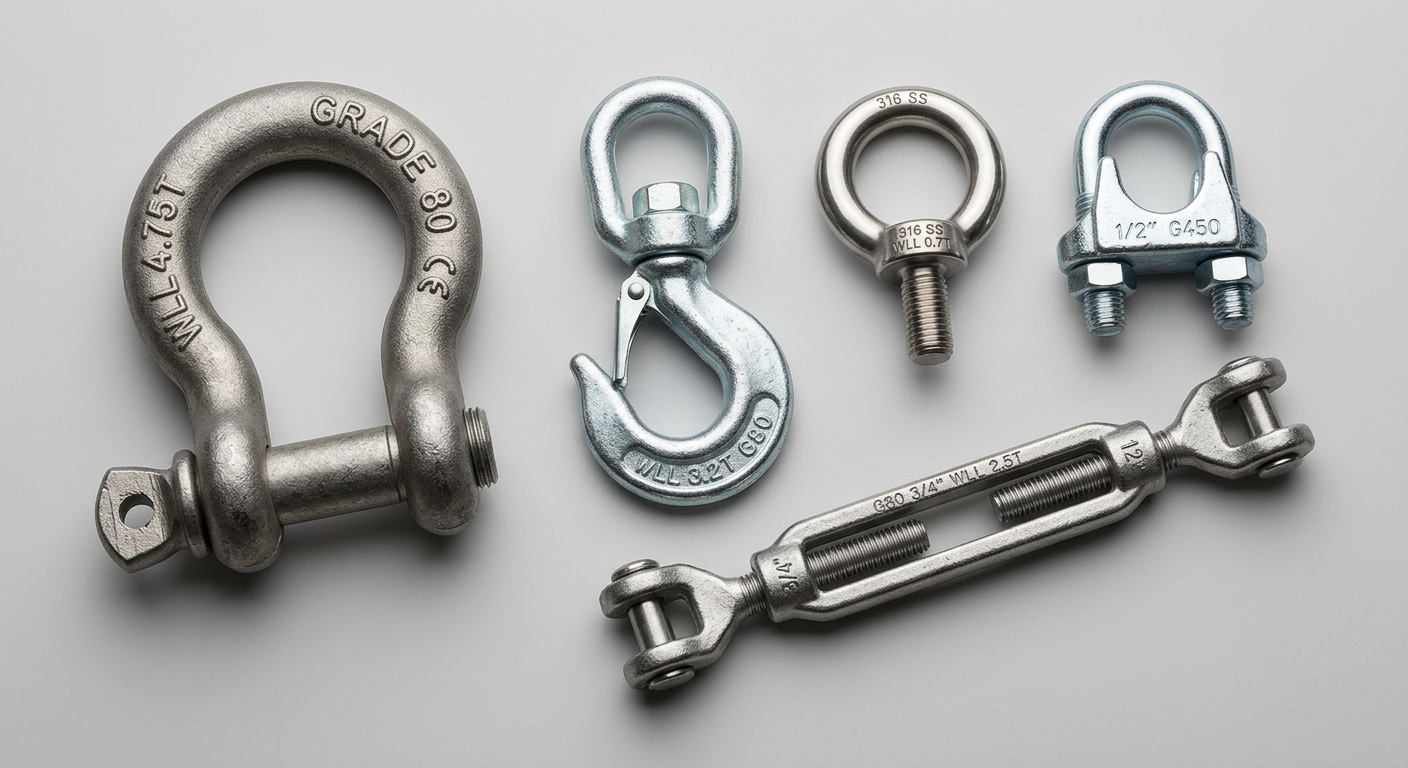
1.1 Key Types of Rigging Hardware and Their Functions
A lifting system is only as reliable as its weakest component. For procurement teams, understanding the function and application of each rigging hardware component is the first step toward building a safe and compliant lifting assembly.
- Shackles: One of the most commonly used connecting components in lifting systems. Bow shackles are suitable for multi-leg sling assemblies and angled loading conditions, while dee shackles are typically used for straight-line pulls. All shackles should have clear WLL markings and traceable identification.
- Hooks: Designed to connect loads or sling systems to lifting equipment. Swivel hooks help reduce sling twisting during rotation, while clevis hooks provide secure attachment for specific lifting configurations. Safety latches are required for most overhead lifting applications.
- Swivels: Used to prevent sling rotation, twisting, and torque buildup, especially in long vertical lifts or applications involving rotating loads.
- Turnbuckles: Provide controlled tension adjustment and length positioning in rigging assemblies. They are commonly used for bracing, lashing, and tensioning applications but should never replace a load-rated lifting component unless specifically designed for that purpose.
- Eye Bolts: Serve as fixed lifting or anchoring points in structural applications. Shoulder eye bolts are suitable for angular loading, while standard eye bolts are generally limited to vertical loading conditions.
- Wire Rope Clips (U-bolt Clips): Used to create wire rope terminations and loops. Proper installation spacing, orientation, and torque are essential, as incorrect installation can significantly reduce connection strength.
Each component should be selected as part of a complete rigging hardware system, ensuring that shackles, hooks, slings, and connectors have compatible ratings and are suitable for the intended lifting conditions.
1.2 Working Load Limit (WLL) and Safety Factor Explained
Working Load Limit (WLL) defines the maximum load that a rigging hardware component is designed to safely support under normal operating conditions. It is different from Minimum Breaking Strength (MBS), which represents the point at which the component may fail during testing.
The relationship between them is expressed as:
Safety Factor = Minimum Breaking Strength (MBS) ÷ Working Load Limit (WLL)
Common industry requirements include:
- 4:1 safety factor for general lifting components such as shackles, hooks, and eye bolts
- 5:1 safety factor for many wire rope and chain lifting applications
- Higher safety factors for dynamic loading, impact forces, or specialized environments
To determine the required WLL, buyers should consider the total load weight, number of load-bearing legs, sling angle, and any environmental factors that may affect performance. Every component in the lifting assembly must have a rated capacity equal to or higher than the calculated requirement.
For procurement purposes, always specify WLL rather than only MBS. Some suppliers may highlight breaking strength figures because they appear higher, but WLL provides the practical working capacity required for safe lifting operations.
2. Critical Selection Criteria for Rigging Hardware: Materials, Grades & Compliance Standards
2.1 Material Grades and Environmental Suitability
Selecting the right material is one of the most important steps when sourcing rigging hardware, as material properties directly affect load capacity, corrosion resistance, and service life in different operating environments.
Alloy Steel (Grade 80 / Grade 100):
Alloy steel is the preferred material for most overhead lifting applications due to its excellent strength-to-weight ratio. Grade 80 alloy steel is widely used for chain slings and lifting fittings, while Grade 100 provides a higher Working Load Limit (WLL) with a similar component size, helping reduce overall lifting weight without compromising safety. However, alloy steel requires proper protection when exposed to corrosive environments or aggressive chemicals.
Stainless Steel (Grade 316 / A4):
316 stainless steel rigging hardware is commonly selected for marine, offshore, food processing, and chemical environments where corrosion resistance is critical. Compared with alloy steel, stainless steel may have a lower load rating in the same size due to different mechanical properties, so buyers must consider both corrosion requirements and WLL specifications during selection.
Carbon Steel:
Carbon steel components can be suitable for low-frequency and controlled indoor applications where corrosion risk is limited. However, they are generally not recommended for demanding lifting operations, outdoor exposure, or regulated environments because of their lower corrosion resistance compared with alloy steel and stainless alternatives.
Environmental matching guidelines for rigging hardware:
- Saltwater and offshore applications: Choose 316 stainless steel or corrosion-protected alloy steel according to load requirements and operating conditions.
- High-temperature environments (>200°C): Confirm temperature derating factors with the manufacturer before selecting standard lifting components.
- Chemical exposure areas: Verify material compatibility to prevent corrosion, embrittlement, or premature component failure.
2.2 Certification & Compliance Standards to Verify Before Purchase
Regulatory compliance is non-negotiable. The following standards govern rigging hardware in major markets:
| Hardware Type | Applicable Standard | Minimum Safety Factor | Certification Marking | Common Application |
|---|---|---|---|---|
| Shackle | EN 13889 / ASME B30.26 | 4:1 | CE mark + WLL stamp | Construction, general lifting |
| Hook (Swivel/Clevis) | EN 1677-1 / ASME B30.10 | 4:1 | CE mark + grade marking | Crane, hoist attachment |
| Eye Bolt | ASME B18.15 / BS 4278 | 4:1 | WLL + material grade | Structural anchor points |
| Wire Rope Clip | EN 13411-5 / ASME B30.26 | 5:1 (assembly) | WLL + installation direction | Wire rope termination |
| Turnbuckle | ASME B30.26 / DIN 1480 | 4:1 | WLL + body type code | Tensioning, lashing |
Verification protocol for procurement teams:
- Request the manufacturer’s test certificate and proof load documentation for each batch
- Confirm CE markings (EU market) include the notified body number
- Cross-reference WLL stamped on hardware against the certificate—discrepancies indicate non-conforming product
- For OSHA 1926.251 compliance (US construction), verify hardware is manufactured to a recognized consensus standard and that documentation is retained on-site
3. Rigging Hardware Selection Guide for Different Lifting Applications
3.1 Rigging Hardware Compatibility and Load Configuration
The configuration of a lift directly affects the effective WLL of every rigging hardware component in the system. Understanding sling angle effects is essential before finalizing rigging hardware specifications, as incorrect configuration can reduce lifting capacity and create unsafe load conditions.
Sling Angle Reduction Factors (measured from horizontal):
- 90° (vertical) → Factor 1.0 (full rated capacity)
- 60° → Factor 0.866
- 45° → Factor 0.707
- 30° → Factor 0.500
A two-leg bridle sling at 45° does not double the rated WLL. Instead, each leg contributes only 70.7% of its rated capacity due to increased tension caused by the sling angle. Therefore, rigging hardware installed at the master link must be rated for the combined load forces created by the lifting configuration.
Hitch type compatibility:
- Vertical hitch: The simplest configuration, where hardware is loaded in line with the rated direction and can achieve the expected working capacity.
- Basket hitch: Increases lifting capacity but requires shackles, hooks, and connection points rated for the additional forces at the pick point.
- Choker hitch: Reduces effective WLL to approximately 75–80% of rated capacity. The choke point requires sufficient throat clearance and compatible hardware selection.
3.2 Industry-Specific Rigging Hardware Applications and Procurement Considerations
Different industries require different rigging hardware specifications based on load requirements, operating environments, and compliance obligations.
Construction & Civil Engineering: Prioritize Grade 80/100 alloy steel shackles and hooks with safety latches for heavy-duty lifting applications. Verify OSHA 1926.251 documentation and ensure all components have clear WLL markings. Hardware without identification marks or with welded repairs should not be accepted.
Offshore & Marine: Specify corrosion-resistant marine rigging hardware, such as Grade 316 stainless steel or hot-dip galvanized components, with DNV or Lloyd’s type approval where required. Standard alloy steel hardware without proper corrosion protection certification is unsuitable for continuous saltwater exposure.
Manufacturing & Overhead Cranes: Industrial rigging hardware used in overhead crane systems requires regular inspection records and compliance with ASME B30.2 requirements. Swivel hooks and below-the-hook lifting devices must meet applicable ASME B30.20 standards. Products without traceable batch documentation create unnecessary compliance risks.
Rigging for Pulling/Horizontal Applications: Many lifting components are designed for vertical loading and may have reduced capacity under angular or horizontal forces. Before using lifting hardware for pulling applications, confirm the manufacturer’s load data and ensure the selected component is suitable for the intended direction of force.
4. Inspection, Maintenance & Total Cost of Ownership
4.1 How to Inspect Rigging Hardware Before Use
Even properly selected rigging hardware can lose performance over time due to repeated loading, corrosion, improper storage, or mechanical damage. Regular inspection is essential to confirm that every lifting component remains within its rated working condition.
Before each lift, a competent person should inspect all lifting hardware and rigging components according to applicable safety requirements. Key inspection points include:
- Deformation: Bent shackle bodies, enlarged hook openings, or stretched components indicate overloading and require immediate removal from service.
- Cracks and fractures: Visible cracks should never be ignored. For critical lifting applications, additional testing methods such as magnetic particle or dye penetrant inspection may be required.
- Corrosion damage: Light surface corrosion may require cleaning and evaluation, while deep pitting or material loss can significantly reduce the strength of the component.
- Pin and thread condition: Shackle pins, eye bolt threads, and connection points must operate smoothly without excessive wear or deformation.
- Marking visibility: Any component without a clear WLL, grade, or manufacturer identification should not be used because its load capacity cannot be verified.
- Safety mechanisms: Hooks with safety latches must be checked to ensure proper engagement before operation.
A consistent inspection process helps identify damaged rigging hardware before failure occurs and reduces unexpected downtime, safety risks, and compliance issues.
4.2 Lifecycle Management and Supplier Qualification Tips
The service life of rigging hardware is not determined by a fixed replacement date. Instead, replacement decisions should be based on operating conditions, inspection records, loading frequency, and environmental exposure.
For high-frequency lifting operations, organizations should maintain usage records and establish scheduled inspections, typically every 6 or 12 months depending on the application and regulatory requirements.
Supplier qualification is equally important when sourcing lifting components. Reliable suppliers should provide:
- ISO 9001-certified manufacturing systems to ensure consistent production quality
- Batch-specific proof load test certificates rather than general product declarations
- Material certificates and traceability records for alloy steel or stainless steel components
- Documented quality control procedures covering inspection and non-conformance handling
Choosing the lowest-cost supplier without verifying manufacturing capability and documentation often creates higher long-term costs through premature replacement, failed inspections, and increased operational risks.
For contractors, offshore operators, and industrial users, selecting certified rigging hardware from a qualified manufacturer is not only a safety requirement but also an effective way to improve equipment reliability and lifecycle value.
Pertanyaan yang Sering Diajukan
Q1: What is the difference between WLL and Breaking Strength?
WLL is the maximum safe working load of rigging hardware during normal operation. Breaking Strength is the failure point during testing. Procurement documents should always specify WLL because it reflects the actual safe lifting capacity.
Q2: How can I verify rigging hardware quality from a supplier?
Request batch-specific test certificates, material documentation, and traceability records. Confirm that WLL markings, manufacturer information, and compliance documents match the supplied rigging hardware before purchase.
Q3: Can rigging hardware be used for both lifting and pulling?
Not always. Most lifting components are designed for specific load directions. Horizontal pulling or side loading may reduce capacity and create additional stress. Always check manufacturer load ratings before changing applications.
Q4: Which material is best for marine rigging hardware?
316 stainless steel is preferred for marine environments because of its excellent corrosion resistance. For heavy lifting applications, galvanized alloy steel may also be suitable when properly protected and maintained.
Q5: How often should rigging hardware be inspected?
Rigging hardware should be inspected before every lift. Formal inspections are typically required every 6 or 12 months, depending on usage frequency, environment, and applicable safety regulations.
Q6: How do I choose the right size rigging hardware?
Select hardware based on load weight, Working Load Limit (WLL), sling configuration, and operating conditions. Every component in the lifting system should meet or exceed the required load rating.
Kesimpulan
Selecting the right rigging hardware is not only about load capacity—it requires matching WLL, material grade, certification standards, and application conditions to ensure safe and reliable lifting performance.
By choosing properly certified hardware and working with a qualified supplier, companies can reduce equipment failures, compliance risks, and long-term maintenance costs. Whether for construction, marine, or industrial lifting applications, the right specification helps improve safety throughout the equipment lifecycle.
Need help selecting the right rigging hardware for your project? Contact GN Ocean for application-specific recommendations, product specifications, and certification support.