

Абстракт
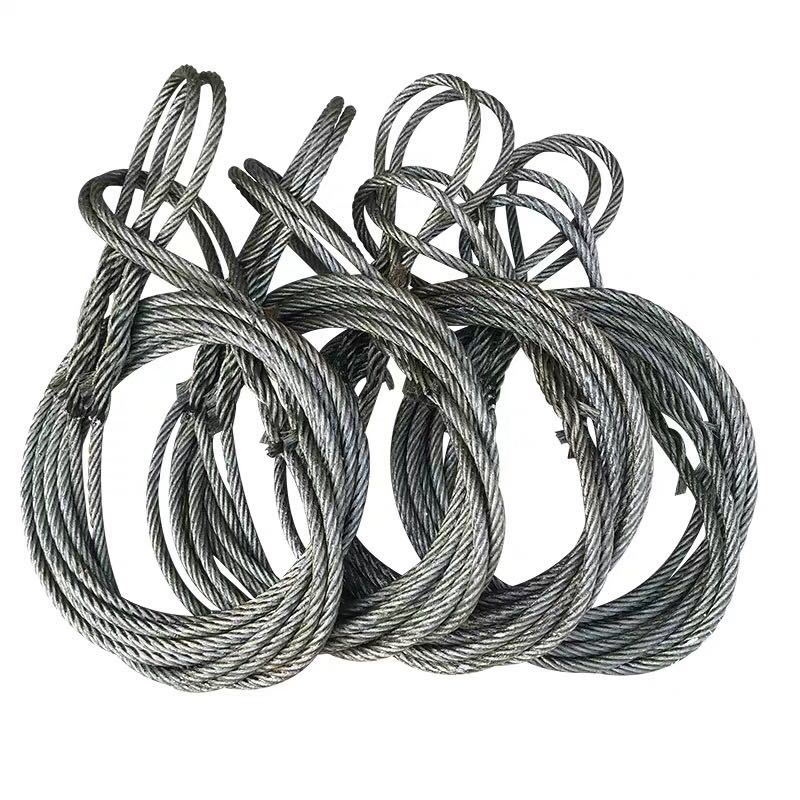
Offshore lifting operations place extraordinary demands on rigging hardware. Unlike onshore crane work, offshore environments combine dynamic vessel motion, saltwater corrosion, high-cycle fatigue loading, and stringent regulatory oversight — all simultaneously. A сплитна стоманена въжена петля that performs adequately in a fabrication yard may fail prematurely or fall outside compliance requirements when deployed on a platform deck or subsea installation vessel.
This article provides procurement engineers and rigging managers with a structured framework for evaluating spliced steel wire rope slings against the specific demands of offshore work. We cover rope construction and splice integrity, Working Load Limit (WLL) calculations under offshore design factors, corrosion protection strategies by exposure zone, and the inspection and documentation protocols required by classification societies and industry standards. The objective is to help sourcing teams make technically defensible, safety-first decisions — not simply to select the lowest-cost sling that clears a basic load rating threshold.
1. Understanding Spliced Steel Wire Rope Sling Construction for Offshore Use
1.1 Rope Construction & Splice Integrity
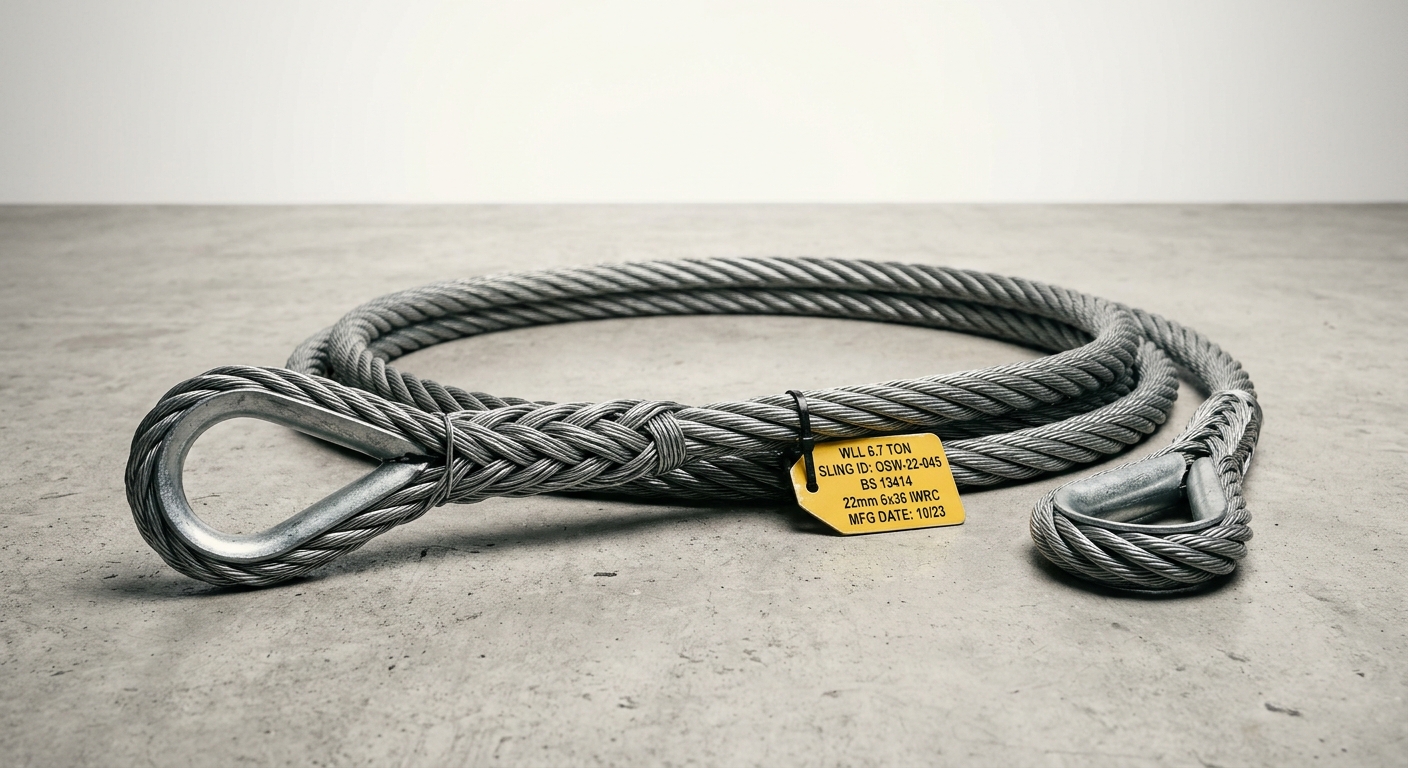
The mechanical performance of a spliced steel wire rope sling begins with rope construction. For offshore applications, the most commonly specified constructions are 6×36 IWRC (Independent Wire Rope Core) and 6×19 IWRC — both offering superior resistance to crushing and deformation compared to fiber-core alternatives. The IWRC configuration adds approximately 7.5% to the rope’s breaking strength while maintaining flexibility under dynamic loading conditions typical of crane lifts from a floating vessel.
Splice efficiency is a critical but frequently underestimated parameter. A mechanical (Flemish eye) splice achieves approximately 95–100% of the rope’s catalog breaking strength when properly executed, making it the preferred method for offshore slings. Hand-tucked splices, while acceptable in some onshore applications, typically achieve only 75–90% efficiency and are generally not accepted under offshore project specifications or classification society review.
Strand count and lay direction also influence fatigue behavior. Regular-lay ropes distribute bending stress more evenly across individual wires, extending fatigue life in applications involving repeated lifts over sheaves or pad eyes. Lang-lay constructions offer improved abrasion resistance but require careful handling to prevent unlaying under load — a consideration when slings are rigged in choker configuration around irregular structural members.
1.2 Sling Configuration Options
Sling geometry directly determines how load is distributed and what WLL applies in a given lift. The four primary configurations used offshore are:
- Single-leg slings: Simplest configuration; WLL applies directly in vertical hitch. Used for symmetrical, well-defined lifts.
- Multi-leg slings (2-, 3-, or 4-leg): Load is shared across legs; WLL is angle-dependent. At 60° included angle, a two-leg sling retains approximately 87% of its single-leg vertical WLL per leg.
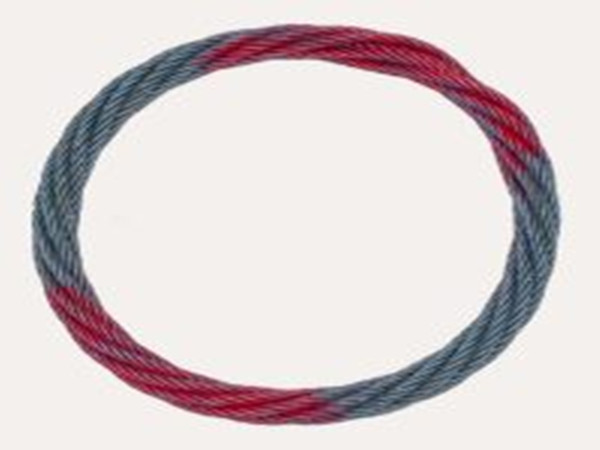
- Endless (grommet) slings: No termination hardware; uniform load distribution around circumference. Preferred for subsea lifting frames and spreader beam rigging.
- Basket hitch configurations: Double the contact area on the load; WLL up to 2× vertical rating when properly supported.
| Sling Type | Rope Diameter (mm) | WLL Vertical (t) | WLL Choker (t) | WLL Basket (t) | Splice Efficiency | Typical Offshore Application |
|---|---|---|---|---|---|---|
| Single-leg, eye & eye | 16 | 3.15 | 2.36 | 6.30 | 95% | General deck lifts |
| Two-leg bridle | 20 | 5.30 × 2 legs | — | — | 95% | Module installation |
| Endless grommet | 22 | 6.70 | — | 13.40 | 100% | Subsea structure lifts |
| Four-leg chain sling | 25 | 8.50 × 4 legs | — | — | 95% | Heavy topside modules |
Table 1: Representative WLL values at 5:1 design factor; actual ratings subject to manufacturer certification and third-party verification.
2. Load Ratings & Rope Specifications: What Offshore Standards Require
2.1 Working Load Limit Calculation & Design Factor
Offshore lifting standards universally mandate a minimum 5:1 design factor (also expressed as a safety factor of 5) between the minimum breaking load (MBL) of the sling assembly and its stated WLL. This is more conservative than the 4:1 factor permitted for general industrial lifting under some onshore standards, and for good reason: offshore crane operations involve dynamic amplification factors (DAFs) that can increase effective load by 15–35% depending on sea state, vessel motion, and lift-off dynamics.
Proof load testing — typically at 2× WLL for sling assemblies — must be conducted and documented prior to offshore deployment. Some project specifications and classification societies require proof loads up to 2.5× WLL for critical lifts. Dynamic load amplification must be factored into the WLL selection, not treated as a post-selection safety margin.
For lifts classified as engineered lifts (typically above 10 tonnes or involving complex rigging geometry), a formal lift plan incorporating sling WLL, DAF, and angle de-rating is required by most offshore operators and flag state regulations.
2.2 Applicable Compliance Standards
Multiple standards govern offshore sling certification, and they are not fully interchangeable:
- EN 13414-1 (Europe): Specifies construction, WLL, marking, and testing for steel wire rope slings. Required for CE marking; widely accepted on European Continental Shelf projects.
- ASME B30.9 (North America): Covers sling construction, use, inspection, and removal criteria. Mandatory on US Gulf of Mexico and many international projects with American operators.
- DNV-ST-E271: DNV’s standard for lifting appliances and accessories used in offshore operations. Required when DNV acts as the certifying authority for the lifting operation or equipment package.
- LEEA Code of Practice: The Lifting Equipment Engineers Association provides supplementary guidance on inspection intervals, rejection criteria, and competency requirements widely adopted across the North Sea and Asia-Pacific offshore sectors.
Procurement teams should confirm which standard(s) apply to their specific project jurisdiction and operator requirements before sourcing. A sling certified only to EN 13414-1 may require supplementary DNV or Lloyd’s verification before it is accepted on a DNV-classed vessel or installation.
3. Corrosion Resistance in Marine & Offshore Environments
3.1 Wire Coating & Lubrication Strategies
Corrosion is the primary life-limiting factor for steel wire rope slings in offshore service. Three protection strategies are commonly deployed, either individually or in combination:
- Hot-dip galvanized wire: Provides a zinc coating that sacrificially protects the steel substrate. Galvanized slings are standard for atmospheric and splash zone exposure and offer a cost-effective balance of protection and mechanical performance.
- Stainless steel wire (Grade 316): Superior chloride resistance; preferred for permanently submerged or highly corrosive splash zone applications. Carries a cost premium of 3–5× carbon steel equivalents but significantly extends service life in aggressive environments.
- Factory-applied penetrating lubricant: All offshore-grade wire rope slings should be supplied with internal lubrication applied during stranding. This lubricant protects internal wires — where corrosion is not visible during inspection — and reduces inter-wire fretting fatigue. Re-lubrication in service should be specified in the maintenance plan.
- Polymer/PVC jacketing: Provides mechanical abrasion protection and secondary corrosion barrier. Useful for slings in contact with structural steel edges but limits visual inspection of the wire beneath; must be removed periodically for full inspection.
3.2 Material Selection by Exposure Zone
Offshore structures are classified into exposure zones, each demanding a different material and finish specification:
| Exposure Zone | Description | Recommended Wire Material | Surface Protection |
|---|---|---|---|
| Atmospheric Zone | Above splash, no direct seawater contact | Galvanized carbon steel | Factory lubricant + periodic re-lubrication |
| Splash Zone | Intermittent seawater wetting, high oxygen | Galvanized or 316 SS | Heavy lubricant + polymer jacket |
| Submerged Zone | Continuously submerged | 316 Stainless Steel | Factory lubricant; inspect at retrieval |
| Enclosed/Chemical | Cargo holds, chemical tanker decks | 316 SS or duplex alloy | Application-specific coating |
Table 2: Material selection by offshore exposure zone.
4. Inspection, Rejection Criteria & Service Life Management
4.1 Pre-Use & Periodic Inspection Requirements
Offshore sling inspection is governed by both the applicable standard and the operator’s safety management system. Under ASME B30.9 and LEEA guidelines, a pre-use visual inspection is mandatory before every lift. A formal periodic inspection by a competent person is required at intervals not exceeding 12 months, with more frequent inspection required in severe service environments — typically every 3–6 months for offshore splash zone slings.
Rejection criteria under ASME B30.9 and EN 13414-1 include:
- Broken wires: More than 10 randomly distributed broken wires in any rope lay length, or more than 5 broken wires in one strand
- Corrosion: Pitting visible on outer wires; evidence of internal corrosion at strand interstices
- Deformation: Kinking, birdcaging, core protrusion, or diameter reduction exceeding 10% of nominal
- Splice condition: Any distortion, wire protrusion, or tuck displacement at the splice termination
- Heat or chemical damage: Discoloration, embrittlement, or loss of lubrication indicating thermal or chemical exposure
Any sling meeting one or more rejection criteria must be removed from service immediately and either repaired by a certified sling manufacturer or destroyed.
4.2 Documentation & Traceability for Offshore Projects
Offshore lifting operations require a complete documentation chain from manufacture through each lift. At minimum, this includes:
- Test certificate (EN 10204 Type 3.1 or 3.2): Issued by an accredited laboratory; links sling identity to proof load test results and material heat numbers
- Third-party verification: DNV, Bureau Veritas, or Lloyd’s Register endorsement where required by the project specification or vessel class
- Unique sling identification: Permanent marking (tag, stamp, or RFID) enabling traceability to the test certificate
- Inspection and maintenance logbook: Records each pre-use inspection, periodic inspection findings, re-lubrication events, and any damage/repair history
Operators and offshore contractors increasingly require digital traceability — linking sling IDs to cloud-based inspection records accessible during project audits. Suppliers who can provide this documentation infrastructure alongside the physical product offer measurable procurement value.
Често задавани въпроси
Q1: What minimum design factor is required for spliced steel wire rope slings used in offshore crane lifts?
The industry-standard minimum is 5:1 (breaking load to WLL ratio) for offshore lifting slings, as required by DNV-ST-E271 and consistent with LEEA and most major operator specifications. Some critical or engineered lifts may require higher factors — confirm requirements with the certifying authority and lift plan engineer before procurement.
Q2: How does saltwater exposure affect the inspection interval and service life of a wire rope sling?
Saltwater accelerates both external and internal corrosion, significantly reducing service life relative to onshore equivalents. Offshore operators typically reduce inspection intervals to 3–6 months for slings in splash zone or wet deck service, compared to the 12-month maximum for standard service. Internal corrosion — not visible externally — is a leading cause of premature failure; factory lubrication quality and re-lubrication frequency are critical mitigation measures.
Q3: Can a standard EN 13414-certified sling be used directly on an offshore installation, or is additional DNV certification required?
This depends on the project specification and the class of the vessel or installation. EN 13414-1 certification satisfies CE marking requirements and is accepted on many European offshore projects. However, if the installation is DNV-classed or the operator’s lifting procedure requires DNV-ST-E271 compliance, a supplementary DNV verification or third-party endorsement will be required. Always confirm certification requirements with the project’s lifting authority before procurement.
Заключение
Selecting the right spliced steel wire rope sling for offshore work is a multi-variable engineering and procurement decision. Rope construction — particularly IWRC configuration and Flemish eye splice efficiency — establishes the mechanical foundation. WLL ratings must be calculated against a minimum 5:1 design factor with dynamic amplification factored into the lift plan. Corrosion protection strategy must be matched to the specific exposure zone, with galvanized or stainless steel wire selected accordingly. And documentation — test certificates, third-party verification, and inspection logbooks — is not administrative overhead but a core deliverable that enables offshore operators to meet audit requirements and manage liability.
Procurement teams that treat these criteria as an integrated checklist, rather than independent specifications, will source slings that perform reliably across their full service life, satisfy classification society review, and reduce the operational risk that makes offshore lifting one of the highest-consequence activities in the energy sector.