

الملخص
Selecting the correct round-strand wire rope for overhead crane duty in steel mill environments requires balancing three critical performance axes: thermal resistance, surface wear tolerance, and certified minimum break force (MBF). Overhead cranes in active steel mills operate under M5–M8 duty classifications, cycling thousands of lifts per shift under radiant heat, scale abrasion, and aggressive humidity. A rope specification error in this context doesn’t just shorten service life — it creates regulatory exposure, unplanned downtime, and potential catastrophic failure.
This article provides procurement engineers and maintenance managers with a structured specification framework covering strand construction, wire grades, compliance standards, discard criteria, and total cost of ownership. The goal is to eliminate guesswork and give your team a defensible, data-backed rope selection process for the most demanding crane duty environments in industrial operations.
1. Understanding Round-Strand Wire Rope Construction for Crane Applications
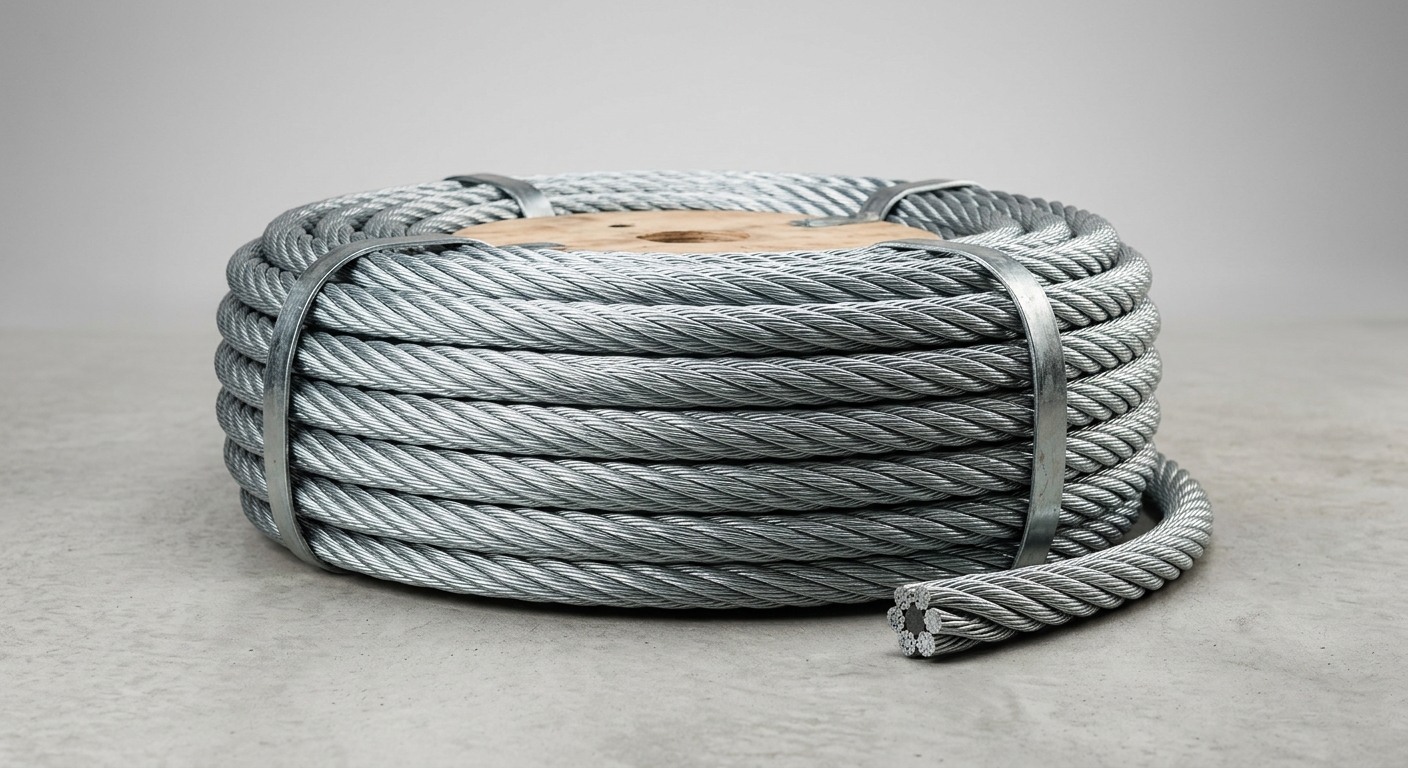
1.1 Strand Architecture and Core Types
Round-strand wire rope for overhead crane duty is defined primarily by its strand-count construction and core type — two variables that govern flexibility, crush resistance, and fatigue performance under cyclic loading.
The most common constructions for crane applications are:
- 6×19 class: Moderate flexibility, high abrasion resistance. Suited for single-layer drum winding and lower-speed hoists with larger sheave diameters.
- 6×36 class: Higher flexibility due to finer outer wires, preferred for multi-layer drum winding in ladle cranes and charging cranes where rope fleet angles change continuously.
- 8×36 construction: Eight strands improve flexibility and reduce bearing pressure on sheave grooves, extending both rope and sheave life in high-cycle applications.
Core selection is equally decisive:
- Fiber Core (FC): Lower cost, provides cushioning, but compresses under high radial load. Unsuitable for multi-layer drum winding or elevated temperatures above 100 °C.
- Independent Wire Rope Core (IWRC): Resists crushing under high drum pressure, maintains rope diameter stability, and tolerates higher operating temperatures. IWRC is the standard specification for steel mill overhead crane duty.
Lay direction (regular lay vs. Lang’s lay) also matters. Lang’s lay wire rope offers superior abrasion resistance and fatigue life on smooth sheaves, but requires careful fleet angle management to prevent unlaying. For most crane configurations, regular lay remains the safer default.
1.2 Wire Grade and Surface Finish Options
Wire tensile grade directly determines MBF for a given rope diameter. Three grades dominate crane rope procurement:
- IPS (Improved Plow Steel): Baseline grade, adequate for light-to-medium duty. Rarely specified for steel mill applications.
- EIPS (Extra Improved Plow Steel): 10% higher tensile strength than IPS. The industry standard for M5–M7 crane duty classes.
- EEIPS (Extra Extra Improved Plow Steel): Highest available tensile grade, delivering maximum MBF per millimeter of diameter. Preferred for M8 duty class ladle cranes and applications where rope diameter is constrained by drum geometry.
Surface finish selection must account for the mill’s thermal and humidity profile:
- Ungalvanized (bright) wire: Highest tensile strength, lowest corrosion resistance. Acceptable only with rigorous lubrication programs.
- Galvanized wire: Zinc coating sacrifices approximately 5–8% tensile strength but provides meaningful corrosion protection in humid or chemically active mill bays.
- Drawn-galvanized (DG) wire: Galvanized before drawing, producing a thinner but more uniform coating with minimal tensile strength penalty. The preferred balance for most steel mill environments.
| Construction | Wire Grade | Core | Nominal MBF (kN) at 32mm | ISO 4301 Duty Class | Service Environment |
|---|---|---|---|---|---|
| 6×19 | EIPS | IWRC | ~680 | M5–M6 | General overhead crane |
| 6×36 | EIPS | IWRC | ~660 | M6–M7 | Multi-layer drum, charging crane |
| 8×36 | EEIPS | IWRC | ~720 | M7–M8 | Ladle crane, high-cycle mill duty |
| 6×36 | EEIPS | IWRC | ~700 | M7–M8 | High-temperature mill environments |
Table 1: Construction × Wire Grade × Core × MBF × Duty Class × Application
2. Critical Performance Parameters for Steel Mill Overhead Crane Duty
2.1 Minimum Break Force, Safety Factor, and Fatigue Life
Under ISO 2408 and EN 12385-4, MBF is calculated as the aggregate breaking force of all individual wires, multiplied by a spin-loss factor specific to the rope construction. For procurement purposes, always specify MBF from the certified test report — not the catalog nominal value.
Safety factor requirements for overhead crane wire rope are governed by duty class:
- M5–M6: Minimum design factor of 5:1 on MBF relative to maximum working load
- M7: Design factor of 6.3:1 or higher, per FEM 1.001 and ISO 4301
- M8 (severe/continuous): Design factor of 8:1 or higher; some ladle crane specifications require 10:1
Fatigue life is the limiting variable in 24/7 operations. A 6×36 IWRC rope on a correctly sized sheave (D/d ratio ≥ 25:1) can sustain 200,000–400,000 bending cycles before discard criteria are reached. Reducing the D/d ratio below 18:1 can cut fatigue life by more than 50%, making sheave diameter specification inseparable from rope selection.
2.2 Heat Resistance and Abrasion Tolerance Thresholds
Steel mill overhead cranes — particularly ladle cranes, stripper cranes, and charging cranes — operate in ambient radiant heat environments that can exceed 150 °C at rope level. Key thermal limits by component:
- Fiber core ropes: Discard above 100 °C continuous exposure
- IWRC with petroleum-based lubricant: Operational limit ~120–150 °C; lubricant oxidation accelerates above this threshold
- IWRC with high-temperature synthetic lubricant: Extends operational range to 200 °C with scheduled re-lubrication
Abrasion wear concentrates at sheave contact points and drum wrap zones. EEIPS wire grade provides surface hardness approximately 15% higher than EIPS, directly reducing wear rate per cycle. For ladle and charging crane applications, specifying compacted-strand (swaged) outer wires in a 6×36 or 8×36 construction reduces the contact stress per wire and extends abrasion service life by 20–35% compared to standard round-wire constructions.
3. Compliance Standards and Specification Checklist
3.1 Applicable International and Regional Standards
Four standards frameworks govern round-strand wire rope specification for overhead crane duty:
- ISO 2408: Defines dimensional tolerances, MBF calculation, mass per meter, and test methodology for general-purpose steel wire ropes.
- EN 12385-4: European standard for stranded ropes for general lifting applications; mandatory for CE-marked crane systems in EU jurisdictions.
- ASME B30.2: Governs overhead and gantry crane design and operation in North American markets; references wire rope selection, installation, and inspection intervals.
- FEM 1.001: Federation Européenne de la Manutention classification system for crane duty classes (M1–M8); the most widely used framework for mapping operational intensity to rope and component specifications globally.
For steel mill procurement, the minimum documentation package should include: EN 12385-4 or ISO 2408 mill certificate, third-party MBF test report, material traceability records, and lubricant specification data sheet.
3.2 Inspection, Discard, and Replacement Criteria
ISO 4309 is the definitive standard for wire rope discard criteria in crane applications. Key thresholds:
- Broken wire count: For 6-strand ropes, discard when visible broken wires reach 2 in any rope diameter length (6d) or 4 in any 30d length over the outer strands
- Diameter reduction: Discard when measured rope diameter falls more than 3% below nominal for IWRC constructions
- Corrosion: Internal corrosion visible at strand interstices, or external pitting reducing wire cross-section, triggers immediate discard regardless of broken wire count
- Kinks, birdcaging, and core protrusion: Automatic discard — no threshold applies
For 24/7 steel mill operations, inspection frequency should be:
- Daily visual check by certified operator: surface damage, kinking, lubrication state
- Weekly detailed inspection by competent person: broken wire count, diameter measurement
- Monthly documented inspection with written records retained for regulatory traceability
4. Commercial and Operational Value: Total Cost of Ownership
4.1 Rope Lifecycle Cost vs. Initial Purchase Price
The purchase price of a premium EEIPS 8×36 IWRC rope may be 25–40% higher than a standard IPS 6×19 FC rope of equivalent diameter. In continuous steel mill operations, this premium typically pays back within the first replacement cycle.
TCO drivers that favor premium rope construction:
- Replacement frequency: A correctly specified EEIPS 6×36 IWRC rope in an M7 application typically achieves 1.8–2.5× the service life of a standard IPS equivalent
- Crane downtime cost: In integrated steel mills, overhead crane downtime can cost $15,000–$50,000 per hour in lost production throughput; a single avoided emergency rope change justifies significant upfront rope investment
- Lubrication intervals: Compacted-strand constructions retain lubricant more effectively, reducing re-lubrication frequency and associated labor costs
- Sheave and drum wear: Higher-grade ropes with smoother outer wire profiles reduce groove wear, extending sheave replacement intervals
4.2 Supplier Qualification and Procurement Risk Factors
For critical lifting applications, supplier qualification must go beyond catalog specifications:
- Mill certificate traceability: Each rope reel must carry heat number, wire rod origin, and test results traceable to the specific production batch
- Third-party test reports: Independent MBF testing by accredited laboratories (e.g., TÜV, SGS, Bureau Veritas) is non-negotiable for M7–M8 duty class procurement
- Lead time risk: Specialty constructions (8×36 EEIPS compacted strand, large diameters >40mm) carry 8–16 week lead times from major manufacturers; procurement planning must account for safety stock
- Vendor qualification criteria: Require ISO 9001 certification, documented process controls for wire drawing and stranding, and reference installations in comparable steel mill environments
الأسئلة الشائعة
Q1: What is the recommended round-strand wire rope construction for a steel mill overhead crane operating at temperatures above 150 °C?
Specify an 8×36 or 6×36 EEIPS IWRC construction with a high-temperature synthetic lubricant rated to at least 200 °C. Fiber core constructions must be excluded. Verify lubricant re-application intervals with the rope manufacturer, as oxidation at elevated temperatures is the primary driver of internal wire fatigue in thermal environments.
Q2: How do I calculate the correct minimum break force for a 24/7 duty-class M7 ladle crane application?
Determine the maximum static working load (SWL) including hook block, lifting beam, and rated load. Apply a design factor of 6.3:1 per FEM 1.001 for M7 duty class: MBF (kN) = SWL (kN) × 6.3. Select a rope construction and diameter from certified supplier data where the tabulated MBF meets or exceeds this calculated value. Always verify against the actual test report MBF, not catalog nominal values.
Q3: What discard criteria apply under ISO 4309, and how often should inspections occur in high-abrasion environments?
ISO 4309 mandates discard at 2 broken outer wires in any 6d length, 3% diameter reduction for IWRC ropes, or any evidence of internal corrosion or mechanical deformation. In high-abrasion steel mill environments, conduct daily visual checks, weekly broken wire counts with diameter measurement, and monthly documented inspections with written records. Increase frequency if operating conditions deteriorate or after any abnormal loading event.
الخاتمة
Specifying the right round-strand wire rope for overhead crane duty in steel mill operations is a multi-variable engineering decision with direct consequences for safety, regulatory compliance, and production continuity. The optimal specification aligns strand construction (6×36 or 8×36 IWRC), wire grade (EIPS or EEIPS), surface finish (drawn-galvanized for corrosive environments), and MBF rating with the actual ISO 4301 duty class and thermal operating profile.
Procurement teams that integrate discard protocols, supplier qualification requirements, and TCO analysis into the rope selection process consistently achieve lower lifecycle costs and fewer unplanned outages than those optimizing on purchase price alone. In a 24/7 steel mill environment, the wire rope is not a consumable — it is a critical load-bearing component that deserves the same engineering rigor as any structural element in the crane system.