

Abstrakt
For procurement engineers and rigging supervisors handling high-value or surface-sensitive loads, minimizing damage during lifting is a critical operational and financial concern. A single marred surface on a precision-machined component or a polished architectural panel can translate into rework costs, project delays, and supplier liability claims that far exceed the cost of the lifting hardware itself.
This article examines how polyester round slings — by design — address the core challenges of delicate load handling: material flexibility, contact pressure distribution, and compatibility with professional rigging practices. Drawing on material science fundamentals and established rigging standards (EN 1492-2, ASME B30.9), the discussion provides procurement teams and site engineers with a technically grounded rationale for specifying round slings in damage-sensitive applications. Readers will gain both a product-level and application-level understanding of why the polyester round sling has become the preferred lifting solution wherever surface integrity is non-negotiable.
1: Why Delicate Loads Demand a Different Lifting Approach
1.1: Defining “Delicate Loads” in Industrial Lifting Contexts
In industrial rigging, a “delicate load” is not necessarily fragile in the structural sense — it is any load where surface integrity, dimensional accuracy, or coating condition is operationally or commercially critical. This category is broader than many buyers initially recognize and includes:
- Polished and coated metals: Stainless steel equipment housings, anodized aluminum panels, chrome-finished machine components
- Natural stone and architectural materials: Granite slabs, marble countertops, pre-cast decorative concrete elements
- Precision machinery and electronics: CNC machine beds, turbine casings, transformer cores, large-format display modules
- Glass and composite panels: Structural glazing units, GFRP boat hulls, carbon fiber aerospace assemblies
- Finished automotive and aerospace components: Painted body panels, engine nacelles, landing gear assemblies
What these loads share is vulnerability to point-load stress, abrasion, and chemical contamination introduced by lifting hardware. A scratch on a turbine casing may require full surface re-treatment. A pressure mark on a polished granite slab may render it commercially unacceptable. The damage mechanism is predictable — and preventable with the correct sling selection.
1.2: How Conventional Slings and Hardware Cause Surface Damage
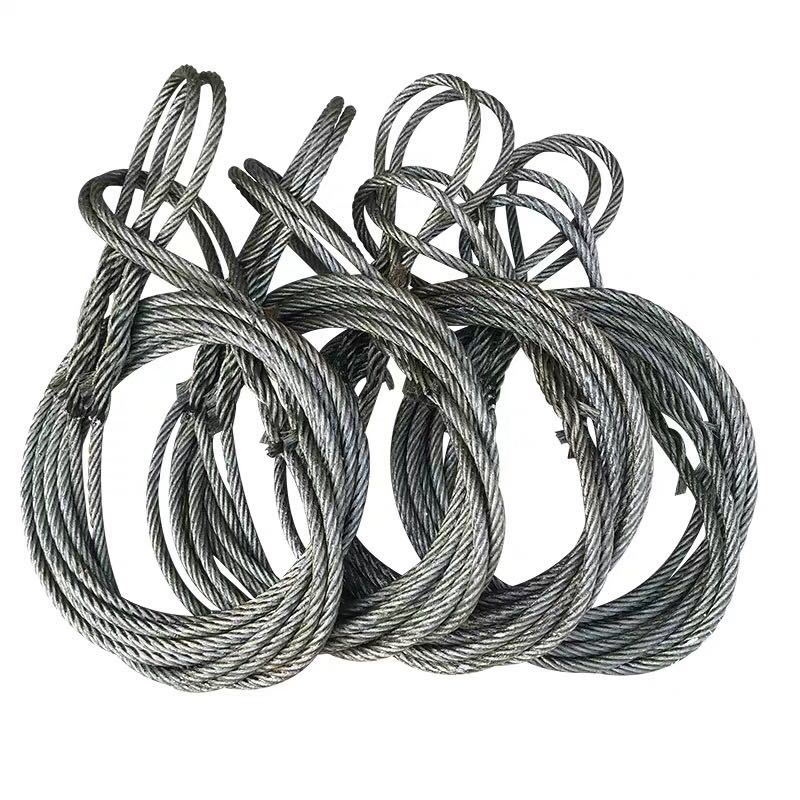
Wire rope slings and chain slings are engineered for raw tensile strength, not surface protection. Their fundamental geometry creates the problem: rigid, small-diameter contact points that concentrate load stress onto a narrow band of the load surface. Under tension, a wire rope sling can generate localized contact pressures sufficient to mark soft metals, chip stone edges, or fracture surface coatings.
Chain slings introduce additional risk through link-edge abrasion and the potential for chemical contamination from chain lubricants. Even flat web slings, while softer than wire or chain, present a relatively stiff contact profile that can crease or dent surfaces on irregular geometries.
The commercial cost of this damage is significant. In B2B operations, a single damaged load can trigger replacement procurement, project schedule disruption, insurance claims, and reputational consequences with end clients. For procurement managers, the business case for specifying purpose-designed slings for delicate loads is not marginal — it is straightforward risk elimination.
2: Material & Structural Properties of Polyester Round Slings
2.1: Polyester Fiber Characteristics That Minimize Load Damage
The protective performance of a polyester round sling begins at the fiber level. High-tenacity polyester yarn — the load-bearing core of every round sling — combines several properties that are directly relevant to surface protection:
- Non-abrasive surface texture: Polyester fibers are smooth and non-metallic. Unlike wire strands, they cannot score, scratch, or indent metal surfaces under normal working loads.
- Controlled elongation: Polyester exhibits approximately 2–3% elongation at working load. This controlled compliance allows the sling to conform slightly to load geometry without the snap-back energy of more elastic materials, reducing dynamic impact on sensitive surfaces during lift initiation.
- Chemical inertness: Polyester is resistant to most oils, mild acids, and alkaline solutions encountered in industrial environments. It will not transfer reactive contaminants to finished surfaces — a critical consideration for aerospace and food-grade equipment handling.
- UV and moisture stability: Polyester retains structural integrity and surface softness in outdoor and humid environments, maintaining its protective characteristics across a wider range of operating conditions than natural fiber alternatives.
These properties collectively make polyester the material of choice when the sling-to-load interface must be both strong and non-damaging.
2.2: Endless Loop Construction and Contact Pressure Distribution
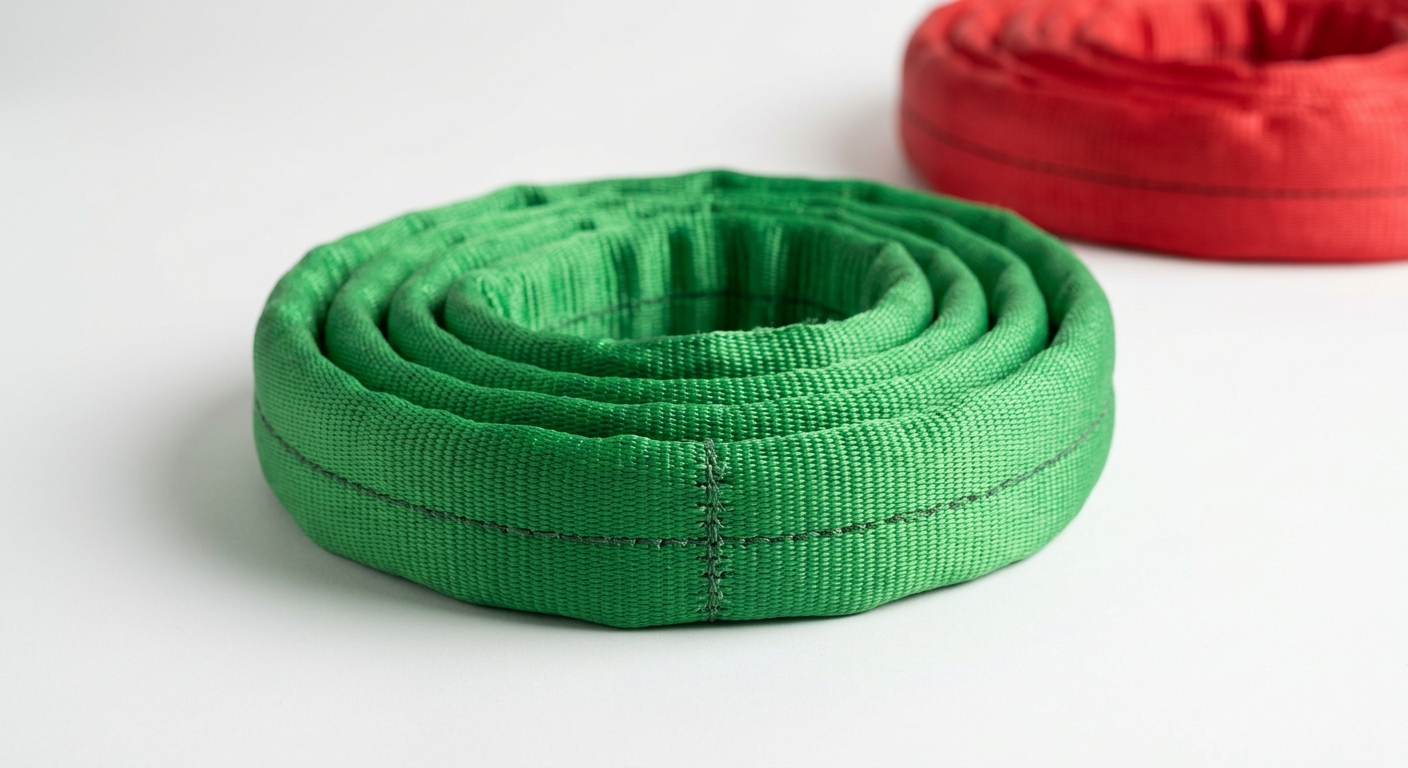
The defining structural feature of a round sling is its tubular endless-loop construction. Multiple polyester yarn bundles are wound continuously inside a seamless protective sleeve, creating a circular cross-section that distributes load across a significantly wider contact area than wire rope or chain of equivalent capacity.
This geometry has a direct engineering consequence: contact pressure — the force per unit area applied to the load surface — is substantially reduced. Where a wire rope sling concentrates load onto a contact width measured in millimeters, a round sling spreads that same force across several centimeters of surface contact, reducing peak stress at any single point.
The tubular sleeve also provides a secondary protective layer between the yarn bundle and the load, further buffering surface contact.
| Sling Type | Surface Contact Area | Risk of Surface Marking | Flexibility on Irregular Shapes | Typical WLL Range | Recommended Load Surface |
|---|---|---|---|---|---|
| Polyester Round Sling | Wide (tubular) | Low | High | 1T – 100T+ | Polished, coated, fragile, irregular |
| Flat Web Sling | Medium (flat band) | Low–Medium | Medium | 1T – 25T | Flat or mildly curved surfaces |
| Sznur liny | Narrow (strand contact) | High | Low | 1T – 500T+ | Rough industrial, structural steel |
| Chain Sling | Point (link edges) | High | Medium | 1T – 150T+ | Rough, high-temperature surfaces |
3: Rigging Techniques That Enhance Surface Protection
3.1: Hitch Configurations for Delicate Load Applications
Sling selection is only part of the solution — hitch configuration determines how and where the sling contacts the load. Three primary hitch types are used with round slings, each with distinct implications for surface protection:
- Basket hitch: The sling passes under the load with both eyes attached to the hook. This doubles the effective contact area and distributes load symmetrically, making it the preferred configuration for polished or coated surfaces. It also provides the highest WLL efficiency of the three hitches.
- Vertical (straight) hitch: A single-point connection from eye to hook. Efficient for symmetrical loads but concentrates sling tension at a single attachment point. Suitable for loads with reinforced lifting points; less ideal for bare finished surfaces.
- Choker hitch: The sling wraps around the load with one eye passing through the other. This configuration applies circumferential pressure and is effective for securing cylindrical loads (pipes, shafts), but the choke point can concentrate contact stress. For delicate cylindrical surfaces, supplementary load protection sleeves or corner pads should be used at the choke point.
When the load geometry introduces edge contact risks — such as lifting a stone slab or a fabricated metal frame — corner protectors or softener pads placed between the sling and the load edge are standard practice. These accessories extend sling service life while providing an additional buffer for the load surface.
3.2: Inspection, WLL Compliance, and Industry Standards
Polyester round slings manufactured to EN 1492-2 (Europe) or ASME B30.9 (North America) carry standardized color-coded sleeves that identify Working Load Limit (WLL) at a glance, eliminating capacity ambiguity on the lift site:
| Sleeve Color | WLL (Vertical Hitch) |
|---|---|
| Violet | 1 tonne |
| Zielony | 2 tonnes |
| Żółty | 3 tonnes |
| Grey | 4 tonnes |
| Czerwony | 5 tonnes |
| Brązowy | 6 tonnes |
| Niebieski | 8 tonnes |
| Pomarańczowy | 10 tonnes |
WLL selection for delicate loads must account for the hitch configuration efficiency factor, the number of sling legs, and any dynamic loading from lift acceleration. For sensitive lifts, a conservative safety factor and a controlled, low-acceleration lift profile are both standard best practice.
Pre-use inspection criteria include: cuts or tears in the outer sleeve, exposed core fibers, chemical discoloration indicating acid or alkali attack, heat damage, and any deformation of the end fittings. Any sling exhibiting these conditions must be removed from service immediately — not tagged for later review.
4: Application Scenarios and Commercial Value
4.1: Industries and Use Cases Where Round Slings Are Specified
Polyester round slings appear across a broad range of sectors wherever surface-sensitive loads are moved:
- Aerospace manufacturing: Lifting engine nacelles, composite fuselage sections, and avionics racks where surface integrity is a certification requirement
- Automotive production: Handling painted body panels, finished subassemblies, and glass roof modules on assembly lines
- Stone and monument handling: Moving polished granite, marble, and engineered stone slabs in fabrication shops and on installation sites
- Offshore and energy: Lifting coated pipeline sections, subsea equipment modules, and sensitive instrumentation packages
- Precision machinery installation: Positioning CNC machining centers, large metrology equipment, and medical imaging systems where surface marks or dimensional distortion are unacceptable
In each sector, the specification driver is the same: the cost of load damage exceeds the cost of the sling by orders of magnitude, making the round sling the economically rational choice.
4.2: Total Cost of Ownership vs. Load Damage Risk Reduction
A quality polyester round sling represents a modest capital expenditure — typically ranging from tens to a few hundred dollars depending on capacity and length. Its service life, under proper storage and inspection protocols, can extend to several years of regular use.
Compare this to the cost of a single damage event: a scratched aerospace component may require surface stripping and recoating at costs in the thousands. A cracked granite slab must be replaced entirely. A contaminated precision instrument may require factory recalibration.
For procurement teams, the justification framework is straightforward: the round sling is not a cost — it is damage insurance with a tangible, calculable return. Specifying the correct sling for delicate loads is a defensible procurement decision that reduces operational risk, protects supplier relationships, and supports project schedule integrity.
Najczęściej zadawane pytania
Q1: What is the maximum load capacity of a polyester round sling, and how is it selected for delicate loads?
Polyester round slings are manufactured in WLL ratings from 1 tonne to over 100 tonnes in vertical hitch configuration. For delicate load applications, WLL selection should be based on the calculated rigging load (including dynamic factors), the chosen hitch configuration’s efficiency factor, and a safety margin appropriate to the load’s value and fragility. Always select the next capacity grade up when operating near the calculated limit.
Q2: Can polyester round slings be used outdoors or in chemically active environments without compromising load surface protection?
Polyester offers good resistance to UV radiation, moisture, and most mild industrial chemicals. However, strong acids (pH below 4) and strong alkalis (pH above 11) can degrade polyester fibers. In chemically active environments, inspect slings more frequently and replace at the first sign of discoloration, stiffness, or fiber breakdown. The protective sleeve provides a primary barrier, but it is not a substitute for correct chemical compatibility assessment.
Q3: How do I know when a polyester round sling must be retired to prevent rigging failure during sensitive load lifts?
Mandatory retirement criteria include: any cut, tear, or hole in the outer sleeve; visible core fiber damage or exposure; chemical burns or heat discoloration; end fitting deformation; and any sling involved in a shock load event. For delicate load applications, adopt a more conservative retirement policy — if the sleeve shows significant wear or abrasion even without core exposure, retire the sling. The replacement cost is negligible relative to the value of the loads being handled.
Podsumowanie
Polyester round slings offer a structurally and materially sound solution for protecting delicate loads during lifting operations. Their non-abrasive fiber composition, tubular endless-loop construction, and controlled elongation characteristics work together to minimize contact pressure and eliminate the surface damage mechanisms inherent in wire rope and chain alternatives.
When combined with correct hitch selection, appropriate load protection accessories, and compliance with EN 1492-2 or ASME B30.9 standards, the polyester round sling provides a complete, defensible solution for damage-sensitive lifting. For procurement engineers evaluating lifting hardware for high-value assets, the specification calculus is clear: the protective performance and low total cost of ownership of the polyester round sling make it the rational, risk-reducing choice wherever surface integrity matters.