

Pengantar
Choosing the wrong shackle type can lead to load misalignment, accelerated wear, and increased safety risks in lifting and rigging operations. A shackle that does not match the actual load direction may contribute to equipment damage, operational delays, and compliance issues.
This guide compares the structural, mechanical, and application differences between bow shackles and D shackles. It is designed for procurement engineers, rigging specialists, and project managers who need a practical selection framework based on load conditions, industry standards, and real-world applications.
The key difference between these two shackle types lies in load geometry. Understanding how body design affects load capacity, side-loading performance, and application suitability is essential for selecting the right shackle for each lifting scenario.
1. Anatomy & Mechanical Differences: Bow Shackle vs D Shackle
1.1 Load Geometry & Body Shape
The primary difference between a bow shackle and a D shackle lies in body geometry, which determines how each type manages different load directions.
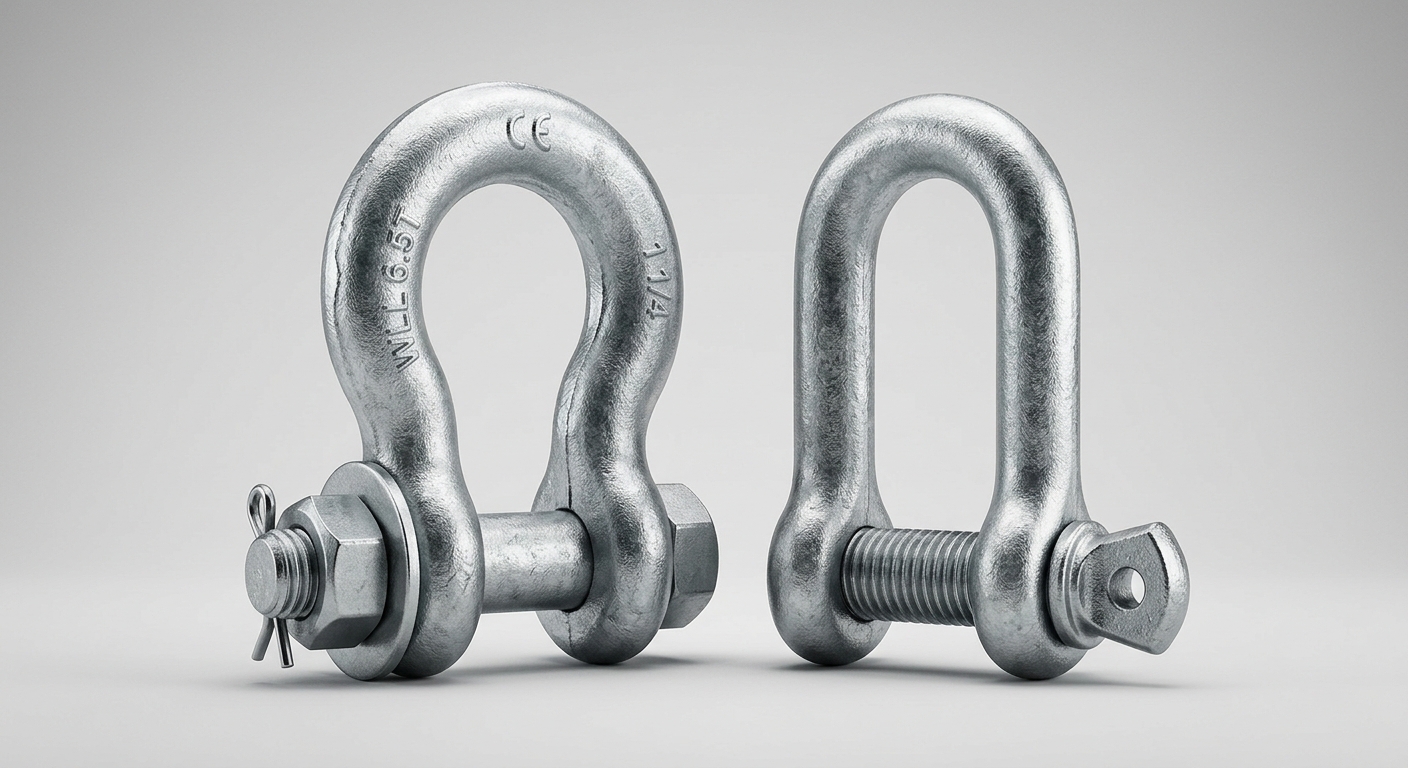
A bow shackle (also known as an anchor shackle) features a rounded, omega-shaped body with a wider bow design. This larger internal space allows loads to distribute across multiple contact points, making it suitable for multi-directional and angular loading conditions. It is commonly specified for multi-leg sling assemblies, where sling angles can create transverse forces on both the pin and shackle body.
A D shackle (also known as a chain shackle) has a narrower D-shaped body that creates a more direct load path between the pin and crown. This design performs efficiently under straight-line tension, where the load remains aligned with the shackle axis. However, its limited tolerance for side loading makes it unsuitable for applications involving significant angular forces. Depending on the loading angle, side-loading a D shackle can significantly reduce its effective Working Load Limit (WLL) and increase the risk of deformation or pin binding.
In practical terms, bow shackles are designed for variable load directions, while D shackles are intended for controlled, axial loading conditions.
1.2 Pin Types & Retention Mechanisms
Both bow shackles and D shackles are available with several pin configurations. The appropriate choice depends on the application, connection frequency, and operating conditions.
- Screw pin: A threaded pin tightened by hand and typically secured with mousing wire for temporary rigging. It allows fast installation and removal but requires regular inspection to prevent loosening under vibration or rotation.
- Bolt-type (nut and cotter pin): A through-pin secured with a hex nut and cotter pin. It is commonly selected for long-term or high-vibration applications where connection security is critical, including many offshore and lifting operations.
- Safety pin (snap pin): A quick-release pin designed for light-duty applications requiring frequent connection changes. It is generally not recommended for overhead lifting or high-cycle dynamic loading.
For multi-leg sling assemblies, bow shackles are typically paired with bolt-type pins because sling movement can introduce rotational forces that may loosen screw pins. In contrast, D shackles used in towing or tie-down applications often use screw pins when the load remains aligned and relatively static.
2. Working Load Limits, Ratings & Compliance Standards
2.1 WLL Ratings & Safety Factors
Working Load Limit (WLL) ratings for bow shackles and D shackles cover a broad range, from lightweight rigging hardware to heavy-duty offshore applications exceeding hundreds of tonnes. When comparing shackles with similar pin diameters, bow shackles may achieve higher rated capacities due to their wider body design, which distributes load across a larger material cross-section.
Common industry design factors include:
- 4:1 safety factor: Widely used for general lifting and rigging applications in accordance with standards such as EN 13889 and ASME B30.26.
- 6:1 safety factor: Commonly specified for personnel lifting, offshore operations, and applications involving dynamic or shock loading conditions.
Load angle is another critical factor affecting effective WLL. When a sling applies force away from the shackle axis, the stress on the pin and body increases. D shackles are particularly sensitive to side loading because their narrow body is designed primarily for axial tension. Bow shackles provide better tolerance for angled loading conditions, making them the preferred option for multi-leg sling assemblies where load direction may vary.
2.2 Applicable Standards & Certifications
For lifting and rigging applications, procurement teams should define applicable standards and certification requirements before placing orders. Common references include:
- EN 13889 (Europe): Defines requirements for forged steel shackles, including dimensions, mechanical properties, marking, and testing.
- ASME B30.26 (North America): Covers rigging hardware requirements, including WLL ratings, inspection criteria, and safe usage practices.
- DNV-ST-E271 / DNVGL-OS-E301: Applies to offshore and subsea shackle applications requiring third-party certification and material traceability.
- OSHA 1926.251 (United States): Provides requirements for rigging hardware used in construction lifting operations.
Under EN 13889, shackle markings should include the manufacturer identification, WLL rating, grade designation, and applicable standard reference. For offshore and critical lifting projects, procurement specifications should also include EN 10204 3.1 material certificates and individual proof load test documentation.
Bow Shackle vs D Shackle — Specification Comparison Matrix
| Parameter | Bow Shackle | D Shackle |
|---|---|---|
| Body Shape | Rounded omega/anchor form | Narrow D-profile |
| Pin Types Available | Screw pin, bolt-type, safety pin | Screw pin, bolt-type |
| WLL Range (typical) | 0.33 t – 400+ t | 0.33 t – 150+ t |
| Load Direction | Multi-directional, angular load capable | In-line axial only |
| Side Load Tolerance | Yes (within rated angular limits) | No — significant capacity derating |
| Applicable Standards | EN 13889, ASME B30.26, DNV | EN 13889, ASME B30.26 |
| Typical Application | Multi-leg slings, crane hooks, anchor points, offshore mooring | Towing, in-line tie-downs, chain connections |
| Material Grade Options | Carbon steel, alloy steel, stainless steel, duplex | Carbon steel, alloy steel, stainless steel |
| Relative Price Index | Moderate–High | Low–Moderate |
3. Application Scenarios: When to Specify Each Type
3.1 Bow Shackle Ideal Use Cases
A belenggu busur is the preferred choice when the load direction may vary or when multiple load paths connect at a single point. Its wider body design provides better tolerance for angular forces and uneven loading conditions.
Common applications include:
- Multi-leg sling assemblies: Two-, three-, or four-leg slings connected to crane hooks or spreader beams. The wider bow design helps accommodate sling angles and reduces stress concentration on the pin and body.
- Crane hook connections: Used at hook blocks where load direction may change during lifting operations.
- Offshore mooring and anchor systems: Suitable for dynamic, multi-directional loads commonly found in marine environments. Bow shackles with appropriate offshore certifications are widely specified for these applications.
- Structural anchor points: Used in fall protection systems and fixed anchors where loading direction may not remain predictable.
The additional internal clearance of bow shackles also allows compatibility with larger wire rope thimbles and synthetic sling eyes, making them suitable for various lifting configurations.
3.2 D Shackle Ideal Use Cases
A D shackle is best suited for applications where the load remains aligned with the shackle axis and side loading can be avoided.
Typical applications include:
- In-line towing: Vehicle recovery, marine towing, and trailer connections where the pulling force remains axial.
- Chain-to-chain or chain-to-fitting connections: The compact D-shaped profile provides efficient connection between chain components.
- Structural tie-downs: Cargo securing and fixed anchoring applications with controlled load directions.
- Single-leg vertical lifts: Applications where a sling or wire rope remains vertically aligned without angular deviation.
For these controlled conditions, the narrower design and lower material usage of D shackles provide a cost-efficient solution while maintaining reliable performance.
4. Procurement & Specification Checklist
4.1 Key Parameters to Define Before Ordering
A proper shackle specification should clearly define the following parameters before purchase:
- Shackle type: Bow shackle or D shackle (anchor or chain configuration)
- Working Load Limit (WLL): Required capacity and applicable safety factor
- Pin type: Screw pin, bolt-type pin, or safety pin
- Material grade: Carbon steel, alloy steel, or stainless steel (such as 316L for marine environments)
- Surface finish: Self-colored, hot-dip galvanized, or electroplated finish
- Applicable standards: EN 13889, ASME B30.26, DNV, or other project requirements
- Certification requirements: EN 10204 documentation level (2.1, 2.2, or 3.1)
- Proof load testing: Required for offshore, critical lifting, and personnel lifting applications
4.2 Common Specification Errors & How to Avoid Them
Error 1 — Using a D Shackle for Side Loading
D shackles are often incorrectly selected for applications where load direction changes, such as multi-leg sling connections. This can reduce effective capacity and increase stress on the shackle body.
Prevention: Use bow shackles whenever angular loading or changing load directions are expected.
Error 2 — Ignoring Sling Angle Effects
Selecting a shackle based only on the vertical load can result in incorrect WLL selection. Sling angles increase the actual force applied to each connection point.
Prevention: Calculate sling angle factors before determining the required shackle capacity.
Error 3 — Selecting the Wrong Pin Type
Using screw pin shackles in applications involving vibration, rotation, or frequent movement may increase the risk of pin loosening.
Prevention: Specify bolt-type pins for multi-leg sling assemblies and overhead lifting applications, and clearly document pin requirements in rigging plans.
Pertanyaan yang Sering Diajukan
Q1: Can a bow shackle replace a D shackle with the same WLL?
Yes, in many applications. However, bow shackles usually have a wider body and larger dimensions. Before replacement, verify jaw width, pin diameter, and compatibility with the connected fitting to ensure proper installation and load performance.
Q2: What certification documents should I require from a shackle supplier?
For lifting or offshore applications, request EN 10204 3.1 material certificates, proof load test reports, dimensional inspection records, and marking verification. DNV-certified projects may also require third-party approval and project-specific certification.
Q3: How does load angle affect the WLL of bow shackles and D shackles?
Load angle directly affects shackle capacity. Bow shackles handle variable loading conditions better, while D shackles are designed mainly for axial loads. Side loading can significantly reduce the effective WLL and should be avoided unless specifically rated.
Q4: Which shackle is better for multi-leg lifting operations?
Bow shackles are generally preferred for multi-leg sling assemblies because their wider body accommodates changing load directions and reduces stress concentration when sling angles vary during lifting.
Q5: What materials are commonly used for bow shackles and D shackles?
Common materials include carbon steel, alloy steel, and stainless steel. Alloy steel shackles are widely used for heavy lifting, while stainless steel options are selected for marine and corrosive environments.
Q6: How often should shackles be inspected before use?
Shackles should be inspected before each use for deformation, cracks, corrosion, damaged pins, and unreadable markings. Critical lifting applications may require additional inspections according to applicable standards and project requirements.
Kesimpulan
Selecting between a bow shackle and a D shackle is a load-path engineering decision rather than a matter of preference or availability. Bow shackles are designed for multi-directional and angular loading conditions, while D shackles are optimized for controlled, in-line tension applications. Choosing the wrong type can reduce safety margins and create loading conditions beyond the hardware’s intended design.
The selection process starts with understanding the actual load direction, identifying potential side-loading risks, and matching the shackle type with the required application standards, WLL rating, and certification requirements.
For reliable lifting performance, always specify shackles based on engineering requirements rather than cost or convenience. If you need assistance selecting the right lifting shackle solution for your project, contact GN Ocean Engineering to discuss your application requirements and technical specifications.