

The difference between a D shackle and a Bogen-Schäkel mainly depends on load direction and rigging requirements. A D shackle has a narrow, straight-sided bow that is designed for direct in-line pulls, while a bow shackle features a wider, rounded bow that allows more flexibility for angled or multi-directional loads. Choosing the right shackle type is essential for safe lifting operations, as the wrong configuration can reduce working load capacity and affect overall rigging performance.
Why the Shape Difference Matters When Choosing Between D Shackle and Bow Shackle
At first glance, a D shackle and a bow shackle may appear almost identical because both consist of a body, a pin, and a load-bearing bow. However, their performance changes significantly when the load direction changes.
A D shackle (also known as a dee shackle or chain shackle) features a narrow, straight-sided design that keeps the load aligned with the pin and bow. This geometry makes it highly efficient for straight-line lifting applications, where the force remains centered through the shackle body. Because of this direct load path, a D shackle usually provides a higher working load limit (WLL) than a bow shackle of the same size when used in an in-line pull.
A Bogen-Schäkel, sometimes called an anchor shackle, has a wider rounded bow that provides greater internal clearance. This design allows multiple sling legs, larger attachments, or changing load directions to be accommodated more easily. The trade-off is that the load is distributed across a wider curved section, meaning the WLL is generally lower than a comparable D shackle in straight vertical loading.
The key difference between a D shackle vs bow shackle is not simply strength — it is the type of load each shackle is designed to handle. A D shackle is optimized for centered, in-line pulls, while a bow shackle is better suited for applications where the load direction may vary.
Using the wrong shackle type can reduce safety margins. For example, applying a side load to a D shackle places stress on areas that are not designed to handle that force. A bow shackle can accommodate angled loading, but its rated capacity must be adjusted according to the manufacturer’s side-loading guidelines.
D Shackle vs Bow Shackle: Key Differences at a Glance
| Feature | D Shackle | Bow Shackle |
|---|---|---|
| Bow shape | Narrow, straight-sided “D” design | Wide, rounded bow design |
| Main load direction | Straight in-line pulls | Multi-directional or angled loads |
| Side loading | Not recommended | Allowed with WLL reduction |
| Working Load Limit (WLL) | Higher in straight pulls | Lower in straight pulls of the same size |
| Internal clearance | Limited | Larger clearance for multiple connections |
| Common applications | Chain connections, single-leg slings, straight lifting points | Multi-leg slings, anchor points, variable load directions |
Understanding these differences helps buyers, rigging professionals, and equipment users select the correct lifting shackle for their application instead of choosing only by size or rated capacity.
How Side Loading Changes the Choice Between D Shackle and Bow Shackle
Side loading is one of the most important factors when choosing between a D shackle and a bow shackle. Many lifting failures occur not because the shackle itself is under-rated, but because the wrong shackle type is used for the actual load direction.
A D shackle is designed primarily for straight in-line loading. Its narrow bow keeps the load aligned through the pin and the center of the shackle body, allowing efficient force transfer. However, when a load is applied perpendicular to this direction, the shackle experiences additional bending stress that it was not designed to handle. This can increase the risk of deformation or damage to the pin and body.
A Bogen-Schäkel performs differently because its wider rounded bow provides more internal clearance and allows greater flexibility for angled or multi-directional connections. However, side loading does not mean the shackle can maintain its full working load limit (WLL). The rated capacity must be reduced according to the manufacturer’s side loading guidelines.
For example, a 10-ton bow shackle may have a reduced working capacity when loaded at an angle. A 30% reduction at 45 degrees would lower the effective capacity to 7 tons. The actual usable load must always be calculated based on the loading angle and application requirements.
A D shackle does not have the same side-loading capability because its design is optimized for centered loads. If an application involves changing load directions, multi-leg slings, or angled forces, selecting a suitable bow shackle is usually the safer approach.
The key consideration when comparing D shackle vs bow shackle is not simply which one has a higher rating, but whether the shackle matches the actual lifting configuration.
Working Load Limits and Strength: What the Numbers Actually Show
The working load limit (WLL) of a shackle depends on its design, material, and intended loading condition. A higher WLL does not always mean a better choice if the shackle is used outside its recommended application.
A D shackle generally provides a higher WLL in straight-line tension because its narrow profile creates a direct load path between the pin and body. This reduces bending stress and allows efficient load transfer when the force remains aligned.
A Bogen-Schäkel, although often rated lower than a similar-size D shackle for direct pulls, provides greater versatility in complex rigging situations. The wider bow allows multiple sling connections and better accommodates changing load directions.
For example, a single-leg vertical lift with a centered load is typically suitable for a D shackle. In contrast, applications involving multi-leg slings, anchor points, or variable loading directions are usually better matched with a bow shackle.
This is why shackle selection should not be based only on the WLL number shown on a product specification sheet. Load direction, lifting method, and working environment should all be considered before selecting lifting hardware for industrial applications.
Material and Manufacturing: What Separates a Reliable Shackle
The WLL marked on a shackle is only meaningful when the product is manufactured from suitable materials and produced according to recognized quality standards.
For demanding lifting applications, forged alloy steel shackles are commonly preferred because forging improves the internal grain structure of the material and provides better resistance to fatigue and repeated loading compared with many cast alternatives.
The forging process aligns the steel grain flow with the shape of the component, helping improve structural consistency. Casting may introduce internal defects if manufacturing control is insufficient, which can affect long-term reliability under repeated stress conditions.
Material grade is also an important consideration. A high-quality forged D shackle or forged bow shackle should have clearly identified material specifications, rated working load limits, and applicable testing information.
For critical rigging applications, buyers should confirm:
- Material grade and manufacturing process
- Working load limit and safety factor
- Proof load testing records
- Applicable manufacturing standards
- Product traceability information
A reliable shackle manufacturer should be able to provide this documentation before supply. Proper material selection and verified production testing help ensure that the shackle performs safely throughout its service life.
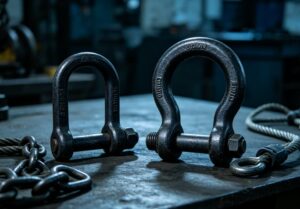
Screw Pin vs Bolt Type Shackle: A Key Choice for Rigging Safety
The pin configuration is another important factor when selecting a D shackle or bow shackle. While the bow shape determines how the load is handled, the pin type affects installation, security, and suitability for different rigging applications.
A screw pin shackle uses a threaded pin that can be installed and removed by hand, making it a practical choice for temporary connections or applications where equipment is frequently assembled and disassembled. However, because the pin relies on thread engagement alone, it may not be the preferred option for long-term installations exposed to continuous vibration or repeated movement.
A bolt-type shackle uses a bolt, nut, and cotter pin system to secure the connection. The cotter pin helps prevent the nut from loosening during extended service, making this type commonly selected for permanent or long-duration rigging applications where connection security is a priority.
For example, a D shackle used in a single-leg sling that is frequently connected and removed may be suitable with a screw pin design. In contrast, a bow shackle used in multi-leg lifting operations or fixed construction rigging may benefit from a bolt-type configuration for improved retention.
Screw pin and bolt type shackles are not always interchangeable. Differences in pin diameter, thread design, and installation clearance can affect compatibility. When selecting a lifting shackle, confirm that the pin type matches the application, expected loading conditions, and inspection requirements.
Real-World Applications: Choosing the Right Shackle for Each Scenario
The difference between a D shackle and bow shackle becomes clearer when considering actual lifting and rigging applications.
Single-leg vertical lifting
A D shackle is generally suitable for single-leg vertical lifting where the load remains aligned with the shackle centerline. Its narrow bow provides an efficient load path and allows effective use of its rated working load limit (WLL).
Common applications include:
- Chain connections
- Single-leg sling terminations
- Straight-line lifting points
Multi-leg slings and bridles
A Bogen-Schäkel is typically preferred for multi-leg sling systems because its wider rounded bow provides more internal clearance and allows multiple sling eyes to connect more easily.
In two-leg or four-leg sling configurations, load angles can change during lifting. The bow shackle design helps accommodate these changing forces while maintaining a more suitable connection geometry.
Anchor points with changing load directions
For anchor points where the load direction may vary due to movement, wind, or changing rigging conditions, a Bogen-Schäkel is usually the better choice.
Its wider bow provides greater flexibility for applications where the force is not consistently aligned. A D shackle used in the same situation may experience loading outside its intended configuration.
Chain and wire rope connections
For straight-line chain and wire rope connections, a D shackle remains a common choice. Its compact design fits well with chain links, wire rope thimbles, and master links where the load path remains centered.
Marine and mooring applications
Both D shackles and bow shackles are widely used in marine rigging, but the correct choice depends on the expected load direction.
A D shackle is often used for anchor chain connections where loads remain mainly in-line. A bow shackle is commonly selected for mooring connections where vessel movement may create changing load angles.
The selection principle remains consistent:
- Straight, centered loads → D shackle is generally the more efficient option.
- Variable or multi-directional loads → Bow shackle is typically the better choice.
The working load limit only has meaning when the shackle type matches the actual loading condition.
How to Inspect and Maintain Shackles for Safe Operation
Even the right shackle can become unsafe if it is not inspected and maintained properly. Regular inspection helps identify wear, deformation, corrosion, or damage before the hardware is returned to service.
Before using D shackles or bow shackles, check the following conditions:
- Visible cracks, surface damage, or deformation on the body or pin
- Excessive wear that reduces the original dimensions
- A bent bow or damaged pin that affects alignment
- A pin that cannot be installed, removed, or rotated correctly
For lifting and industrial rigging applications, damaged shackles should be removed from service immediately rather than repaired or reused with a reduced load rating.
Inspection frequency depends on the working environment. Shackles used in daily lifting operations may require inspection before each shift, while those used in marine, offshore, or permanent installations should be checked regularly based on exposure conditions.
Proper maintenance also extends service life. For screw pin shackles, keeping the threads clean and applying suitable lubrication helps prevent corrosion and ensures the pin can be removed when required. This is especially important for outdoor lifting equipment exposed to moisture or saltwater.
Specification Checklist When Buying D Shackles or Bow Shackles
Selecting the correct shackle requires more than comparing working load limits. Buyers should evaluate the complete specification to ensure the hardware matches the intended application.
1. Confirm the load direction
The first consideration is how the shackle will be loaded.
- D shackles are designed for straight-line loading and are suitable for chain connections, single-leg slings, and in-line lifting applications.
- Bow shackles are better suited for multi-directional loads, multiple sling connections, and applications where load angles may change.
Choosing the wrong shackle type can reduce safety margins even if the rated capacity appears sufficient.
2. Check working load limit and safety factor
Always match the shackle’s working load limit (WLL) with the actual lifting requirement. For bow shackles exposed to angled loading, apply the manufacturer’s reduction guidelines before selecting the correct size.
A higher WLL does not automatically mean better performance. The shackle must be rated for the actual load direction and rigging configuration.
3. Choose forged alloy steel construction
For demanding lifting applications, forged alloy steel shackles are preferred because they provide better strength, fatigue resistance, and reliability compared with lower-quality alternatives.
When sourcing forged D shackles or bow shackles, confirm:
- Material grade
- Manufacturing standard
- Proof load testing documentation
- Traceability markings
These details are especially important for construction, marine, offshore, and heavy industrial applications.
4. Select the correct pin type
The pin design should match the installation environment:
- Screw pin shackles are suitable for temporary connections where frequent installation and removal are required.
- Bolt type shackles are better for long-term installations or applications exposed to vibration.
The correct pin configuration helps maintain connection security during operation.
5. Request testing and certification documents
Reliable lifting shackle manufacturers should be able to provide product specifications, load testing information, and quality documentation.
Before placing a bulk order, buyers should confirm:
- Working load limit markings
- Material certification
- Testing records
- Production traceability
These documents provide confidence that the shackles meet the requirements of the intended application.
Häufig gestellte Fragen
Q: What is the difference between a D shackle and a bow shackle?
A D shackle is designed for straight-line loads and offers higher efficiency in in-line lifting applications. A bow shackle has a wider rounded shape, providing more clearance and better performance when loads come from multiple directions.
Q: Which is stronger, a D shackle or a bow shackle?
A D shackle usually has a higher working load limit for straight pulls because its design transfers force more directly. However, a bow shackle is stronger for angled or multi-directional loads because it is designed to handle those conditions.
Q: Can a bow shackle be used for side loading?
Yes, bow shackles can handle certain side-loading conditions, but the working load limit must be reduced according to the manufacturer’s guidelines. The load angle should always be considered before using a bow shackle in lifting applications.
Q: Can D shackles be used for lifting?
Yes, D shackles are commonly used for lifting when the load is applied in a straight line. They are suitable for applications such as single-leg slings, chain connections, and other in-line rigging configurations.
Q: Are forged shackles better for industrial applications?
Yes. Forged shackles made from alloy steel generally provide better strength, durability, and fatigue resistance than cast alternatives.
Conclusion: Choose the Right Shackle for Your Load Direction
The difference between D shackles and bow shackles is not simply about strength — it is about selecting the right design for the loading condition. D shackles are ideal for straight in-line pulls, while bow shackles provide greater flexibility for multi-directional rigging applications.
When choosing shackles, consider load direction, working load limit, material quality, and testing requirements. Forged alloy steel construction, proper certification, and reliable proof testing help ensure safe and consistent performance in demanding environments.
If you are sourcing D shackles or bow shackles for lifting, marine, or industrial applications, work with an experienced manufacturer that can provide material specifications, testing records, and customized solutions to match your rigging requirements.